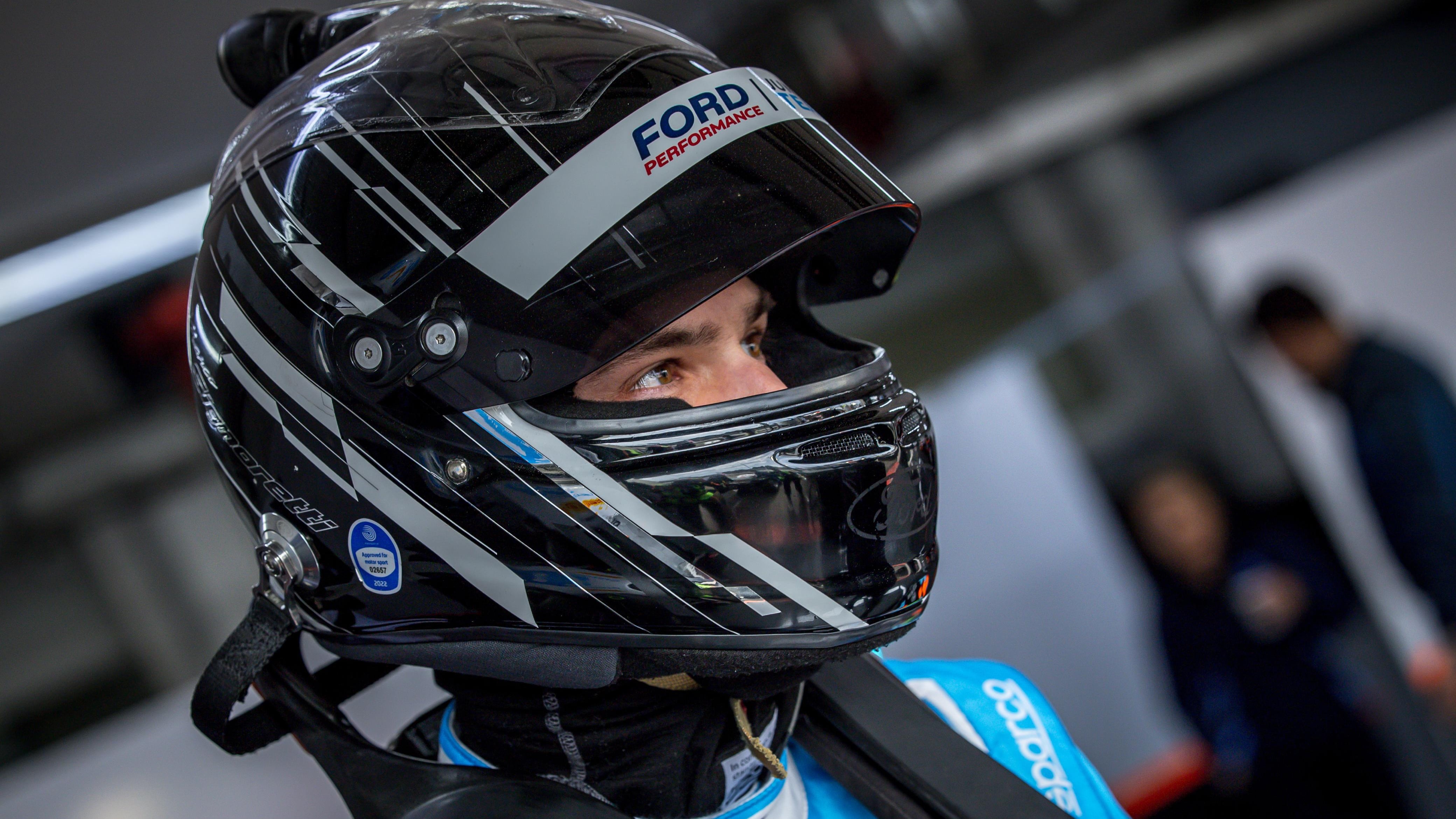
Long before Toronto-born Marco Signoretti received the Rising Star Award at the Canadian Motorsports Hall of Fame in 2021, he and his dad would load up their minivan at dawn and drive to karting tracks with nothing but determination and a shoestring budget to keep his racing dreams alive.
“When I found out how much my family put into karting, I lost sleep over it,” reflected Signoretti. “We were never racing on a crazy budget. Looking back at the money we were spending, I’m shocked we even did the races we were able to do.”
Signoretti, now one of six Ford Performance Junior Team drivers competing in the GT4 European Series, started his career like many young motorsport athletes in junior karting – racing as much against expenses as against the competition.
Elite go-karting has long been fiercely competitive and costly, and is commonly perceived as the stepping stone to the higher ranks of motorsports, demanding full dedication years before a child can even get a driver’s license. By the time a driver is ready for Formula 1, their parents and sponsors will have invested millions into their career. The Washington Post reports that Baby Race, an Italian go-karting academy for children aged six to 13, charges $7,500 for a four-day event and a $600 entrance fee. According to F1, a single season in karting can cost around 300,000 euros.
On top of entry fees, families incur extra costs for equipment, travel, and maintenance, and as young drivers progress onto the single-seater ladder, the expenses grow bigger. Driving in F3, the next step after karting, costs about $1.3 million per year. An F2 season costs at least $2 million.
“To even compete at a national level in Canada with a good feeder series team for just one weekend, you’re looking at roughly $10,000 to $12,000,” said Signoretti. “That’s why it’s so hard for private teams and families to race at a high level – they’re up against teams and families with far more resources and expertise.”
In almost every racing series, you’ll find drivers who represent different marks on the spectrum of go-karting wealth. In Canada, Signoretti competed against Lance Stroll and Nicholas Latifi – two racers whose families had the kind of financial muscle most kids in the paddock could only dream of.
“I raced against Stroll, raced against Latifi – different budgets,” Signoretti stated.
Lawrence Stroll, father of racer Lance Stroll, has an estimated net worth of USD $3.8 billion, while Nicholas Latifi’s father, Michael Latifi, is worth about $3.5 billion, according to Forbes. By contrast, Signoretti’s father worked at Bell Canada and his mother at Toronto Public Library.
“Karting was always a grind because it requires huge budgets, and unlike other sports, being genuinely talented doesn’t automatically give you a chance – so much of it comes down to money and equipment,” said Signoretti. “It’s even tougher now, with a new generation that is both talented and wealthy, making competition harder, and costs keep climbing higher every year.
“It’s one of those sports where money talks.”
For many kids, realizing they don’t have the money to stay competitive is enough to make them quit. But Signoretti didn’t stop. He kept racing, and leaned on the kind of support that gives talented drivers without deep pockets a way in – sponsors.
“In 2014, I got affiliated with Energy Corse North America and started earning credits to race. It was the first time I had support from someone outside my friends or family, and it gave me access to better engines and equipment,” said Signoretti. “I wouldn’t say success took off, but I started performing better, racing in the [United] States and even travelling to Europe for a few events.”
By that point, Signoretti was still grinding it out in karting while many of his former competitors had already moved on to open-wheel racing or left the sport altogether. Most kids his age weren’t in karts anymore. He kept competing across North America and Europe until 2018, and by the time he finally made the jump from karts to cars in 2019, some of the drivers he once raced against, like Stroll, were in F1.
In 2019, after winning the Nissan Micra Cup championship in his rookie season, Signoretti joined Multimatic Motorsports, a Markham-based company that serves as the competition arm of Multimatic.
Founded in 1992, Multimatic Motorsports has spent three decades designing, building, and campaigning race cars worldwide, including Le Mans-winning Ford GTs and Mazda RT24-P DPi cars. The only Canadian team to win Sebring outright and score a Le Mans class victory, it boasts multiple championships, podiums, and driver honours across sports car racing.
Multimatic signs professional drivers from various disciplines, including sports car, stock car, and rally racing, fielding 12 drivers on its roster as of 2025. By securing both established and emerging talent, it provides racers like Signoretti opportunities to compete in racing series all over the world, as well as test and develop multiple Multimatic cars.
“Multimatic changed my life,” Signoretti said. “They’ve given me the resources to get me track time, seat time, and develop me into the driver I am today.”
Signoretti’s career shifted into gear in 2020 when he jumped into a Ford Mustang at Sebring, finishing third on the grid. In 2021, he raced a Mustang GT4 with Multimatic in the Sports Car Championship Canada series, winning every race. In 2022, he joined Academy Motorsport, a UK-based professional team and official partner of both Multimatic and Ford Performance.
In 2023, he helped Multimatic develop the new Mustang GT4, as well as test the Ford GT Mk IV and Ford Bronco DR. He returned in 2024 to race the GT4-spec Mustang in the British and GT4 European Series.
Signoretti is currently racing for Academy Motorsport in 2025, alongside his American teammate, Erik Evans. The pair have achieved two wins this season.
Signoretti knows his own journey is the exception, not the rule. Some drivers are fortunate enough to secure backing from a company like Multimatic, but dozens more quietly leave the sport when costs climb too high. It’s why he believes Canada’s motorsports ecosystem needs a major reset – one that starts from the ground up.
“The whole feeder system needs more support, especially here in Canada. It doesn’t take a huge budget to give a handful of talented kids the resources they need to succeed,” Signoretti said. “I’d like to see more companies get involved in Canadian motorsports and help nurture the next generation of racers. Right now, that support comes from only a small handful of organizations that have the resources to do it.
“When Canadian motorsports was at its peak, they had tobacco sponsorship,” he added, noting that Players, in particular, was a major supporter of grassroots racing in Canada. “Ever since that money got pulled, the karting scene dried up.”
With that funding gone, it’s largely been up to billionaires and their kids to keep the wheels rolling.
Signoretti’s story shows that drive and talent can overcome financial barriers in motorsports. But for every Marco, there are countless kids who never get the chance. If Canada wants to see more homegrown talent rise, the ecosystem needs to open up – with resources and opportunities that let skill, not bank accounts, decide who makes it to the top.
Follow Aleksa on Instagram and X: @aleksa_cosovic

