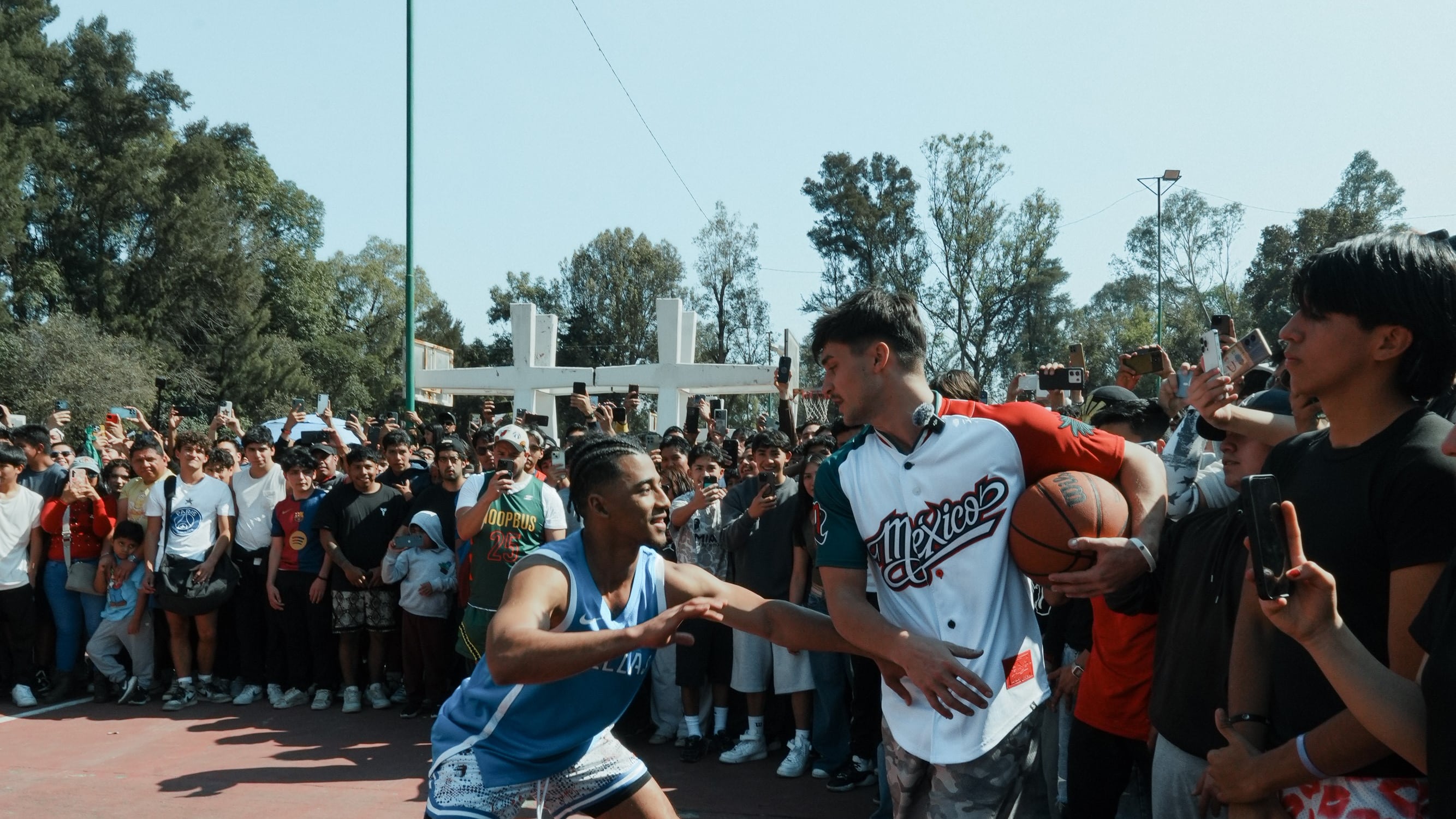
Fans are pressed shoulder to shoulder around a battered outdoor basketball court, spilling right up to the paint. From the sideline, it’s hard to tell where the crowd ends and the game begins. Phones are raised, voices overlap in a deafening swell, and the air is carrying an intense, familiar hum reserved for something worth watching.
But no one is here for an NBA star.
At the centre of the chaos is 25-year-old Matt Kiatipis (widely known online as “MK”) from Newmarket, Ont. – a content creator turning one-on-one basketball into a traveling spectacle on social media. From sun-cracked blacktops in São Paulo, Brazil, to neatly lined, cobblestone-framed courts in Rome, Italy, he’s fusing streetball, storytelling, and digital reach to build a personal brand and global seven-figure business that stretches far beyond the game itself.
Before he was racking up millions of views per video across his more than 5 million combined Instagram and TikTok followers with his flashy handles and polarizing trash talk, Kiatipis was playing at an elite level of high school and collegiate basketball in North America. He spent his prep school years on the court in North Carolina before moving on to NCAA Division II basketball at Simon Fraser University.
After transferring to a school in Georgia in pursuit of more playing time, his hopes of advancing toward the NBA were abruptly derailed when the COVID-19 pandemic shut down the season. He later joined a professional league in Costa Rica – a temporary stage that allowed the young Canadian guard to continue gaining exposure and earn a living while the basketball world remained at a standstill.
Upon returning home, Kiatipis began exploring ways to continue pursuing his passion for the sport while also making money. Fortunately for him, the pandemic had ushered in an era of social media influencers, and one person who capitalized on this phenomenon was Kevon Watt (also known as “K Showtime”), a close friend of Kiatipis.
Watt was gaining traction online by posting videos of himself playing one-on-one basketball in the streets of Toronto. His talent, flair, and charisma resonated with viewers – qualities that immediately struck a chord with Kiatipis and sparked his lightbulb moment: he realized there was a new path to fuse his love of the game with the reach and influence of a growing digital audience.
“I saw [Watt] racking up millions of views and followers, growing fast, and I thought to myself, I also play my best when I’m in the streets,” Kiatipis said.
Kiatipis quickly found momentum on social media through his now-signature “park takeovers.” What started as videos of him playing on outdoor courts against strangers soon revealed a brand with undeniable viral potential.
Everything changed after his third-ever park takeover.
“I hit a few shots, made a couple of dunks, and woke up to 100,000 Instagram followers,” Kiatipis recalled.
The overnight surge was followed by a personal voice message from Drake, who appeared to admire Kiatipis’ content.
“That’s when I realized there was something special I could build from this.”
And so he built – a brand that took the social media landscape by storm. The young Canadian hooper, who once dreamed of stepping onto an NBA court to fulfill his basketball ambitions, was now traveling the world, dunking on opponents, breaking their ankles, and sharing every highlight online, hoping to captivate those watching.
For a content creator, views and followers are only part of the equation, and in the age of fleeting trends, they can rise quickly and thin out just as fast. What many don’t realize is that this isn’t how creators make a living. It’s about learning to monetize their name by turning influence into income, and that’s exactly what came next for Kiatipis when he decided to commit to a full-time job on the internet.
“I started with a jump program, which evolved into a full fitness program,” said Kiatipis, referring to his Air Vert WORLDWIDE business. He offers it in three packages, ranging from $29 to $100, and is meant to help basketball players improve their on-court skills and conditioning.
Though that was a tiny whiff of what it meant to turn his new career into cash. Kiatipis quickly learned that as his popularity grew, so did opportunities – and they came in stages, each one showing that association with his name didn’t merely bring exposure; it brought money, often from people chasing their own shot at fame.
“There’s that next level after you build a brand where your face becomes the brand – that’s mine,” Kiatipis said.
“An artist reached out and offered me $5,000 to use his song in one of my videos. This was back when I wasn’t making any money ... I thought, ‘That’s more than I’ve ever made in a month – for one minute of content.’”
Paid promotions and one-off deals are only the icing on the cake. The real cash cow is the steady stream of ad revenue handed down by the tech giants.
“A creator’s first step [to making money] is usually earning ad revenue. It’s the easiest way, thanks to companies like TikTok, YouTube, Snapchat, Facebook, and Instagram. I call them the ‘Five Pillars,’” said Kiatipis.
Creator earnings are influenced by platform size and audience reach, with monetization unlocked through revenue-share programs. On YouTube, this comes through the Partner Program, which allows eligible creators to earn advertising income after reaching either 1,000 subscribers and 4,000 valid public watch hours in the past 12 months, or 1,000 subscribers and 10 million valid public Shorts views in the past 90 days. As with Facebook Reels and TikTok’s Creator Rewards Program, earnings are not guaranteed and depend on ad views and audience engagement.
“When I was starting out, I could make $5,000 a month from YouTube and another $5,000 from featuring a song in one of my videos. That’s $10,000 in a month, and I’d just dropped out of college,” said Kiatipis.
Now generating more than 2 billion views per month across all platforms, Kiatipis credits a content strategy built on quality and consistency – one that keeps viewers watching until the final second. As a result, ad revenue has skyrocketed. Combined with paid appearances at EuroLeague events or Tracy McGrady’s one-on-one basketball league, and partnerships with athletic brands like Nike, Adidas, and YoungLA, Matt Kiatipis is no longer purely a creator, but a business generating well over $1 million annually, according to the Canadian.
Kiatipis isn’t widely known outside the social-media demographic where his brand lives and breathes. He’s hoping to change that with ISO THAT – the next step in further unlocking his earning frontier.
The one-on-one basketball league and show grew out of his realization that the mano-a-mano format strongly engaged fans yet remained largely unexplored as its own sport, separate from traditional five-on-five or even three-on-three basketball. After two seasons on YouTube, Kiatipis says it’s close to finding a home on a major streaming service.
“We’ve teamed up with Mike Tollin Productions and Electric Panda [Entertainment], who are helping bring [ISO THAT] to a platform like Netflix or Amazon Prime,” said Kiatipis.
Michael Tollin, President of Mike Tollin Productions, is an American producer and director who served as executive producer on The Last Dance, the Emmy-winning documentary chronicling Michael Jordan and the Chicago Bulls’ dynasty.
Kiatipis has already figured out both the blueprint for the show and its path to making money.
“The way we’re structuring the show blends three viral concepts – traveling the world to find top talent, the pressure-cooker intensity of one-on-one competition for cash and glory, and crowning a league champion during a live-streamed event.
“When a boxer steps into the ring, they have their cool boots and viral-looking shorts – I’ve always found that fantastic. Also, like in F1, where brand logos are visibly seen everywhere, and fans wear them too ... [ISO THAT] is a place for brands to live, and merchandising by itself could be an incredible business venture for the league,” Kiatipis said.
Whatever becomes of his show, the foundation is already in place – a million-dollar global business built from the ground up by a young Canadian leaving his mark on the sport in his own unique way, on a scale never quite seen before.
As the crowd presses in around the paint once more, the game at the centre now feels like something bigger.
Follow Aleksa on Instagram and X: @aleksa_cosovic

