It came down to one play.
Fourth-and-goal. Gold medal on the line. In Düsseldorf, Germany, at the 2026 IFAF Flag Football World Championships, the United States women’s national team needed a touchdown to keep its title hopes alive against Canada.
The pass into the end zone fell incomplete – and with it, the Americans’ comeback bid.
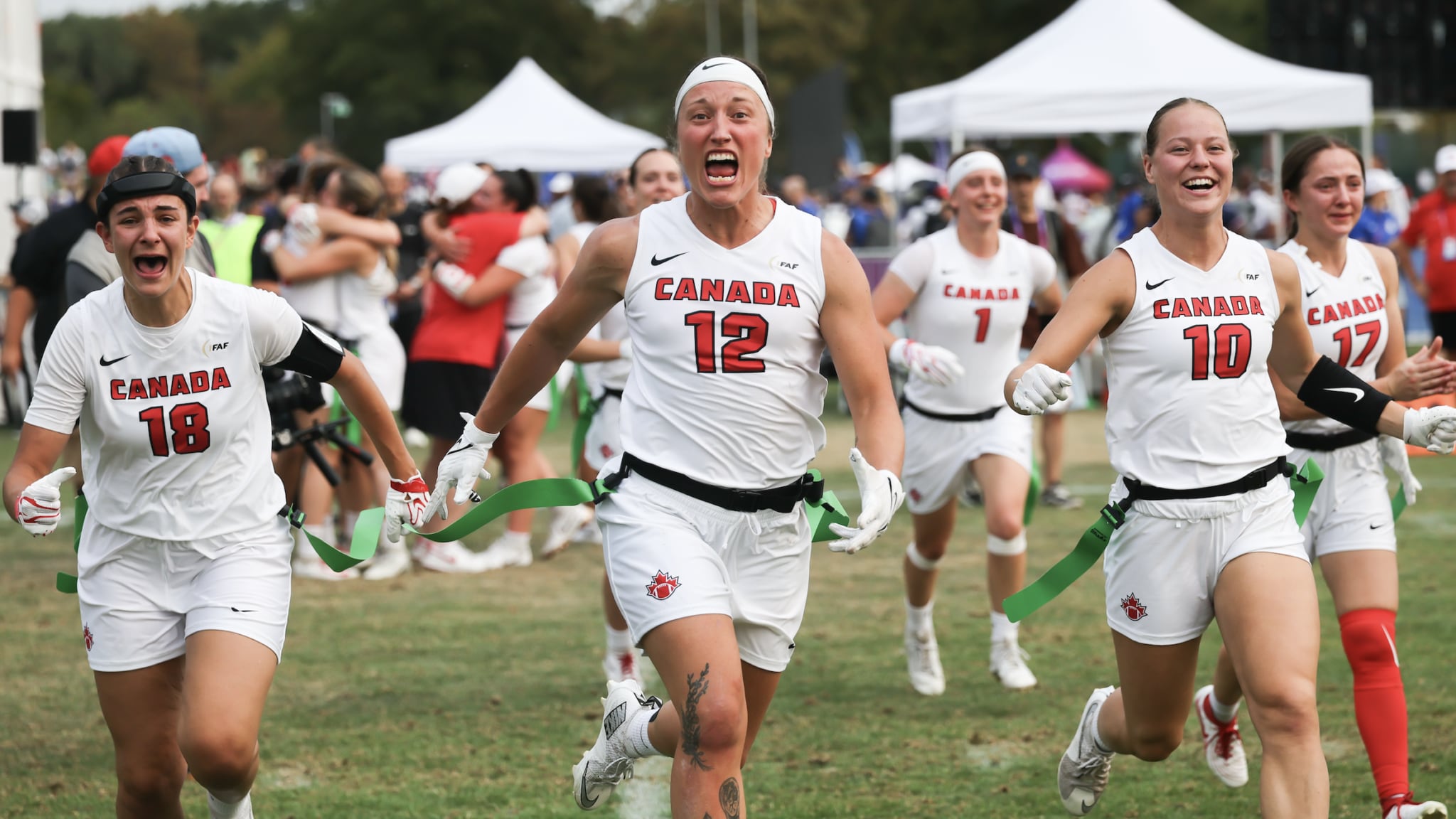
For 17-year-old Akemi Higa, the youngest player on the U.S. roster and its starting quarterback, it was the final play of a remarkable international debut. For the Canadian women, it was the culmination of a dominant run through the tournament – the moment that crowned them the best flag football team on the planet.
It was the icing on a cake already baked – Canada had punched its ticket to the 2028 Summer Olympics in Los Angeles a day earlier, dispatching top-ranked Mexico 20-6 to make it official.
And it wasn’t just the women who left Germany on the podium. The Canadian men delivered too, grinding out a 34-26 overtime win over Mexico in the third-place game to secure bronze – and a ticket to the Games alongside their female counterparts.
“We’re the only country right now with two teams confirmed for the Olympic Games – and both have a very real chance to get on the podium, if not win,” said Eva Havaris, Chief Executive Officer of Football Canada, the national governing body for amateur football.
Football Canada’s mandate has never been limited to a single version of the sport. The organization oversees the development of tackle, touch, and flag football across the country, from grassroots programs to national team competition. But it’s flag – long dismissed as the entry point, the accessible cousin to its padded, higher-contact sibling – that has suddenly become the organization’s biggest opportunity. That shift crystallized in the fall of 2023, when the International Olympic Committee voted unanimously to add flag football to the program for the 2028 Los Angeles Games.
Overnight, a discipline once viewed largely as a feeder sport or recreational alternative became a legitimate pathway to Olympic gold – and Football Canada finds itself with two senior national teams positioned to contend for it.
The Olympic decision opened the door to something flag football had never really had before: serious investment. Leagues began popping up in countries looking to build Olympic programs, NFL teams expanded youth and girls’ initiatives overseas, and national governing bodies started building more formal pathways into the sport.
In late 2025, the NFL’s 32 owners authorized up to USD $32 million to help launch a professional flag football league of its own. The league then raised USD $160 million in outside investment from Tier 1 institutional investors and athletes, according to Sports Business Journal.
In Ireland, the government, Sport Ireland, the NFL and American Football Ireland committed up to €600,000 over three years to expand the sport, including through schools. In Britain, UK Sport allocated £500,000 to flag football for the 2025-29 Olympic cycle. Countries including Germany, Poland and China, along with nations across Africa, have also been building out flag football programs at the grassroots level.
Yes, it’s exciting that more than 200 NFL players – Cincinnati Bengals quarterback Joe Burrow among them – have thrown their names into the ring for a shot at the 2028 Olympics, according to Reuters, and there’s a real chance we see some of the league’s biggest stars trade shoulder pads for flags on home turf in the City of Angels.
But as former Football Canada president Jim Mullin said after the IOC granted flag football Olympic status, the inclusion would create more participation across all levels of football in Canada, filling a long-standing void in the marketplace for younger athletes. Because this was never just about slapping a shiny new league onto an existing sport and letting the best of the best chase a medal. It’s about the kid who’ll never sniff an NFL roster but deserves a version of football built for them anyway – one that’s safer, cheaper to play and open to just about anyone willing to strap on a belt.
“If families from all backgrounds can access flag football at whatever level they choose, that’s a marker of success,” said Havaris, who assumed the role of CEO in June. “I don’t think any family or any kid should be denied the chance to reach their potential because of financial barriers.
“We’ll know we’ve done our job [of growing the sport] when families and kids from every corner of Canada are playing the game.”
Football Canada operates like many other national amateur sport organizations in Canada – a non-profit, membership-based governing body funded in part by the federal government, with provincial football bodies supported separately by their respective provincial governments. Government grants and membership revenue have traditionally been the sport’s two biggest funding sources.
In 2026, the federal government announced a $755-million commitment to Canada’s sport system over five years, including $118 million in ongoing funding for athletes and National Sport Organizations such as Football Canada. The broader package also includes $660 million over five years to expand grassroots access, address capacity challenges and lower barriers to participation.
The timing is particularly important for Football Canada, with flag football’s Olympic debut less than two years away and interest in the sport growing. But government funding alone won’t be enough to capitalize on the moment. That is why Havaris is looking to tap into new sources of revenue through sponsorships and fundraising.
“When you’re an amateur, not-for-profit organization without the opportunity to host a major sporting event or be part of the Olympic or Paralympic pathway, it makes it a lot harder to diversify your revenue,” said Havaris. “We’re now able to position ourselves differently and become more attractive to donors and sponsors. It doesn’t mean it’s all going to translate right away, but it gives us a better chance than we would have had previously without this Olympic opportunity.”
Football Canada’s partners include some of the biggest names in Canadian football, including NFL Canada, the CFL, U SPORTS – whose women’s flag football pilot will officially launch in the 2027-28 season – and the Canadian Junior Football League. Its sponsors include TeamLinkt, Baron Championship Rings, Royal Retros, Nothers The Award Store and Avis – companies that support the football ecosystem through league and tournament management, championship rings and awards, team apparel and transportation.
On top of the Olympic opportunity, Havaris says the pitch to partners and investors comes down to something simple: talent, and Canada has it on both the men’s and women’s sides. After the showing in Germany, that pitch practically makes itself.
The players currently competing on Canada’s Senior Men’s and Women’s National Flag Football Teams have taken wildly different paths to get there. On the men’s side, the roster is a study in contrasts. Some have never wandered far from the local leagues that raised them, while others have already stood at the very top of the sport. Antony Auclair, the biggest name on the roster, is a former NFL tight end who played for the Tampa Bay Buccaneers and Houston Texans and was part of Tampa Bay’s Super Bowl LV championship team. The squad also features former CFL players Marc-Antoine Dequoy and Daniel Petermann, along with names like Jackson Tachinski – a former University of Manitoba quarterback who started playing flag football in Grade Four, made three trips to nationals, won gold in his final year, and went on to become a star tackle-football quarterback at Manitoba.
The women’s team tells another story. Rather than being a collection of tackle-football converts, many of Canada’s top players have spent years developing within the country’s flag football system. Sara Parker, Caroline Moquin-Joubert, Sabrina Gervais, and Léa Duval are just a few of the names that have all been through Canada’s senior program over multiple years. Historical roster data shows players coming through the program dating back to the 2010s.
“[The women’s national team] is the best in the world. They knew that, but we can actually say that now,” Havaris said. “Our athletes are true pros – they’re educated, they’re professionals, and they’re great ambassadors for the sport. I’m really excited for people, and especially Corporate Canada, to know their stories and start backing the sport and these athletes.”
Football Canada is targeting 100,000 flag football participants within three years, representing roughly 67 per cent growth from the current level of 60,000. Havaris says reaching that target will require building an integrated national development system.
“The game is popping up everywhere organically. We need to harness that growth and build the infrastructure around it, and that work has to happen in parallel with our senior teams getting ready for LA. It means creating clear pathways for athletes, coaches and officials, and making sure the system is connected from the grassroots level all the way to the national level.”
Every flag pulled, every route run, every rep in a small-town gym or local field between now and the summer of 2028 – it’s all building to the moment flag football makes its mark on the world’s biggest sporting stage in LA. And if this August’s run through Germany proved anything, it’s that Canada isn’t just headed to the Games. It’s going there to win.
Follow Aleksa Cosovic on Instagram and X: @aleksa_cosovic

