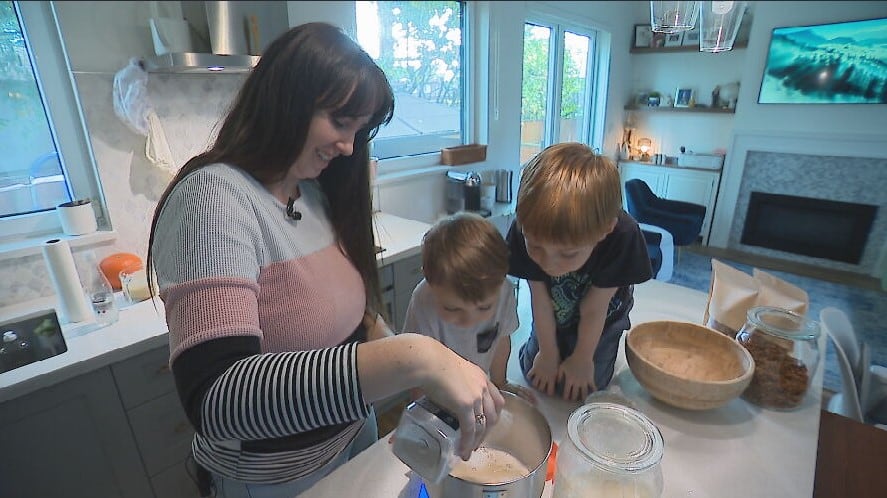
With the federal budget expected next week, affordability remains top of mind for many Canadians, including one multi-generational family in North Delta, B.C., that’s finding creative ways to cope with rising costs.
Inside Caitlin Higgins’ home, 3-year-old Oliver and 5-year-old Gabriel are helping her crack eggs into a mixing bowl. A loaf of homemade sourdough will soon be rising in the oven, which is a small way to stretch the family’s grocery budget.
“The cost (at the store) is, you know, four or five dollars a loaf. And my kids go through so much bread,” Higgins said.
Like many parents, she’s cutting back where she can.
“Juice is becoming a luxury,” she said. “Maybe we need to stick to milk and water for the kids.”
Higgins will sometimes make the trip to Costco in search of lower prices, but that plan can quickly go sideways. “We come out with a $600 grocery bill, and that was me saying no to most things we really don’t need.”
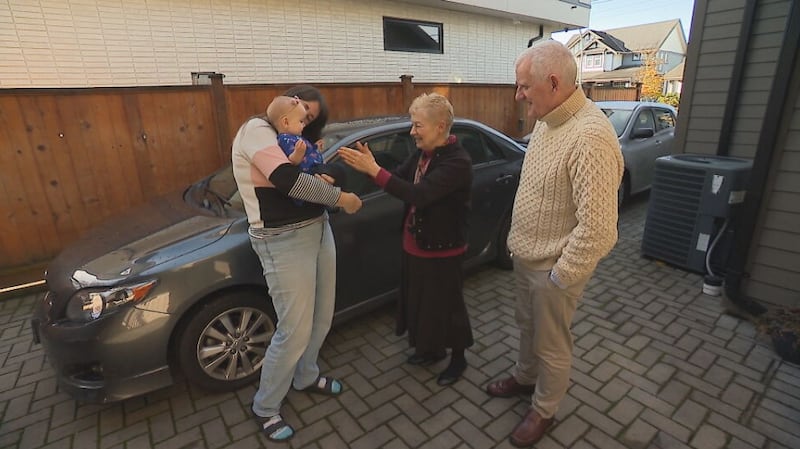
Higgins says gas and groceries have become two of her family’s biggest financial strains. Her hope for next week’s budget is straightforward: relief at the checkout and the pump.
The Higgins family is in a relatively rare position for Metro Vancouver in that they own their homes. Three generations share what used to be a single property. Caitlin’s in-laws tore down their 1980s rancher and built four smaller houses so their adult children could afford to stay nearby. It was a years-long process of cutting through red tape and selling the idea to neighbours and city council.
“My husband made a cardboard model, and I walked around the neighborhood with it,” said family matriarch Kathleen Higgins.
“I showed people and said, ‘Which would you rather have? One great big house, or four little houses with each person, each owner paying their own set of taxes.’”
Youngest son Patrick, 32, also lives on the property, and says he is grateful to his parents for the opportunity unavailable to many living in one of Canada’s most expensive regions.
“A lot of people I know are probably going to rent forever,” he said. “They’ve been living in the same basement suite for the last 15 years.”
Despite his housing advantage, Patrick is feeling the same financial pitch expressed next door, noticing even simple outings have become more expensive.
“This morning, I went out with my girlfriend. We got a couple of coffees and breakfast, and it was like 30 bucks,” he said.
He hopes the federal government will focus on stabilizing the economy and maintaining strong trade ties with the United States.
“Find a way to smooth it out,” he said. “I’m not saying appease everything that Trump has to say, but just smooth it out.”
The Higgins parents say they’d like to see all levels of government make it easier for more Canadians to re-imagine a single older home on a larger lot, like they did.
“The federal government could do a lot by giving tax breaks to people that redevelop their own property,” Kathleen said. “We really want young people, not just our own kids, to have a chance to own a home on the ground, where they can put down roots.”
They also want more seniors to have the opportunity to live in something like a carriage house as opposed to a condominium.
“We know people that have been basically crushed by strata fees if they’re on a fixed income or they have a limited income,” Kathleen said. “Especially in elevator buildings – the maintenance of elevators is huge. If you’re older and have issues with getting around, if you can’t navigate stairs, then an elevator needs repairs, you’re basically stranded.”
As Ottawa prepares to unveil its fiscal plan, many families like the Higgins’s are looking for solutions, from outside-the-box thinking on housing, to lowering food and fuel costs, and a better relationship with the U.S., that might make everyday life a little more affordable.

