


Premier Danielle Smith says a new agreement between Alberta and the federal government will help build the economies of her province and the rest of Canada.
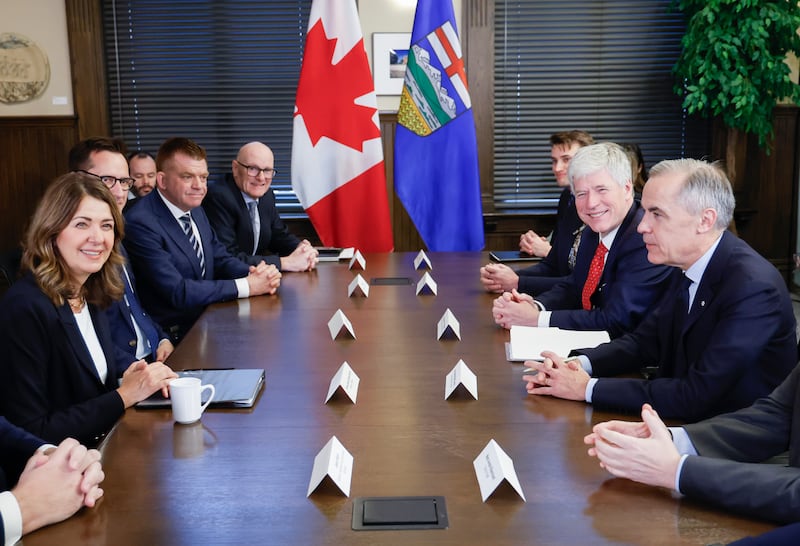
Prime Minister Mark Carney signed a new federal–provincial agreement Thursday with Smith that could shape Alberta’s resource sector.
Carney began the morning by meeting Smith for a short photo opportunity before the two met privately.
They signed a memorandum of understanding (MOU) meant to strengthen energy collaboration and improve Canada’s competitiveness.
The province calls this new energy collaboration framework a key step toward unleashing Alberta’s energy sector.
“Today is a great day for the people of Alberta and the rest of Canada,” Smith told the media after signing the agreement with Carney.
“We fought and won in the courts of law and we fought and won in court of public opinion and we fought because we had to, because that’s what Albertans do - we always fight very hard for this province.
The terms of the MOU include a series of measures aimed at strengthening co-operation on major infrastructure projects, increasing energy production and improving Canada’s economic sustainability and export potential.
Among the terms that would see the Canadian government help fast-track an Alberta pipeline, is the province signing on to an industrial carbon pricing agreement to lower methane emissions by 75 per cent over the next 10 years, and the federal Liberals not implementing the oil and gas emissions cap.
Smith to find ‘common ground’ with B.C.
One of the top opponents of a new Alberta pipeline has been the B.C. government.
Smith says the MOU doesn’t contain any ability for that province to veto a project, but it does require consultation with B.C. and First Nations groups.
“We know that’s hard work that needs to be done, that we will do, that we intend to do.
“We look forward to having genuine consultation over ownership.”
Smith says there is a lot in the MOU that she can work on with B.C. Premier David Eby.
“He is supportive of the Trans-Mountain expansion, he is supportive of interties, he’s supportive of working with us on nuclear, he’s supportive of expanded LNG export, including ammonia.
“We may not be in agreement with everything that’s in this proposal, but we’re going to have tri-lateral talks to make sure we can move forward.”
After his meeting with the Smith, Carney met unionized skilled trades workers and later, he delivered remarks and took part in a fireside chat hosted by the Calgary Chamber of Commerce.
“Calgarians and Albertans have always been bold,” he said. “Here, the resources are every bit as powerful as what lies beneath our soil.
“This is a city that grew from a fort on the Bow River to a global energy capital in a little more than one lifetime.”
Carney said the MOU is a framework for building a more competitive and sustainable Canadian economy.
“Together, we will strengthen federal-provincial collaboration to unlock the full potential of Alberta’s energy resources.”
President and CEO of the Calgary Chamber of Commerce, Deborah Yedlin, said earlier Thursday that the chamber will also push the prime minister’s office for ways to increase productivity.
“We’ll be talking about how to manage expectations – obviously, nothing can change on a dime.
“How is the government going to handle the short- and long-term goals that are really important to the country?”
She says Carney “has a lot on his plate,” but it’s important to maintain consensus to build the economy in the way Canada needs to.
Yedlin says Calgary plays an important role in Carney’s plan as “Canada’s energy headquarters.”
“The decisions from an energy standpoint in terms of where the investments and that capital are going to be risked are going to happen in Calgary – we are pivotal to that energy future.”
Industry reaction
At the Chamber of Commerce event on Thursday, several energy executives were present, including the Canadian Association of Petroleum Producers (CAPP).
“The elimination of the emissions cap, changes to the green washing legislation, and the commitment to expand to global markets can be the catalyst to unlock Canada’s economic potential, to invite new investment, and to enable our country to take our rightful place as the world’s next energy superpower,” ” said Lisa Baiton, CEO of the Canadian Association of Petroleum Producers.
Not everyone was excited about the MOU: a Greenpeace Canada spokesperson said the news left them shocked and angered.
“This is taking us completely in the wrong way economically and environmentally,” said Keith Stewart, a senior energy strategist at Greenpeace Canada.
“This is actually much worse than I expected. It’s not only about a new pipeline. It’s also about delaying the methane regulations. It’s about exempting Alberta from the clean electricity regulations,” said Stewart.
With files from CTV New’s Rachel Aiello

