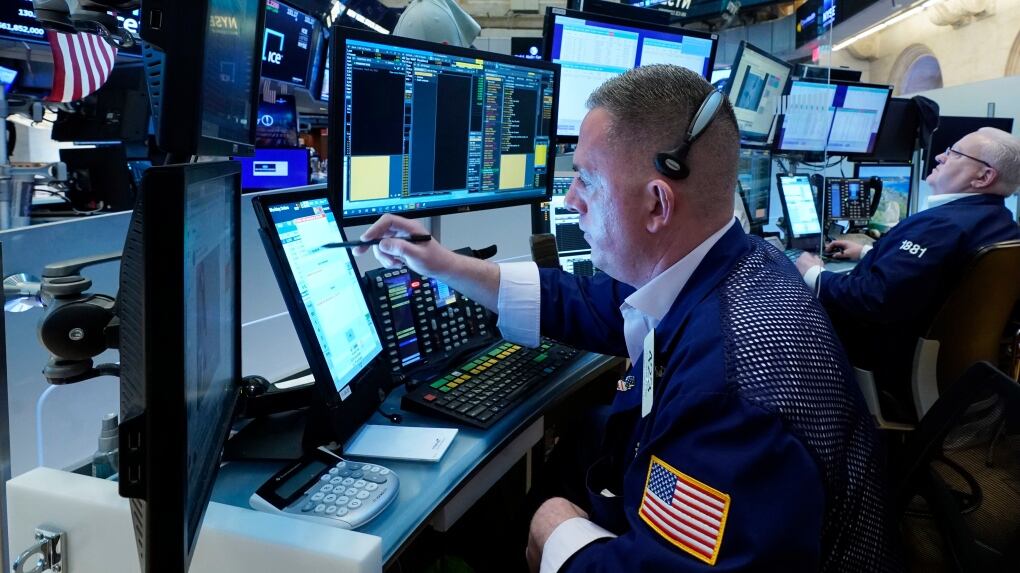
Wall Street closed out another banner year for stocks Wednesday with a downbeat finish that extended the market’s recent losing streak to a fourth day.
The S&P 500 gave up 0.7 per cent, the Dow Jones Industrial Average fell 0.6 per cent and the Nasdaq composite closed 0.8 per cent lower. Trading volume was very thin ahead of the New Year’s Day holiday, when markets will be closed, as most big investors have already closed out their positions for the year.
Even with their mini post-Christmas pullback, the major U.S. stock indexes finished with strong gains for the year.
The S&P 500, which set 39 record highs in 2025, closed 16.4 per cent higher for the year, it’s third straight double-digit annual gain. The Nasdaq gained 20.4 per cent and the Dow finished 13 per cent higher.
Wall Street’s 2025 gains came as investors embraced the optimism surrounding artificial intelligence and its potential for boosting profits across almost all sectors. But the market had no shortage of turbulence along the way amid President Donald Trump’s on-again, off-again tariffs on imported goods worldwide and uncertainty over the trajectory of interest rates.
The S&P 500 plunged nearly five per cent on April 3, it’s worst day since the 2020 COVID crash. It fell another six per cent a day later, after China’s response raised fears of an escalating trade war. Worries also gripped the U.S. Treasury market.
Trump eventually put most of his tariffs on pause and negotiated agreements with countries to lower his proposed tariff rates on their imports, helping calm investors’ nerves.
“Once the market realized that no, these tariffs are on again, off again, and probably will not result in a recession, it was amazing how quickly it got back to breakeven,” said Sam Stovall, chief investment strategist at CFRA.
Strong profit reports from companies and three cuts to interest rates by the Federal Reserve also helped drive markets higher.
“You could say that it’s the long-term AI optimism combined with the continuously improving earnings growth outlook for this year and the coming two years, as well as the Fed easing interest rates, that’s kept optimism alive,” Stovall said.
Still, the AI frenzy that drove markets in 2025 did not come without concerns. Chief among them is the worry that artificial intelligence technology may not produce enough profits and productivity to make all the investment worth it. That could keep the pressure on AI stocks like Nvidia and Broadcom, which were responsible for much of the market’s gains this year.
And it’s not just AI stocks that critics say are too pricey. Stocks across the market still look expensive after their prices climbed faster than profits.
On top of concerns that stocks are overvalued, the ongoing impact of the wide-ranging U.S.-led trade war threatens to add more fuel to inflation in the U.S. Despite the Fed cutting rates over concerns about the labor market, inflation remains solidly above the central bank’s two per cent target.
Wall Street is betting that the Fed will hold interest rates steady at its next meeting in January.
Traders got an update on the state of the job market Wednesday. The Labor Department reported that fewer Americans applied for unemployment benefits last week with layoffs remaining low despite a weakening labor market.
All of the sectors in the S&P 500 closed in the red Wednesday, with technology stocks the biggest drag on the market. Western Digital fell 2.2 per cent and Micron Technology lost 2.5 per cent. Both were among the biggest gainers in the S&P 500 this year.
All told, the S&P 500 fell 50.74 points to 6,845.50. The Dow dropped 303.77 points to 48,063.29, and the Nasdaq gave up 177.09 points to close at 23,241.99.
Treasury yields mostly rose in the bond market. The yield on the 10-year Treasury rose to 4.17 per cent from 4.13 per cent late Tuesday. The yield on the two-year Treasury, which moves more closely with expectations for what the Federal Reserve will do, rose to 3.48 per cent from 3.45 per cent.
Trading in precious metals continued to be volatile as the year wound down. Silver swung back to a big loss, giving back 9.4 per cent after Tuesday’s gain of more than ten per cent. Following Friday’s 7.7 per cent jump, silver lost nearly nine per cent on Monday. It still notched a gain of more than 140 per cent for the year.
Gold fell one per cent, but closed out the year with a 63.7 per cent gain.
U.S. benchmark crude slipped 0.9 per cent to US$57.42 per barrel. The price of Brent crude, the international standard, fell 0.8 per cent to US$60.85 per barrel.
Global stock markets including those in Germany, Japan and South Korea were closed Wednesday for the New Year’s holidays, while trading was mixed in those that remained open.
___
Alex Veiga The Associated Press

