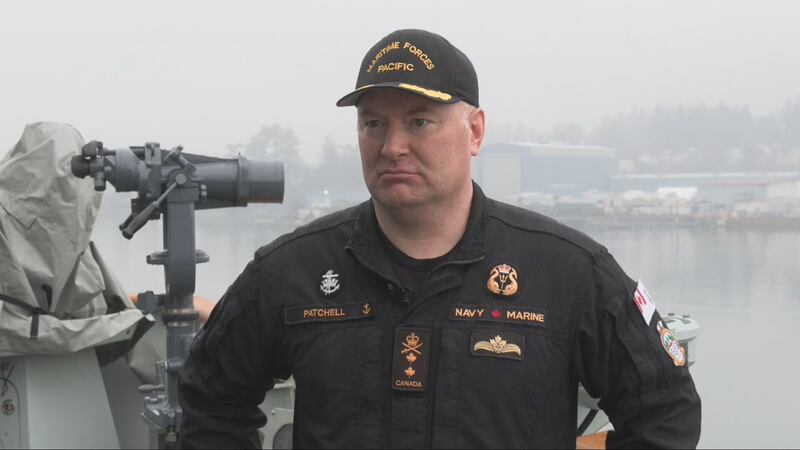
When Rear Admiral David Patchell, the commander of Canada’s Pacific naval fleet, looks out to sea from the docks at Canadian Forces Base Esquimalt, he sees an ocean filled with hidden perils.
Behind him is HMCS Corner Brook, one of Canada’s four aging diesel-electric submarines, sitting in drydock as an overhead crane lifts its guts aloft and onto the pavement.
The Department of National Defence estimates there are nearly 300 submarines capable of operating in the Pacific Ocean at any one time, constituting the largest concentration of military submersibles anywhere in the world.
Yet in 2026, it’s unlikely that any of those submarines will be Canadian. While the Corner Brook undergoes maintenance, its sister vessel in the west, HMCS Chicoutimi, has been relegated to a training platform for the foreseeable future.
Canada purchased four second-hand submarines from Britain in 1998. The initial $750 million purchase price for the vessels is a fraction of the billions of dollars the federal government has since spent on maintaining them.
Ottawa now plans to acquire a fleet of up to 12 new submarines for the Royal Canadian Navy and has narrowed the competition to two suppliers. South Korea’s Hanwha Oceans and Germany’s ThyssenKrupp Marine Systems (TKMS) are vying for the multibillion-dollar contract to replace the Victoria-class submarines, which are set to be retired in the coming decade.
Patchell, who assumed command of Canada’s Pacific fleet in August, says his preferred supplier is “whichever one I can get in this harbour as soon as possible.”
Recruitment shortfall
In a wide-ranging interview with CTV News aboard a Halifax-class frigate, the new leader of the country’s western naval forces says acquiring a credible submarine capability is the most pressing issue facing the fleet.
“In Canada, being a true submarine nation, the threats to undersea infrastructure concern me, the threats from adversary submarines concern me,” Patchell said. “If I had the ability to have one new capability now—with enough sailors—it would be 12 brand new submarines for a persistent, lethal deterrent.”
That caveat—“with enough sailors”—points to another persistent challenge that has long plagued not only Canada’s submarine force, but the military more broadly.
The Royal Canadian Navy is short roughly 2,000 trained regular-force sailors—or about a quarter of its 7,700-sailor benchmark— just to outfit and deploy its existing ships.
Among those unfilled positions are approximately 1,000 naval technicians who would otherwise be repairing, maintaining and operating the whole array of Canadian marine hardware. “Those are technicians that allow us to put these ships to sea,” Patchell said.
That minimum staffing requirement is only expected to increase over the next decade as the navy prepares to introduce a range of new vessels, including destroyers, support ships, and the final Arctic patrol vessel, which is expected to sail from Halifax to its home port in Esquimalt this fall.
“We need about 7,700 sailors today, and then as we bring in new capabilities, new ships, that number is going to grow significantly,” Patchell said. “We are in the process of working on exactly what that future number will be, but I think it’s roughly two, two and a half times that.”
TKMS, Hanwha proposals
Advances in computer software and automation, and the navy’s growing reliance on uncrewed vehicles, have helped alleviate some of the staffing burden. The new Arctic and Offshore Patrol Ships, for example, can operate with fewer than 50 sailors, while the smaller Halifax-class frigates require a minimum crew of about 225.
Last week, TKMS announced a partnership with Canadian artificial intelligence company Cohere to integrate the firm’s data management and decision-making models into its Canadian submarine proposal.
Dave Ferris, vice-president of the Americas and global public sector at Cohere, says the technology is intended to reduce cognitive load and “empower sailors to act decisively.”
“Submarines are the ultimate high-stakes workplace,” Ferris said in a Jan. 13 news release announcing the partnership. In the same release, TKMS chief sales officer Thomas Keupp described the collaboration as “an opportunity to bring the most modern and reliable technologies to the Royal Canadian Navy.”
Hanwha, meanwhile, has formally launched a new subsidiary, Hanwha Defence Canada, to be headquartered in Ottawa and led by former Canadian naval officer Glenn Copeland. The Korean firm is also partnering with current Canadian submarine maintenance contractor Babcock Canada to bolster the sovereign sustainment and domestic industrial-benefit components of its proposal to Ottawa.
Canadian sub limits ‘well known’
Whichever proponent is ultimately selected, Patchell says the new submarines cannot arrive too soon. Chinese and Russian vessels, including submarines, are increasingly probing Canada’s western and Arctic approaches, he said, and the limitations of Canada’s existing undersea fleet are admittedly “well known.”
“The age of our fleet is also well known,” Patchell added. “We need to be candid about it as Canadians,” particularly in an era when the umbrella of American protection is increasingly uncertain.
“We have to be clear-eyed about the challenges our countries are experiencing,” Patchell said of the Canada-U.S. relationship. “But the military-to-military relationship remains strong.”
It’s a relationship the admiral knows well. In August, Patchell returned to Canada after three years serving as vice commander of the United States Second Fleet in Virginia, one of approximately 600 Canadian Forces members who routinely serve in the U.S.
Patchell says he has no regrets or reservations about participating in the officer exchange program, even as the U.S. president openly threatens the sovereignty of Canada and other NATO allies.
“Any Canadian goes there clear-eyed, eyes wide open,” he said. “In terms of working with the U.S. Navy, they are completely invested in the defence of North America.”
Retired major-general David Fraser, who commanded Canadian troops in Afghanistan following the Sept. 11 attacks, said American threats to the sovereignty of Canada—and more recently Greenland—must be taken seriously.
“I didn’t think I’d ever be talking about one NATO member threatening another NATO member,” Fraser told CTV News, warning that tensions are approaching a tipping point, particularly in the Arctic, where China and Russia “do not respect our sovereignty.”
“The North is in play now. This is about resources, this is about strategic influence,” Fraser said. “And this is where the navy comes into play to defend ourselves against those threats.”
The federal government has said it expects to award the new submarine contract by 2028 at the latest, with delivery of the first sub no later than 2035.

