QUEBEC -- Mark Carney and his cabinet wrapped up a two-day retreat in Quebec City Friday afternoon, but the prime minister offered no closing remarks, nor did he take questions from journalists during the two-day planning session.
Carney was expected to take questions Friday afternoon, but his press conference was abruptly cancelled at the last minute, with reporters already in line for questions in front of a podium. His office offered little explanation, citing his schedule as a reason, and told reporters on the ground Finance Minister Francois-Philippe Champagne would be available instead.
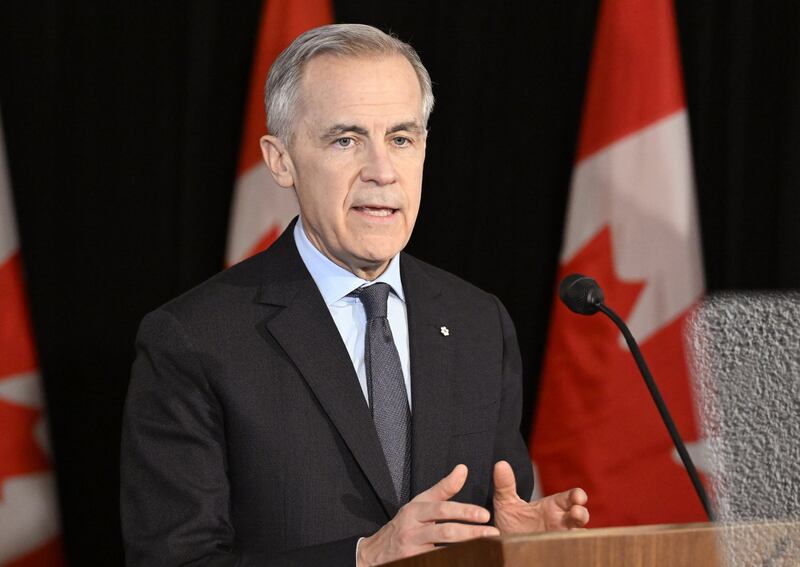
Prime Minister Carney left the Quebec City retreat as Champagne field questions.
“[The] prime minister has been available, I understand, in the last few days, will be available next week, but there were some scheduling issues, so that’s why I’m happy to report back,” said Champagne when pressed on why the prime minister’s press conference was cancelled.
Carney hasn’t taken any questions from reporters since Sunday in Doha, before his speech in Davos.
His office later offered written statements on specific issues.
Late Thursday, U.S. President Donald Trump announced he was rescinding Carney’s offer to join his “Board of Peace”. Carney did not stop to answer reporters’ questions about the move on his way into cabinet meetings Friday morning.
“As the Prime Minister previously stated, we support the intent of President Trump’s pursuit of peace for Gaza. We remain resolute in our support of Palestinians’ right to self-determination,” the Prime Minister’s Office said in a statement Friday afternoon.
“Canada has long been committed to ending the conflict in Gaza. We formally recognized the State of Palestine this September at the UN General Assembly,” the statement added.
The Prime Minister’s Office has not commented on whether the government learned about this via social media or through a more official channel.
“I am constantly in touch with my G7 counterparts,” foreign affairs minister Anita Anand told reporters on her way into cabinet Friday morning, in response to questions about the Board of Peace.
Trump initially set up the board to address the situation in Gaza as part of his 20-point peace plan.
“We will continue to ensure that Canada does whatever possible to ensure that humanitarian aid flows, and that there is a ceasefire that is maintained and that Hamas disarms. Those are Canadian values, those are our values, and we will continue to pursue them, regardless,” said Anand.
Thursday night, in the frigid cold, snow and dark, Anand walked past cameras wearing a ballcap with her head down and wouldn’t stop when reporters asked her a question. That happened less than two hours before the President’s post.
Trump also recently made comments diminishing NATO allies’ contributions to the war in Afghanistan, stating that countries who sent troops “stayed a little back” from the front lines.
“This week, the Prime Minister convened the Cabinet Planning Forum at La Citadelle de Québec, the headquarters of the Royal 22e Régiment,” the Prime Minister’s Office said when asked for a response to Trump’s comments.
“The Van Doos are exemplary of the courage, service and sacrifice of Canadians who have worked in close coordination with the United States and our NATO allies in support of shared peace and security. This service and their sacrifice can never be diminished,” the statement added.
158 Canadian Armed Forces members died fighting in Afghanistan, some of whose pictures hang in the building where the prime minister delivered a speech Thursday.
Second day of retreat focuses on sovereignty, trade, security
Carney and his cabinet focused on sovereignty, trade, security and AI in a second day of cabinet meetings held in Quebec City.
The first part of Friday’s cabinet meetings was a discussion focused on “Canada’s sovereignty, trade and security,” according to the Prime Minister’s Office. Cabinet was briefed by three guest speakers in that session: two university professors, and Nadir Patel.
Patel is Canada’s former High Commissioner to India as well as former Consul General to Shanghai, pertinent as Canada is working to improve relations with both India and China. This is cabinet’s first time together since Carney returned from a global trip that included a Beijing meeting with China’s president Xi Jinping.
Patel would not stop to answer questions on his way into cabinet Friday morning.
The second part of cabinet’s agenda is focused on AI. Cabinet heard from Joelle Pineau, the Chief AI Officer at Cohere, a technology company launched in Toronto.
In August, the federal government signed an MOU with Cohere to “to explore opportunities to deploy AI technologies across the Government of Canada to enhance operations within the public service and to build out Canada’s commercial capabilities in using and exploring AI,” according to a news release.
The government has promised an updated AI strategy in 2026, and the minister responsible did not have anything to share about the funding or elements of it Friday morning, but said it would be a “focus” of the first quarter of the year.
“It’s a key component of building a strong economy of the future. It plays a big role in that,” Evan Solomon said of the strategy. “There’ll be lots of details to come on the scale and scope of it.”
Minister Solomon said 800,000 Canadians currently work in the digital sector, calling it the “largest and fastest growing sector of the economy.”

