Canada’s largest public sector union is calling on the federal government to be “very clear” with the public about possible cuts to the public service, warning plans to cut 28,000 jobs will “hack away” at services.
Federal departments have issued notices to employees that the government’s comprehensive expenditure review may affect their jobs.
Data provided by federal unions and departments show more than 18,000 public servants in 30 departments and museums received notices in December and January warning their jobs may be cut.
“As people are living paycheque to paycheque, struggling to make ends meet, trying to deal with the rising cost of inflation, food and housing, it’s more important than ever that we fight to protect public services that help us navigate the hard times,” Sharon DeSousa, national president of the Public Service Alliance of Canada (PSAC), told reporters on Wednesday.

“This government is choosing to hack away at the very foundation that people in Canada rely on every day. This government has decided to recklessly move forward with their plans to slash critical public services and cut 30,000 public service jobs over the next year.”
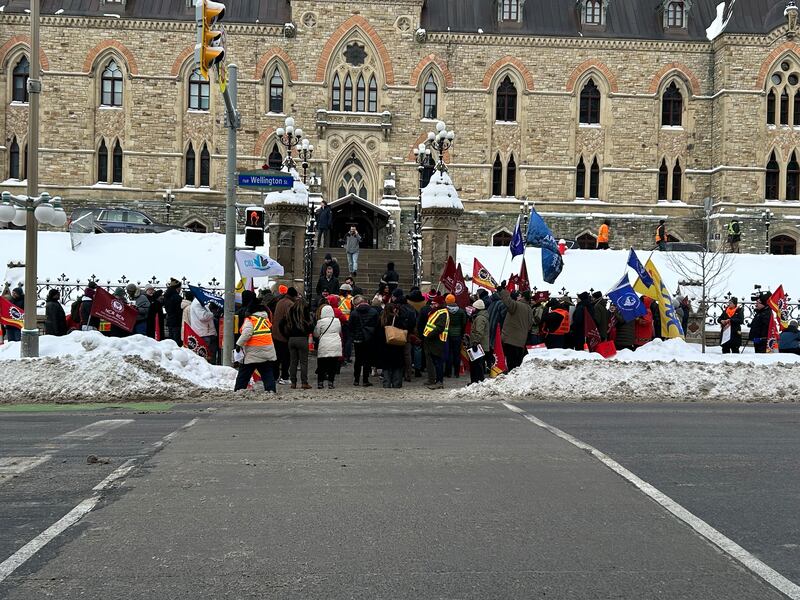
PSAC held a ‘Rally to Protect Public Services’ on Wellington Street in front of Parliament Hill Wednesday afternoon. DeSousa called on the federal government to provide details on what programs and services will be cut.
“This government believes cutting jobs first and explaining later is sound approach. We’re here to tell them loud and clear that this is careless,” DeSousa said.
DeSousa added, “This government needs to be very clear with the public on how many programs and services will be affected by the result of these reckless cuts.”
“People across Canada are being kept in the dark on how these service cuts will impact them. But we know cuts won’t strengthen our communities, cuts won’t protect us, but cuts will slow down services, draw out wait times and weaken programs.”
Daphne Chan, an employee at Innovation, Science and Economic Development Canada, is one of thousands of public sector worker who recently learned she will soon be out of work.
“I was more in shock at first. It was last Tuesday, and then later on during the week, I actually felt quite depressed and upset and almost sick,” she said.
“It’s really tough at work and the morale is really not good.”
Chan says she thought her position would have been safe due to the work she and her colleagues are doing and given that her department is quite busy.
“We’re doing a lot of stuff with AI and digital programs and some defence. We’re kind of a happening department, so I thought we might not have as many cuts or they would be able to do it through attrition,” said Chan.
“It’s just going to be tough, because people are already complaining that the services are already not good. So, then with mass cuts, I don’t know how the services are going to get any better.”
More than 15,000 notices have been issued over the past two weeks, including 10,000 notices during the week of Jan. 19.
The Canada Strong Budget 2025 outlined a plan to cut another 28,000 positions from the federal public service over the next four years and find $60 billion in savings.
“PSAC continues to call on the federal government to reverse these reckless public service cuts and to work with public sector unions to find ways to reduce costs without placing jobs and services at risk,” the union said.
According to the unions, Statistics Canada has released the greatest number of notices so far, with 3,200 notices issued to employees. According to the unions, 2,395 notices were issued at Global Affairs Canada, 1,900 notices to employees at Health Canada, and 1,290 notices to unionized employees at Shared Services Canada.

“These cuts will harm communities in the National Capital Region by triggering widespread job losses that reduce household incomes and weaken local spending,” Ruth Lau-MacDonald, regional executive vice-president of PSAC-NCR, said in a statement on PSAC’s website.
“As unemployment rises, small businesses struggle, housing stability can be affected, and demand for social services may place added pressure on local governments. This will widen inequality, and encourage skilled workers to seek opportunities elsewhere, with lasting social and economic effects.”
Lau-MacDonald said the rally will bring unionized workers together to say, “Stop balancing budgets on workers’ backs. Protect good jobs and strong public services.”
With files from CTV’s Austin Lee.

