Energy and Natural Resources Minister Tim Hodgson wouldn’t rule out allowing Chinese state-owned companies from buying majority stakes in Canada’s oil patch, when asked directly whether that would be a red line for the federal government.
“We will look at every investment from every country against the Investment Canada Act, and we will accept investments that are a net benefit to Canada,” Hodgson said in an interview on CTV Power Play with Vassy Kapelos airing Wednesday, when pressed on the shift from Prime Minister Mark Carney’s assertion last spring that China was the biggest security threat facing Canada.
In late 2012, the then-Conservative government approved the takeover of Nexxen Inc. by the Chinese state-owned company CNOOC, stipulating that thereafter there would be a ban on state-owned companies taking over companies in the oilsands, unless there were exceptional circumstances.
Canada’s Investment Canada Act, passed in 1985 and amended in 2022, expanded on that position, giving the federal government the power to conduct a national security review of all foreign investments in Canada. The amendments in 2022 dictated foreign ownership would be approved only in exceptional circumstances.
After years of acrimony between the two countries, Carney recently became the first Canadian prime minister to travel to China in eight years, framing the trip as necessary to diversify trade amid rising uncertainty with the United States.
During Carney’s trip, he signed a memorandum of understanding (MOU) with Chinese President Xi Jinping that would see Canada ramp up the amount of oil, natural gas and clean energy it exports to China, and reduce barriers to Chinese investment in those sectors.
Asked by Kapelos whether, in light of that MOU, majority stakes by Chinese state-owned companies would be a red line for the federal government, Hodgson wouldn’t directly say.
“We will calibrate our engagement with China,” he said. “We are open to additional investment in the energy sector by China. We will use the same tests we always use: ‘Is it a net benefit for Canada’?”
Hodgson said there’s a difference between minority investment and majority investment, and pointed to PetroChina’s 15 per cent ownership stake in LNG Canada as an example. PetroChina is a Chinese state-owned oil and gas producer.
“And it’s done in an appropriate way, and it’s a net benefit to Canada,” he said. “We’ll look at each particular situation and decide whether it’s a net benefit for Canada.”
“That’s why we have the Investment Canada Act,” he added.
There will be customers for Canadian oil if pipeline built: Hodgson
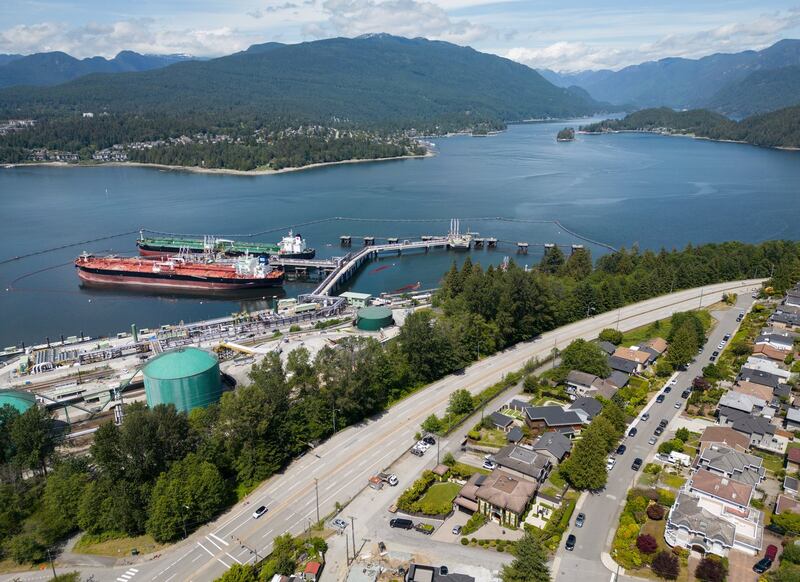
Hodgson in his interview also discussed the prospect of a new oil pipeline to transport Alberta oil to the B.C. coast, saying he knows there are customers for Canada’s product after travelling to both China and India.
“Today, they are buying Canadian crude in rather small quantities off the west coast through the TMX pipeline, but they’re buying larger amounts of Canadian crude off the Gulf Coast,” Hodgson said of India.
“It would clearly be cheaper for them to buy more off of our west coast,” he added. “And I could tell you that the Indian refiners that I spoke to really like our product, and they would like to buy more.”
In November, Carney signed a historic memorandum of understanding (MOU) with Alberta Premier Danielle Smith, outlining the conditions that need to be met for a new oil pipeline to the Pacific to proceed.
Alberta is currently acting as a proponent to fund the initial planning stages of a proposed bitumen pipeline to B.C.’s northwest coast, and Smith reasserted her desire last week to present a proposal to the Major Projects Office by June.
Asked whether eager customers in India and China in principle support the argument for an additional pipeline, Hodgson said: “Assuming we build in an environmentally responsible way, and we do it in with the support of First Nations, I believe there is demand for additional natural gas, (liquefied petroleum gas) and conventional oil.”
“There’s also demand for critical minerals,” he added. “There’s also demand for potash. There’s also an incredible opportunity to exchange capabilities with respect to renewables.”
There’s been pushback against the idea of building a new pipeline, however, including from B.C. Premier David Eby, who has argued the Trans Mountain Expansion Project is already in place, and that he does not want to remove the tanker ban.
“The prime minister and the premiers have all been together as recently as last week,” Hodgson said, when pressed on sectors like critical minerals being more politically palatable than construction of a new pipeline.
“We all agree that we need to work together to find ways to grow our economy and do it in a way that is respectful for the environment, and do it in partnership with First Nations and Indigenous Peoples.”
With files from CTV News’ Stephanie Ha

