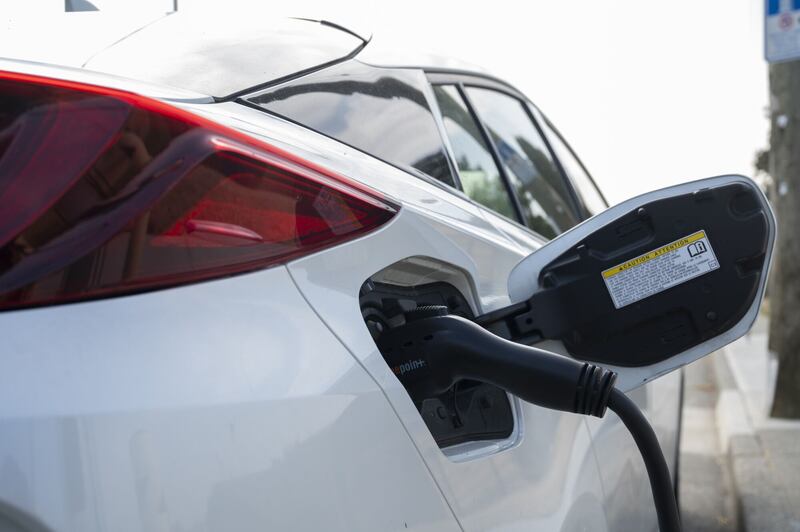
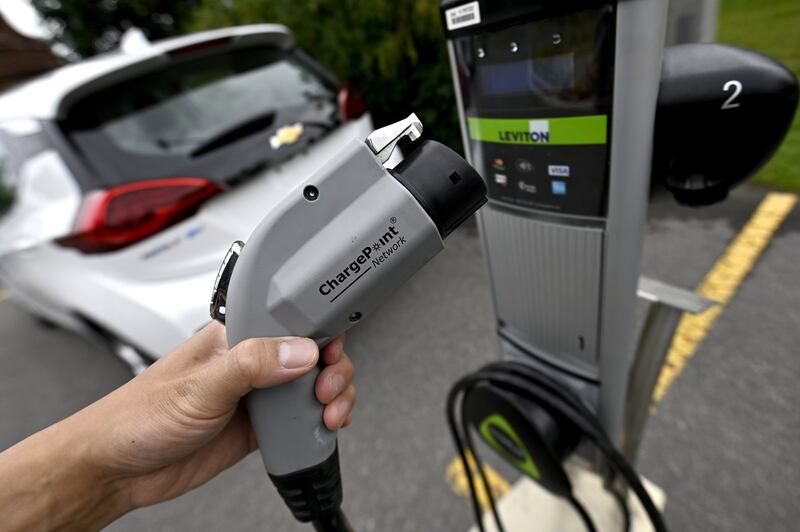
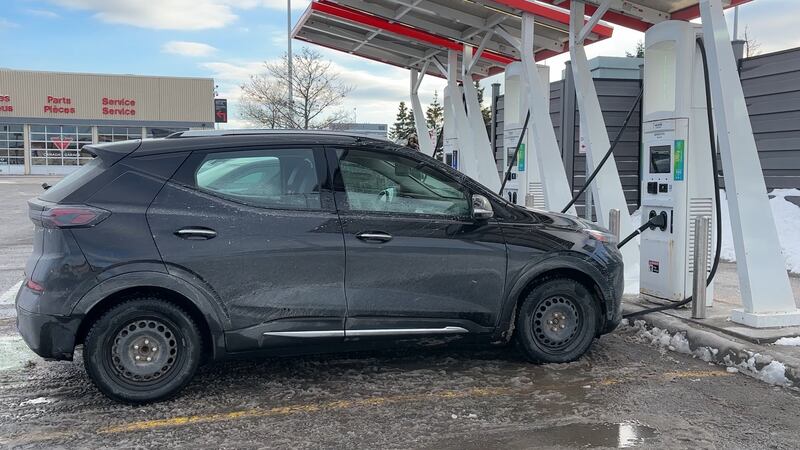
OTTAWA — In an effort to convince more drivers to switch from gasoline to electric vehicles, the federal government announced Tuesday it has committed $84 million to install thousands of new chargers from coast-to-coast-to-coast.
Standing outside an EV charging station on Parliament Hill, the environment minister, energy minister and transport minister announced what they called an advancement to last week’s auto strategy. Ottawa intends to spend $84 million to install more than 8,000 electric chargers across Canada though the Zero Emissions Vehicle Infrastructure Program.
According to Natural Resources Canada, there are currently 16,207 charging stations in Canada, with a total of 45,781 EV charging ports. So far Ottawa has not provided any timeline on how long it will take to get the new chargers up and running.
In addition, $5.7 million was committed to three projects through the Green Freight Program to help Canadian fleets reduce their fuel costs and purchase low-carbon vehicles. Another $7.2 million will be directed towards educational and awareness projects that aim to increase public and industry knowledge and confidence related to EVs.
Ottawa hopes the announcement will help bring certainty to the industry, encourage investment from the private sector and give Canadians the confidence needed to purchase an electric vehicle.
“Many Canadians want to choose cleaner options, but they feel like EVs are too expensive, or they worry about not having enough charge to get where they need to go,” Energy Minister Tim Hodgson said. “It’s time to change that.”
Ottawa says more details will be unveiled in the fall when the federal government releases its National Charging Infrastructure Strategy. That strategy, Minister Hodgson said, will guide the construction and the development of EV charges from coast-to-coast-to-coast.
“The strategy will focus on attracting more private capital, making building EVs ready, creating and supporting a skilled workforce, facilitating grid integration and educating the public on EVs,” Hodgson said.
The commitment comes less than a week after the federal government unveiled a new auto strategy that the government said aims to transform Canada’s auto sector to build vehicles of the future in Canada, with Canadian workers.
As part of that auto strategy, the federal government is launching a new EV consumer rebate that offers up to $5,000 on the purchase of battery electric and fuel EVs and up to $2,500 for plug-in hybrids. Those rebates, Ottawa stipulated, will only be available for vehicles imported from a country that has a pre-existing free-trade deal with Canada, and that cost less than $50,000.
The strategy also included a $1.5-billion commitment through the Canadian Infrastructure Bank to develop a Charging and Hydrogen Refuelling Infrastructure Initiative.
The Liberals have also done away with the Trudeau-era EV sales mandate that required all new car sales to be EVs by 2035.
Instead, Ottawa is introducing a new greenhouse gas emission standard for vehicle models from the years 2027-32. By 2035, the federal government aims to have 75 per cent of vehicle sales be EVs.
“This strategy is about attracting investment into Canada’s clean automotive sector, supporting the workers who build our vehicles, and accelerating a shift to zero emission vehicles in a way that’s predictable and achievable,” said Julie Dabrusin, minister of environment, climate change and nature.
“We’re not just supporting Canadians making the transition. We’re also supporting an industry to do this.”
In a statement, the Conservative Party of Canada questioned the connection between the amount of money being committed and the number of chargers being promised, suggesting the cost to build chargers will depending on where in the country they are being placed.
The statement also raised issues with providing government subsidies to EVs that are likely to be foreign made.
“Canada builds just a single fully electric EV that will qualify for the rebate – the Dodge Charger EV – at a sticker price of $54,790, while the average new EV retailed for nearly $70,000 in Q3 of 2025," the statement said.
The statement reiterated the party’s position during the 2025 election that a proposed cut to the GST on made-in-Canada vehicles would help bring down the cost of cars and put more money in the pockets’ of Canadians.

