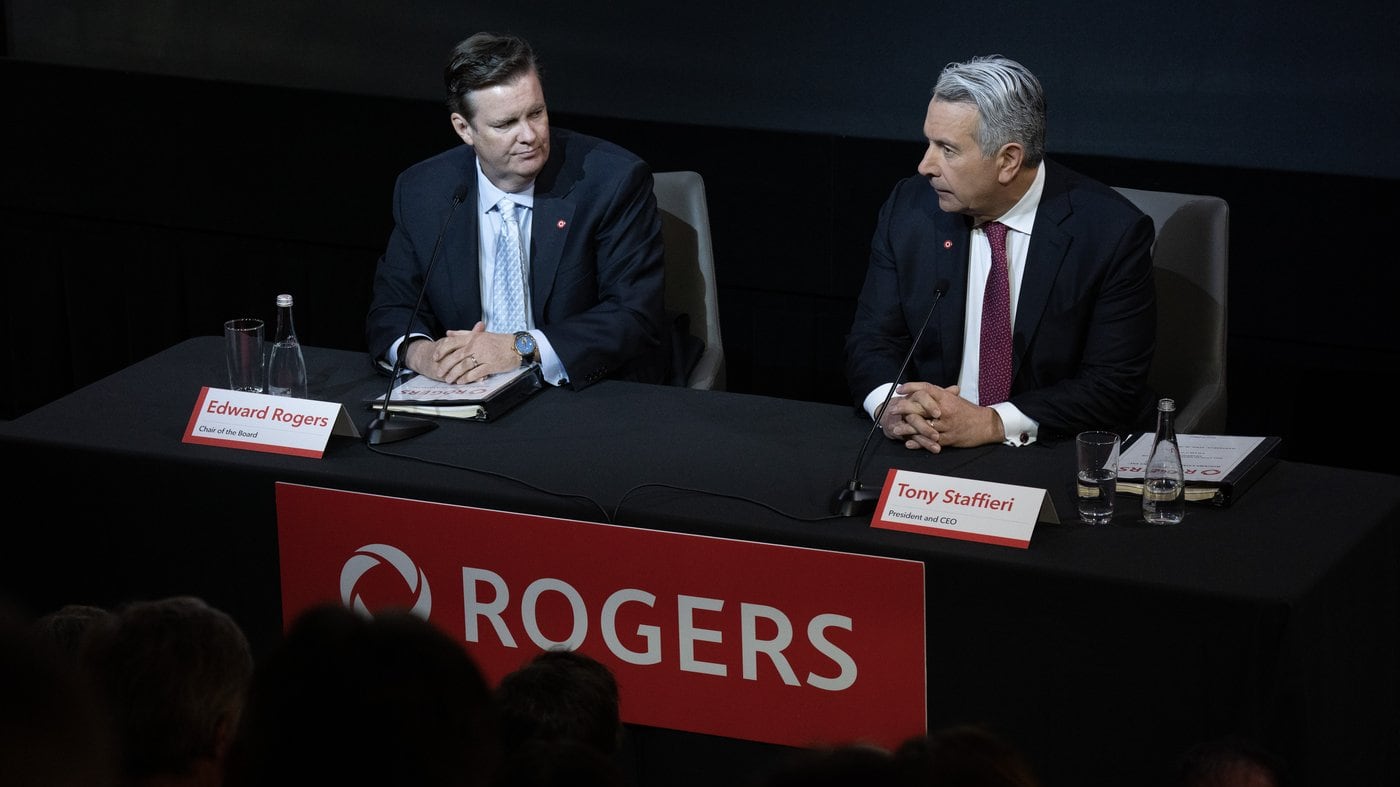
While it’s yet to be determined how many employees will accept Rogers Communications Inc.’s latest buyout offer, an analyst says it could mark the start of a cost-cutting wave throughout the telecommunications industry.
Rogers said Monday it is offering voluntary departure and retirement packages to an undisclosed number of its employees, with Bloomberg reporting around 10,000 would be eligible.
“We are taking steps to adjust our cost structure to reflect the business realities of the current environment,” said spokesman Zac Carreiro in an emailed statement.
“As part of this, some teams have chosen to offer voluntary departure and retirement programs to give some employees the choice to decide whether they’d like to stay with the company or begin a new chapter.”
Carreiro said certain employees within Rogers’ business and corporate levels are eligible to accept a buyout, however others within those groups are excluded. On-air talent, Sportsnet employees, and those who are union members are ineligible for the buyout, along with Maple Leaf Sports & Entertainment and Toronto Blue Jays employees.
Rogers’ workforce totalled around 25,000 employees in 2025, according to its annual report.
Desjardins analyst Jerome Dubreuil said the move could rank among the largest telecom workforce reductions in recent memory, noting there is “room for more cost cutting” among other large telecom companies.
“Details on the attractiveness of the packages are unknown and will have a significant impact on the outcome of the process,” he said in a note.
“The company has not disclosed an expected take-up rate. It is unfortunate to see the industry in conditions where such actions are warranted, but we view management’s commitment to adjust its cost base to the current challenging environment positively.”
Dubreuil added the workforce reduction is probably related to Rogers’ announcement last week that it is cutting its capital spending by 30 per cent compared with last year, which the company blamed on regulatory and competitive pressures.
President and CEO Tony Staffieri had said that decision would mean cancelling certain projects and delaying others, due to “the dynamics that have been placed on us and the sector through regulatory policy.”
Canadian telecom companies, along with their international peers, are currently coping with challenges “from several angles,” said Erik Bohlin, chair in telecommunication economics, policy and regulation at Ivey Business School.
In addition to facing new competition from tech companies for services traditionally provided by telecoms, he said the rise of artificial intelligence has prompted restructuring.
Bohlin said AI’s increasing role in network management has contributed to “labour intensity dropping off for a number of years” in the sector, along with other factors, such as the outsourcing of services to equipment suppliers.
“You have an ongoing sort of industrial transformation,” said Bohlin.
“Of course we know in these transitions that jobs are not completely lost, at least they are transformed, but in some stages they are lost as well.”
Bohlin also pointed to competitive challenges in the sector, an issue cited by Rogers and its rivals recently amid declining cellphone and internet prices, increased customer turnover and slower population growth.
“For Rogers in particular, this might be kind of a waking-up moment after the Rogers-Shaw merger that they have to compete in new ways,” he said.
As part of the federal government’s conditions on that $26-billion takeover, completed in 2023, Rogers was required to create 3,000 new jobs in Western Canada over five years and maintain them for at least a decade.
Rogers has undertaken other efforts to improve its financial flexibility in recent years. It closed a $7-billion deal last June to sell a minority stake in a portion of its wireless network infrastructure to Blackstone, saying those funds would be used to repay debt.
The company is also hoping to extract value from its growing portfolio of sports and media assets. In July of last year, Rogers closed its $4.7-billion purchase of rival BCE Inc.’s 37.5 per cent stake in MLSE, making it the majority owner of the sports conglomerate that includes the Toronto Maple Leafs and Toronto Raptors.
Last week, Staffieri reiterated Rogers’ plans to acquire the remaining 25 per cent of MLSE later this year, a move it estimates will bring the total value of its sports and media assets, including the Blue Jays, to more than $25 billion.
Staffieri said Rogers plans to sell minority stakes in its combined sports and entertainment portfolio to external investors to reduce debt.
This report by The Canadian Press was first published April 28, 2026.
Sammy Hudes, The Canadian Press. With files from Daniel Johnson.

