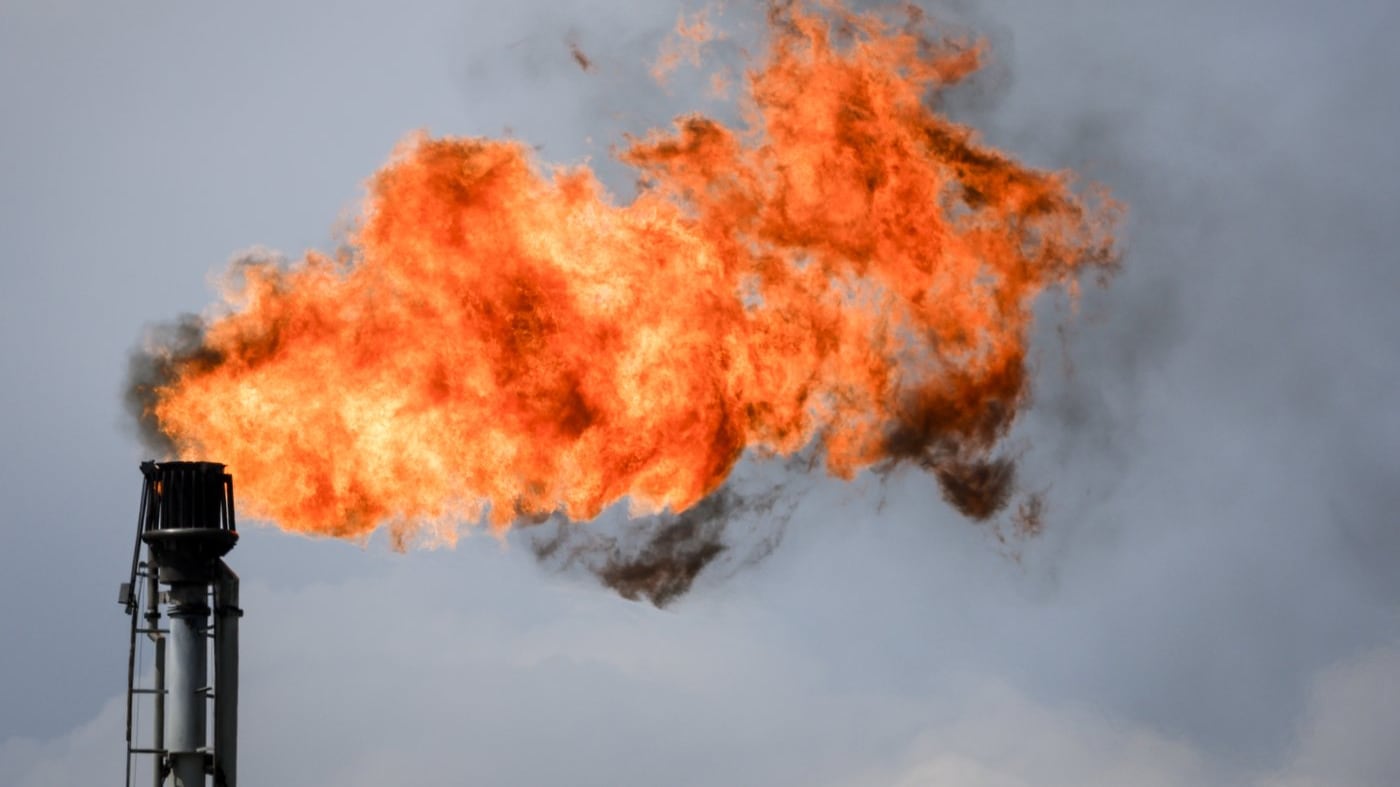
An emissions report LNG Canada filed to the B.C. Energy Regulator details operational issues at the plant in March as it continued to surpass the amount of gas it is allowed to burn off through flaring.
The document, obtained by University of Victoria air quality researcher Laura Minet under freedom of information proceedings, says a crack developed on the plant’s warm/wet flare tip on Feb. 18, followed by another five days later. Work to replace that component is set to begin in mid-June.
In the meantime, gas that would have gone through that flare tip is being diverted to a spare one, which the report said was the largest source of flaring by volume during March, at 16.7 million cubic metres. In non-routine scenarios, like this one, the authorized rate of discharge from the spare flare is “as required” without a specified limit, the LNG Canada permit says.
“The rationale for not subjecting the non-routine flaring volumes to the permit is that non-routine is typically an emergency, and the regulator prefers the facility to flare rather than vent in those cases, for safety reasons,” said Minet.
LNG Canada, based in Kitimat, B.C., also wrote in the report that during March 2026, the acid gas incinerator on one of two production trains was off-line for the whole month for an extended maintenance outage.
That piece of equipment is part of the pre-treatment process, where gases like carbon dioxide and hydrogen sulphide are minimized, said Tim Doty, an air quality expert with Texas group Oilfield Witness who previously worked for that state’s environmental regulator.
“If that unit is down, obviously it means the gas is dirtier and not being purified the way that it’s represented on its operating permits,” Doty said.
Meanwhile the average volume of cold/dry flares throughout March was three times the amount allowed under LNG Canada’s permit. And for the storage/loading flare, it was almost seven times higher.
“The regulator should be holding LNG Canada accountable to its permits and if LNG Canada is not able to meet those permits then it should issue a stop-work order until it fixes the problem with the flare tip and can operate within the conditions of its permit,” said Tracey Saxby, executive director at My Sea to Sky in Squamish, B.C., the site of the under-construction Woodfibre LNG project.
Saxby joined Doty, who specializes in assessments using optical gas imaging, on a trip to Kitimat last week to see first-hand what was happening at the LNG Canada plant. With a specialized camera, Doty was able to observe emissions that can’t be seen with the naked eye.
“We looked at it for three days, and I was pretty convinced just on the very first day that LNG Canada is a big polluter,” he said.
LNG Canada and the regulator did not immediately respond to a request for comment.
But LNG Canada has said flaring ensures gas is managed in a controlled and efficient way.
“It is a critical part of safely operating a facility of this scale and is not expected to be routine during regular operation,” LNG Canada said in a public notice last month.
LNG Canada is led by Shell Canada Ltd. alongside Korean, Chinese, Malaysian and Japanese partners. The plant in Kitimat, B.C., started up last summer, marking the first time Canadian liquefied natural gas cargoes could make their way across the Pacific in specialized tankers. The gas is piped from wells in northwestern Alberta and northeastern B.C. and then chilled into a liquid state.
Several other projects are under construction or in development on the West Coast. The LNG industry has been heralded as a way to elevate Canada’s status as a stable global energy supplier amid geopolitical turmoil. A second phase of LNG Canada and another project further north up the coast called Ksi Lisims, have been deemed projects of national interest by the federal government, which is looking to speed along regulatory approvals.
This report by The Canadian Press, was first published May 12, 2026.
Lauren Krugel, The Canadian Press

