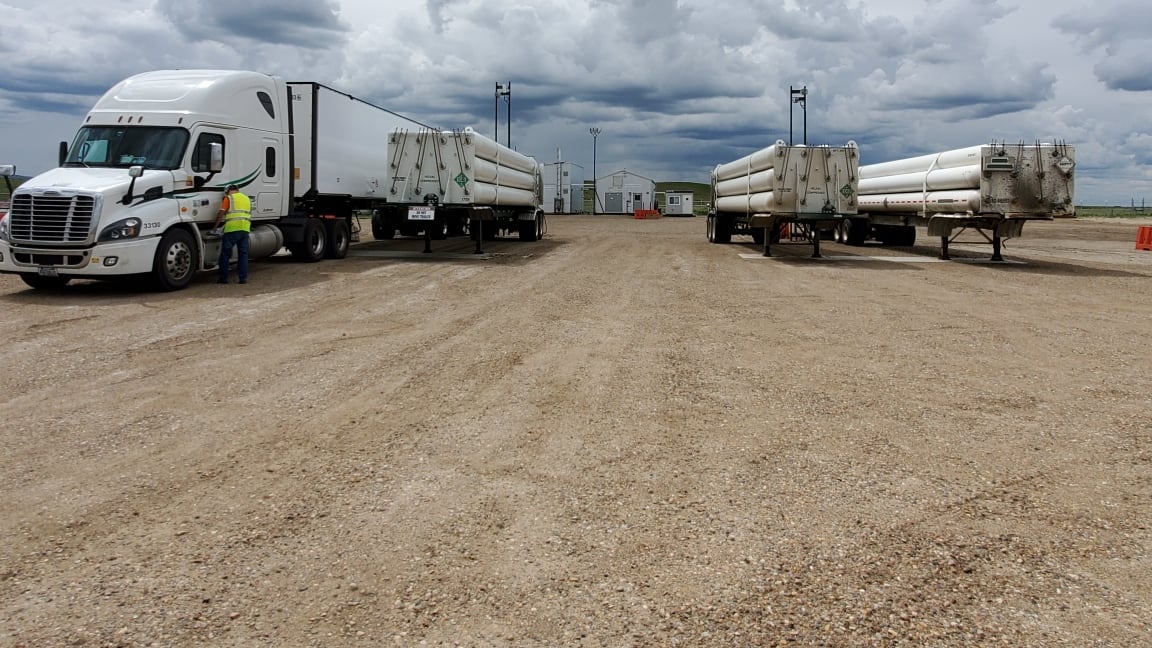
Saskatchewan’s helium industry has a chance to significantly benefit from the war in Iran, but federal policies are holding it back, industry leaders say.
The war disrupted global helium supply chains tied to Qatar, which accounts for roughly a third of global production.
Although Canada boasts the world’s fifth-largest helium reserves, industry leaders argue the country isn’t treating the resource like the critical mineral it claims it is.
“There’s a contradiction there. Absolutely there is,” says Richard Dunn, the executive director of the Helium Developers Association of Canada, which advocates for secure supply chains in the country.

A critical mineral without full policy support
Helium use goes beyond party balloons. It is essential for semiconductor manufacturing, MRI machines, aerospace technology and defence systems because of its unique cooling and non-reactive properties.
Dunn says helium remains excluded from several federal incentives available to other critical mineral sectors. Without access to those programs, companies struggle.
“It’s very difficult for helium to compete for the investment, for the capital required to advance in the exploration and development opportunities.,” says Dunn.
For Saskatchewan, this is particularly important because the province has built its helium industry around dedicated helium wells. Companies drill specifically for helium found in nitrogen-rich gas reservoirs, distinguishing it from other major global producers that extract helium primarily as a byproduct of natural gas production.
Saskatchewan pushes Ottawa for tax changes
Last month, Saskatchewan’s energy minister Chris Beaudry led efforts in Ottawa to push for federal policy changes to support the province’s growing helium industry.
“There are 34 critical minerals, 33 of them have standard tax treatment, and we’re just asking for helium to have the same standard tax treatment that all other critical minerals have,” Beaudry said.
Global supply shocks drive interest in Canada
The push for policy changes comes as global helium markets face growing uncertainty.
The recent attack on Qatar’s Ras Laffan Industrial City, the world’s largest LNG export facility, which produces roughly a third of the world’s helium, is expected to drop helium output by 14 per cent.
With Russia imposing export controls on helium until next year, Dunn says it’s increasing global interest in Canadian production.
“We’re seeing more and more interest,” Dunn says, pointing to inquiries from countries including Japan and South Korea looking for secure helium supply.
Canada still relies on U.S. processing
But even as demand grows, Canada still does not have a commercial-scale helium liquefaction facility.
“All the helium that Canada produces is sent to the states for liquefaction,” Dunn said. “There’s a security supply issue that’s created.”
“Then there’s an uplift in price, in value,” he says.
Spot prices for helium have soared since the beginning of the war.
Saskatchewan’s Ministry of Energy and Resources says that comes with risks.
“Being reliant on the U.S.-based liquefaction infrastructure increases costs, exposes the sector to trade-related risks, and reduces supply chain control,” the ministry said in a statement to BNN Bloomberg.
Saskatchewan’s growth ambition
Saskatchewan is Canada’s leading helium producer with reserves mostly located in the Western Canada Sedimentary Basin.
The province released a Helium Action Plan in 2021 aimed at scaling production and eventually building a domestic liquefaction facility.
It says it accounts for nearly three per cent of global supply and has set a target of reaching 10 per cent by 2030 which would generate $500 million annually from helium exports.
Beaudry said changes to federal tax treatment could accelerate that growth.
“That small change is going to be massive to industry,” he said. “That’s going to unlock a lot of opportunity for us.”
To encourage similar growth, Alberta established a 4.25 per cent royalty rate in 2020 to attract potential developers in its growing industry.
Ottawa says policy falls under finance
In a statement to BNN Bloomberg, Natural Resources Canada said helium is recognized as a critical mineral because of its importance to sectors including healthcare, semiconductors, aerospace and defence.
The department described helium as “a strategic resource over the long term” with growing global demand tied to advanced technologies and critical supply chains.
But Natural Resources Canada says “eligibility for specific tax measures is determined through Canada’s overall tax policy framework.”
Dunn says he’s hopeful for changes even though no new measures were included in the federal government’s latest fiscal update. He believes momentum is building as Canada looks to strengthen domestic critical mineral supply chains.
“When a third of the world’s helium is locked up in the Strait of Hormuz right now and can’t be moved, Canada has a great opportunity,” says Dunn. “Saskatchewan has a greater opportunity.”

