A Toronto-based company is changing the way uranium is mined in Canada with cheaper, faster technology that it says will cut production times in half and generate meaningful profit in the next two years.
And it doesn’t require conventional digging.
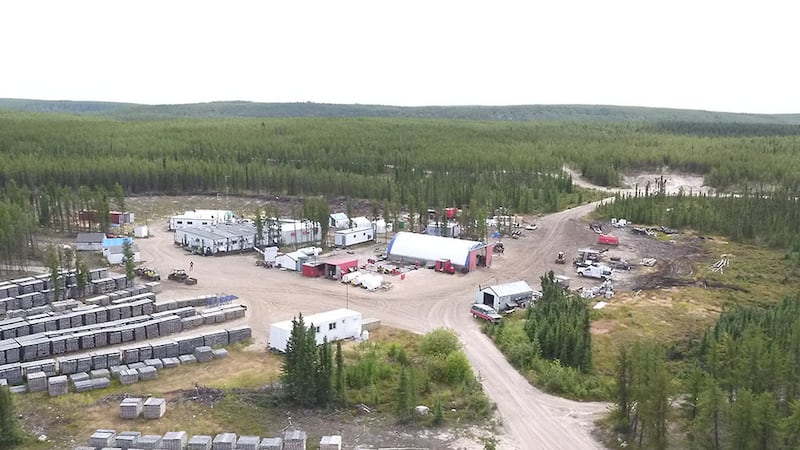
Denison Mines is currently in the early stages of construction for Canada’s first in-situ recovery uranium mine at the Phoenix deposit of its Wheeler River Project, located in the Athabasca Basin of northern Saskatchewan.
Instead of digging massive pits, in-situ recovery mining dissolves and extracts metals to the surface. The technology is already being used in countries around the world.
“We’re at a very exciting time,” says the company’s president and chief executive officer, David Cates.
He says the Phoenix mine will be the company’s “ticket to generating positive returns and meaningful cash flow” for investors.
Denison Mines plans to extract 56.7 million pounds of uranium from Phoenix reserves over the project’s 10-year lifespan.
Denison Mines reported a net loss of $114.88 million for its first quarter with a reported loss per share of $0.13.
“So right now, our focus is on investing, and you’ll see that in our financial results, as we are investing in the construction of this new mine,” says Cates, adding that it is the first uranium mine that has been approved for large-scale construction in the last two decades.
To fund its new mine construction, Denison is selling its uranium inventory it bought back in 2021 for under $30 a pound.
In the first quarter, the company sold 550,000 pounds of that inventory for roughly $99 a pound, beating the current market rate, which sits in the mid-$80s. Cates says the company had about 1.85 million pounds of uranium inventories at the end of the first quarter, which will give it strength as it goes through financing for its Phoenix project.
“The investors and the uranium market can see that we’re being very responsible with our sales,” says Cates.
Cates says after receiving construction permits in February, the company is targeting for first production by mid-2028.
“That’s pretty unique, owing to the mining method that we’re working with, that we can have such a short construction period,” says Cates.
How recovery mining works
Cates explains that the method does not require a shaft or pit for ore access or the construction of a large mill
Instead, the company will drill boreholes and inject a mining solution designed to dissolve the uranium in place, allowing it to be pumped to the surface through the same network.
“We won’t even have a conventional tailings facility that we need to build and our process plant on the surface won’t be milling or crushing or grinding any rock. It’ll just be precipitating the uranium out of the recovered solution,” says Cates.
“All of that makes the construction of our project much more simple, lower cost, and we can have a shorter timeline.”
Partnerships with Orano and Cosa Resources
Denison is partnering with Orano, a global nuclear fuel leader, at the McClean Lake joint venture to ramp up a unique mining method they developed together called SABRE, which stands for surface access borehole resource extraction.
The method, 20 years in the making, allows them to drill from the surface and pull out underground ore without digging massive open pits or shafts.
After successfully proving the method with commercial production late last year, they plan to resume pulling out and processing ore later this year.
“Work early this year has been focused on resource confirmation drilling, and then later in the year, we will be transitioning into, again, excavating mine cavities and processing the ore,” says Cates.
“And the hope is that we’ll be able to transition into a continuous mining operation over the next several years.”
Denison Mines is also capitalizing on the recent exploration success of its junior partner, Cosa Resources, at the Murphy Lake North property in northern Saskatchewan.
Cosa’s winter drilling program struck a five metre pocket of heavy uranium. The discovery sits on the same underground path as the Hurricane deposit, which is the richest uranium zone on Earth, and close to Denison’s core operations.
“Our strategy for growth at Denison is to work our own exploration portfolio, but it’s also to amplify our exposure to discovery by investing in companies like Cosa,” says Cates.
The company also holds a significant investment in Skyharbour Resources Ltd., whose exploration land directly borders Denison’s main Wheeler River project. It also gave Foremost Clean Energy Ltd. an option to explore 10 of its extra land parcels in the eastern Athabasca Basin.

