Customers have lodged an increasing number of complaints against grocers over alleged “maple washing,” resulting in investigations and thousands of dollars in fines, according to the Canadian Food Inspection Agency.
“Maple washing” refers to the practice of retailers and producers making their products “appear to be as Canadian as possible,” to take advantage of consumers’ preference for domestic products, according to the Consumers Council of Canada. The complaints were largely made after the “Buy Canadian” movement took off, according to the data Canadian Food Inspection Agency (CFIA) shared with CTVNews.ca.
As a result of the movement sparked by trade tensions with the United States, some Canadians favoured domestic products – even if they were pricier – over those made south of the border.
“The CFIA takes labelling issues seriously and wants to know about products that consumers think are labelled in a misleading manner,” a spokesperson from the CFIA told CTVNews.ca in an email, Friday.
According to the oldest data provided by the CFIA, the federal agency only received one and two complaints in November and December 2024, respectively. The number climbed to 25 in February 2025 and 33 the following month, when the “Buy Canadian” movement started to gain steam amid escalating trade tensions.
While the number dipped during some months, it surged to a peak 78 complaints in March. As of May 11, the CFIA has received 17 complaints this month.
The CFIA said it follows up on all complaints about the misrepresentation of products, and has previously reminded businesses to ensure product labels are “accurate and not misleading consumers.”
Despite the actions addressing maple washing, the CFIA data showed “there’s a big problem out there,” consumer advocate Jay Jackson told CTVNews.ca in a Zoom interview on Wednesday.
Jackson, a member of the Consumers Council of Canada, said it’s “unconscionable” that some grocery stores “misrepresent products” and take advantage of the demand to “buy Canadian,” amid high food inflation and affordability challenges.
What happens to maple-washing violators?
The CFIA said that it received a total of 403 complaints between Nov. 1, 2024, and May 11, 2026, adding that it had evaluated 345 complaints as of May 11. The federal agency determined “non-compliance” for 119 complaints from those evaluated, with most related to country-of-origin labelling or advertising for produce at retail. Canadian content claims applied to 96 of the “non-compliance” cases.
For non-compliance cases, the CFIA said it would address the problems, including reviewing the labelling processes and checking if “corrective actions” have been done, adding that more “enforcement actions” would be taken if businesses still don’t meet requirements. These actions, which are posted on its website and on X, include suspending and cancelling food business licences and imposing monetary penalties.
Some companies accused of maple washing
On March 16, the CFIA announced that it had levied $47,000 in fines on food businesses since April 2025 for misrepresenting products as Canadian. Among them, two Loblaw-owned grocers in Ontario were fined $10,000 each. The federal agency also issued warnings to two Loblaw stores in the Atlantic region on Feb. 20 over similar concerns.
In an email to CTVNews.ca on Wednesday, a spokesperson for Loblaw called the incidents “isolated situations.” Rachel Siekanowicz, director of communications at Loblaw, said the retail giant “acted immediately” to address the issues.
“We believe customers want visibility into where products come from, and we continue to provide that information in accordance with CFIA guidance,” Siekanowicz wrote. “This can be challenging with a constantly changing assortment of products sourced from different regions of the country and different times of the year. While we work hard to maintain accuracy, occasional errors can happen.”
A spokesperson from Sobeys suggested that it was challenging to place Canadian flag labels on thousands of products at the grocer’s 1,600 stores across the country.
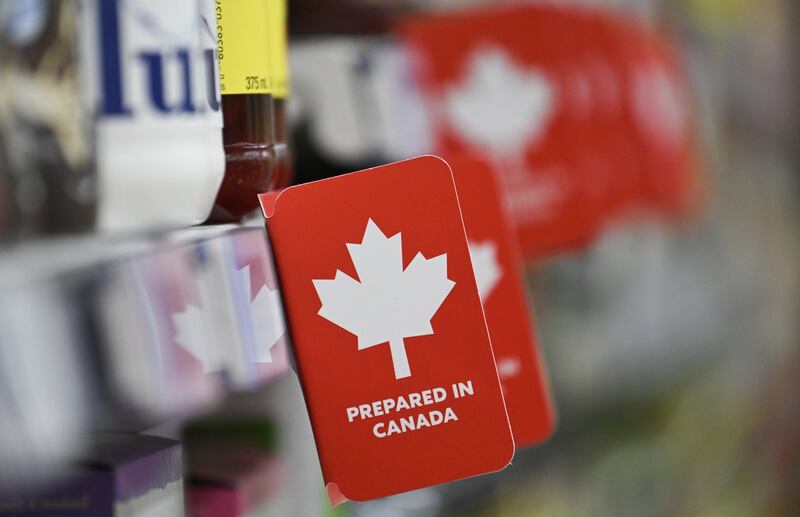
“While we aim to avoid errors of any kind, we know that this highly manual process led to some isolated incidents,” Caitlin Gray wrote in an email to CTVNews.ca on Wednesday. “When identified we moved as quickly as possible to correct. Any suggestion that errors identified in shelf labelling were made willfully is simply not true.”
Sobeys is not among the retailers that faced consequences from the CFIA, based on the information the agency posted online and shared with CTVNews.ca, and the agency didn’t respond by deadline when asked whether the company has been involved in any investigations.
However, Sobeys is among the grocers named in a proposed class action.
Class action against grocers
As Canada deals with cases of alleged maple washing, this class action against grocers accused of “false advertising” is in its early stages. A hearing to authorize the class action is expected in the fall, said Joey Zukran, a lawyer with LPC Avocats in a Zoom interview with CTVNews.ca on Friday. LPC Avocats and Renno Vathilakis are the Montreal-based law firms that launched the class action.
He said the class action aims to hold the businesses “accountable and to get some form of compensation for the public.”
With files from CTV News’ Abigail Bimman

