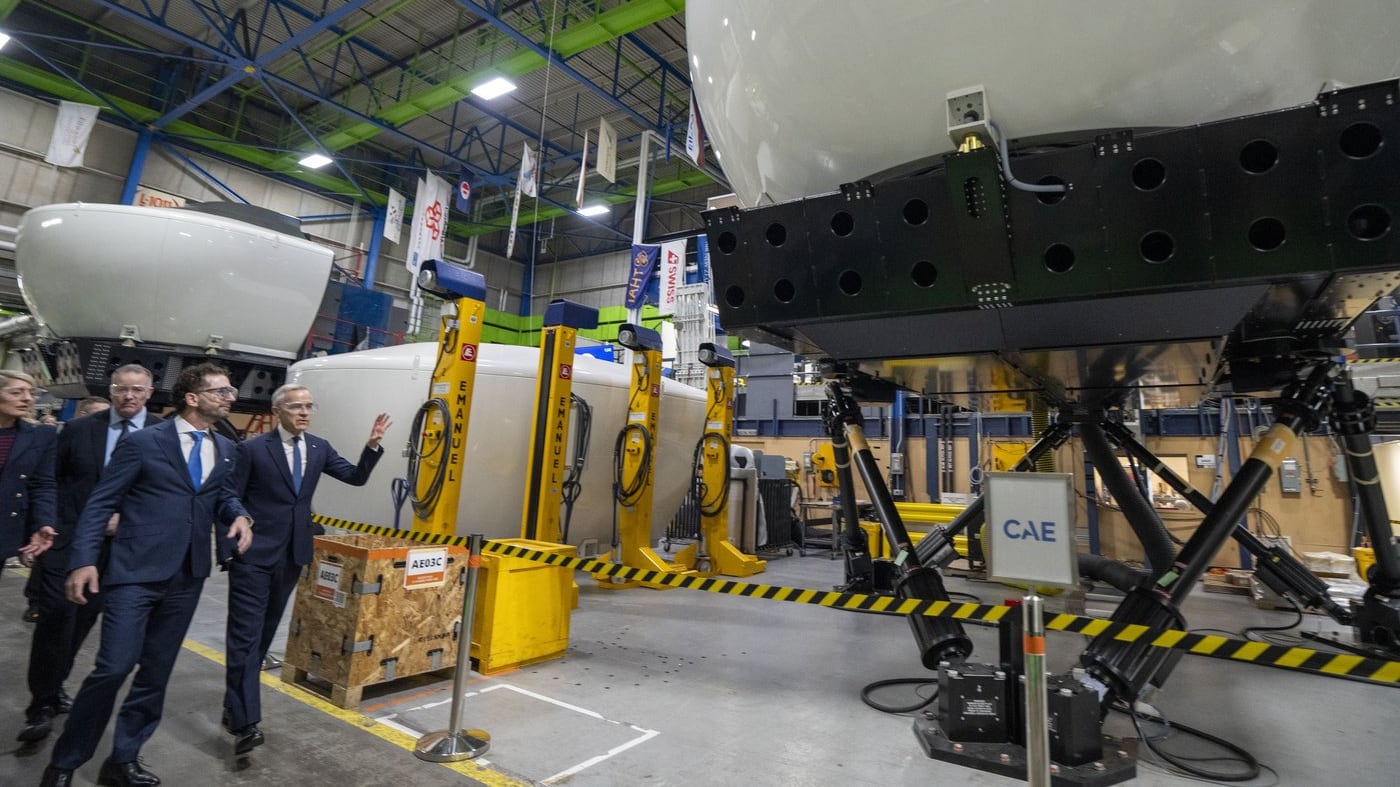
The head of CAE Inc. says the Iran war is poised to continue hammering its bottom line, as the flight simulator maker scales back its footprint abroad to cut costs.
The turmoil in the Persian Gulf is “having a month-by-month impact” on bookings and sales, said CEO Matthew Bromberg, with airlines slashing flight schedules and dialing back pilot training in a conflict zone.
“The training market remains subdued, and recent developments in the Middle East are expected to continue to impact our operations and customers,” he told analysts on a conference call Friday.
Soaring jet fuel costs caused by the closure of the Strait of Hormuz play a role in the demand destruction, pushing carriers to shed lucrative routes and further depressing the need for pilot training — potentially for months ahead — he said.
The Montreal-based company’s share price fell nearly 14 per cent to close at a 52-week low of $32.01 on the Toronto Stock Exchange.
The upheaval comes as CAE enters what Bromberg calls a “reset year,” with the organization six months into a transformation plan that will see it remove 10 per cent of its commercial flight simulators to lower costs.
Another dozen or so will be relocated, he said. Four to six training centres will also be shut down — one already has been. The result will be a global footprint that spans 300,000 fewer square feet, reducing rent and labour expenses from an “overbuilt” network, he said.
However, CAE could lose some clients in the process.
“While we are working closely with customers to retain their business, we expect some stranded cost and attrition as we consolidate sites,” Bromberg said.
“We will sweat our assets,” he said. “This is heavy lifting. This is hard work.”
Bromberg’s overhaul reaches into the realm of values and attitudes.
“We’re changing the culture of one that has missed internally and externally, and that’s disappointing to all the shareholders, all the analysts, and to us. And we’re going to turn the corner,” he said, pointing to a new incentive compensation plan and “operating cadence.”
After markets closed Thursday, CAE reported its fourth-quarter profit plunged 46 per cent year-over-year to $73.1 million, even as revenues ticked up four per cent to $1.33 billion.
For the coming year, CAE expects revenue growth in the low-single-digit percentage range — weighed down by flat or negative sales on the civil aviation side — and adjusted earnings per share of between $1.21 to $1.28.
That outlook assumes the Middle East war winds down before October, the company said.
“The market is clearly underwhelmed by CAE’s 2027 guidance, and while the long-term financial targets are within our range of expectations, the timeline to reaching — four years to 2030 — is more extended than we would have hoped,” said National Bank analyst Cameron Doerksen in a note to investors.
The company aims to achieve up to $150 million in annual savings by 2030 and bring in up to $1 billion in adjusted segment operating income versus $797 million in its 2026 fiscal year.
“As air traffic grows four to five per cent ... the need for simulators is going to grow four to five per cent, and we’re the market leader,” Bromberg said.
CAE counted 371 full-flight simulators across the globe as of March 31, among the facilities used to train more than 150,000 pilots a year.
The same escalation of geopolitical tensions that has dented earnings at the company’s civil aviation division has bolstered prospects at its defence branch.
Chairman Calin Rovinescu, who served as Air Canada’s CEO for a dozen years, said CAE is well positioned as the military spending spigot starts to gush.
“Our D&S (defence and security) business is at the front end of an upcycle driven by rising defence budgets across NATO and allied nations,” Rovinescu told analysts, noting alliance members have targeted defence spending of five per cent of gross domestic product by 2035.
Nonetheless, the company’s backlog at the end of its fiscal year sat at about $19.3 billion, roughly four per cent lower than 12 months earlier.
“2026 was one of the lightest order years we’ve had since COVID, so we have a much lower backlog going into the year,” said Bromberg, who came on board as chief executive in June.
As part of his transformation plan, CAE said last month it would lay off two per cent of its workforce, with two-thirds of the roughly 280 positions affected in Quebec, mainly in the Montreal area.
Bromberg said Friday the company continues to hunt for a buyer for Flightscape, its software aviation business.
In the meantime, aviation regulators in the U.S. and Europe greenlit the world’s first Boeing 777-9 full-flight simulator earlier this year, clearing the runway for a pipeline of CAE training opportunities tied to the massive airliner.
CAE also built on a partnership with InterGlobe Aviation — parent of IndiGo Airlines, India’s largest carrier — by adding a fourth pilot training centre to the country located in Mumbai.
Christopher Reynolds, The Canadian Press
This report by The Canadian Press was first published May 22, 2026.

