Researchers at McMaster University have discovered a new antibiotic that can kill some of the world’s most dangerous drug-resistant bacteria, a breakthrough they say could pave the way for a new class of treatments.
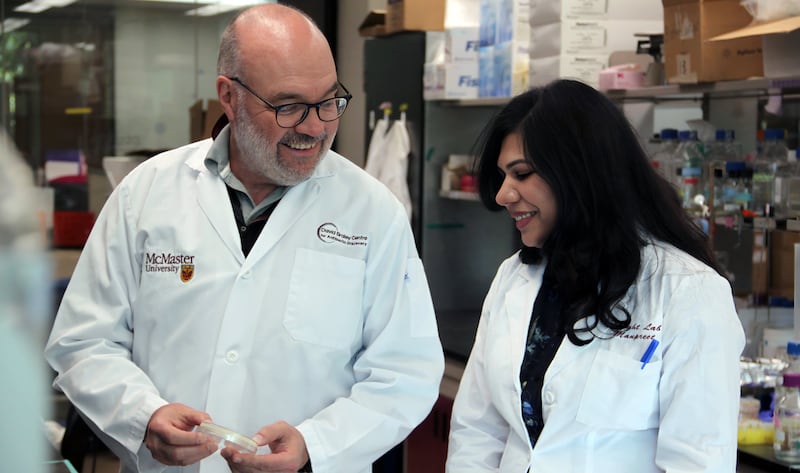
The compound, called manikomycin, was identified by a team led by McMaster professor Gerry Wright. Early testing showed it was effective against several priority pathogens, including salmonella, E. coli and klebsiella.
“What makes this exciting is that it’s a brand new unique structure,” Wright said in an interview with CTVNews.ca.
The discovery builds on research into a soil bacterium that has been studied for decades.
Working with collaborators at the University of Illinois Chicago and the University of Hamburg in Germany, Wright’s team used an advanced laboratory technique known as fractionation to search for previously overlooked compounds.
- READ MORE: Bacteria found in underground cave after thousands of years is resistant to antibiotics: study
The bacterium is already known for producing oxytetracycline, an antibiotic discovered in the late 1940s. But Wright said the newly discovered compound had remained hidden because it was produced in much smaller quantities.
“It was there, and we just didn’t see it because the signal from tetracycline just overwhelmed this,” he said.
The finding is part of a broader effort to revisit older bacterial strains using modern technologies.
“It turns out that when you look at the genetic potential of these organisms now with 21st century tools, genomics and bioinformatics, these organisms produce lots of different compounds,” he said. “So there’s a potential to go back to these so-called older strains and ask, did we miss something?”
- READ MORE: Breakthrough antibiotic treatment could ease daily struggles for Crohn’s patients in new discovery
Researchers say the new antibiotic works differently from drugs currently used in hospitals and clinics.
It targets a previously unknown weakness in bacteria by blocking part of the ribosome, a structure inside cells that produces proteins. Without proteins, bacteria cannot survive. Because manikomycin attacks a different part of the ribosome than existing antibiotics, researchers say many drug-resistant bacteria may not be able to defend themselves against it.
“All these superbugs that we’re worried about do not have resistance to this antibiotic, and so that gives us a new class of chemical structure, a new molecular target, and a lack of resistance,” Wright said, noting that antibiotic resistance develops because bacteria evolve over time, allowing some strains to survive exposure to drugs that once killed them.
“The antibiotics that we have, that we discovered 50 years ago, are losing their power, not because they’re getting weaker, but because the bacteria have just simply evolved to overcome them,” he said.
If new antibiotics are not developed, Wright said vulnerable patients could face greater risks from infections, including cancer patients undergoing chemotherapy, premature babies and people recovering from major surgery.
“Antibiotics are foundational to modern medicine,” he said. “Imagine doing a heart bypass without antibiotics … all of modern medicine is based on our ability to control these infections. We control them with antibiotics. We have no antibiotics; we lose modern medicine."
Researchers say the new antibiotic remains in the early stages of development, but several key milestones have already been reached.
The team found that manikomycin was not toxic to human cells and that it performed well in a laboratory model of infection.
Scientists are now working to improve how long the drug remains active in the body. They have already created about 60 modified versions of the compound and hope to identify one suitable for further development and clinical testing.
Wright cautioned that turning a discovery into a medicine is a lengthy process that will require years of additional research and significant investment.
“The discovery of manikomycin is just the first step in a long road towards making a new medicine,” he said.
Wright said many large pharmaceutical companies have moved away from antibiotic development because the drugs are typically taken for short periods and are often inexpensive, compared with medications used to treat chronic conditions.
“Antibiotics cure disease, so you take them for a short period of time and then hopefully you’ll never have to take it again, and they’re relatively cheap,” Wright said. “Drug companies are like car companies, they’re selling products, and so, from the perspective of a drug company, it’s better to have something that you’re taking chronically.”
Wright said governments, researchers and the health-care industry continue to search for economic models that encourage investment in new antibiotics, warning that discoveries alone are not enough if promising drugs cannot be developed and brought to patients.
“A discovery is hard enough to begin with, but developing it and finding ways to do that require resources that are really significant,” he said.
“(I’m) excited about the discovery, very optimistic about the potential that this might have to help address the antibiotic resistance crisis, but also highly realistic that the road ahead is not gonna be easy.”

