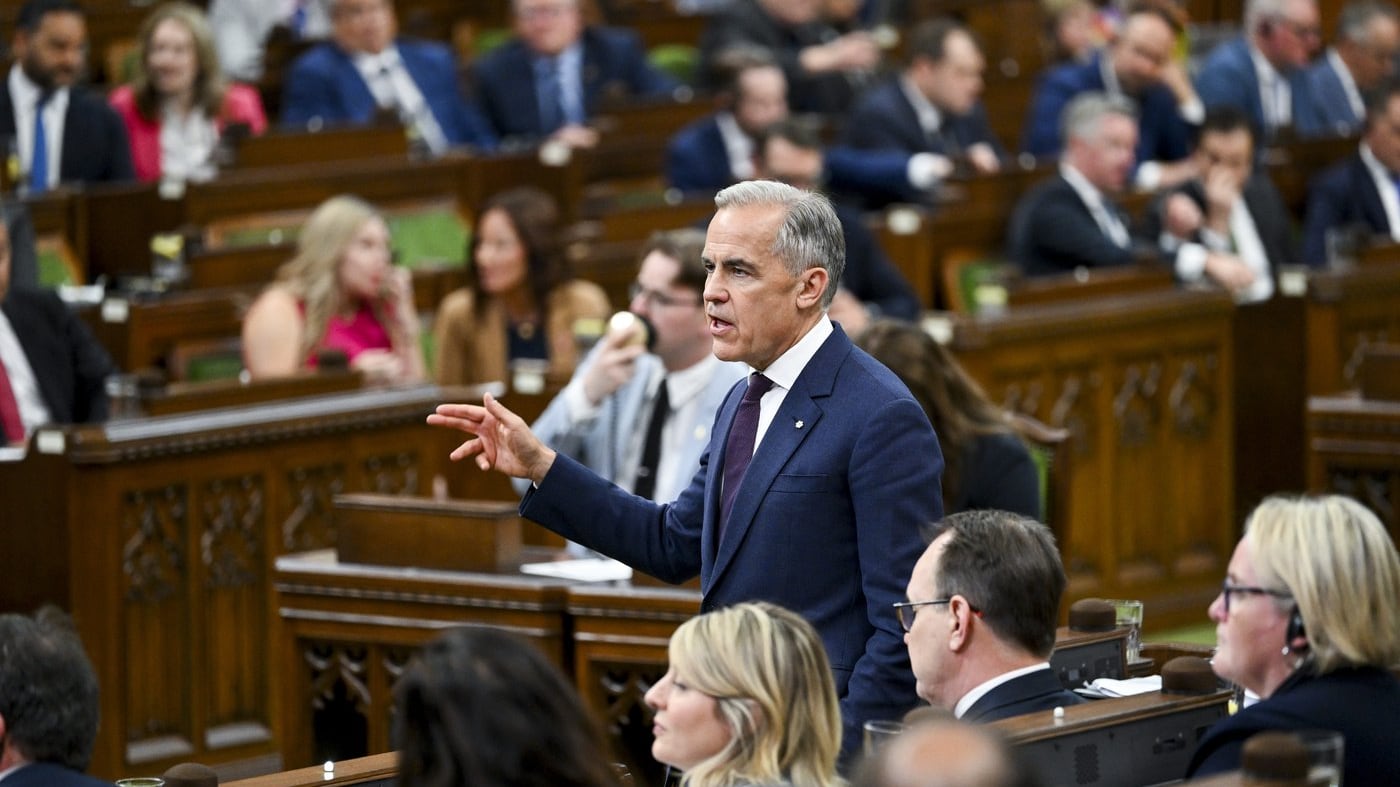
OTTAWA — Prime Minister Mark Carney has said that lower immigration under his government helps to explain why Canada’s economy has declined for the last two quarters, pushing it into recession territory.
While Carney has not said the word “recession” himself when asked about the decline — and while economists citing broader economic indicators argue Canada is not in a true recession — critics have said that years of high immigration intake served to conceal the extent of Canada’s economic troubles.
Those critics include Conservative immigration critic Michelle Rempel Garner, who posted on social media Tuesday that “mass rapid intake of low-skilled temporary foreign labour both masked and juiced structural economic issues.”
“It’s a basic fact, it’s one of several factors, but the underlying point is we’re putting in place the foundations a stronger, more resilient, more independent Canadian economy. You can do the math, you should do the math, in terms of declining population growth as an impact,” Carney said in response to that criticism.
Nathan Janzen is a Royal Bank of Canada economist who has done the math. He said high population growth, driven by immigration, contributed to a higher gross domestic product despite household economic challenges.
“Absolutely, in a sense that large inflows of immigration did help prop up measures like total GDP growth and total employment growth, but there were significant other things going on at that period,” Janzen told The Canadian Press.
He said these other factors included rising unemployment and high interest rates as the Bank of Canada looked to rein in post-pandemic inflation.
Canada’s population grew by 2.4 per cent in 2022, 3.1 per cent in 2023 and 2.21 per cent in 2024. This growth was driven primarily by permanent and temporary immigration rates, with annual population increases well above historic averages.
Statistics Canada tracked annual population growth of about one per cent annually in the years before the pandemic.
Janzen said topline GDP for Canada was strong in 2023 and 2024, but kitchen table economics painted a different picture.
“Per capita GDP was declining and the unemployment was rising significantly in a way that historically you only usually see in a recession,” he said.
“So … during that period, when ostensibly the economy looked relatively firm, we actually saw on a per-capita basis conditions that were indistinguishable from a recession and right now we’re actually really seeing the opposite.”
Janzen said he and his colleagues are tracking data which suggests economic factors for individuals are stabilizing and he’s “cautiously optimistic” there may be improvements, even while the topline economic data looks weak.
The federal government is reducing the number of permanent and temporary immigrants being admitted to Canada.
The government has set a target of admitting 380,000 permanent residents this year, which it says it will maintain until 2028. On the temporary resident side, the plan is to admit 230,000 workers this year and 155,000 students. The next two years see slight reductions to those targets.
This is a major reduction from the 2024 immigration levels plan, which projected 500,000 new permanent residents in 2026. The government did not set a target for temporary residents at that time.
Statistics Canada tracked flat population growth for the first time ever in 2025, and early indications are that the estimated population dwindled slightly in the first quarter of 2026.
Janzen said that with consumer spending making up about half of GDP, that topline number will be depressed with fewer consumers in Canada.
Immigrants tend to be younger than the average Canadian, so Janzen cautions that while individual economic factors are better than topline data might suggest, Canada may be heading for a labour shortage.
A RBC report he recently co-authored says Canada is seeing about 25,500 workers retire every month — double the monthly retirement rate a decade ago.
Between declining birthrates and tighter immigration, Janzen said, the country is heading toward a smaller workforce.
“So we should get used to seeing weaker growth numbers. This would be both in GDP growth rates, but also you would expect to see this in something like a total employment growth rate. Weaker than what we would normally expect to see in a period where the economy is doing OK,” Janzen said.
He added that a short-term side-effect of this trend might be a decline in youth unemployment — which was at 14.3 per cent in April — as more opportunities open up in the labour market.
David Baxter, The Canadian Press

