ST. JOHN’S – Financial worries are cutting into Canadian vacation plans, a new poll suggests, with a growing number of families looking to tighten budgets during the summer months.
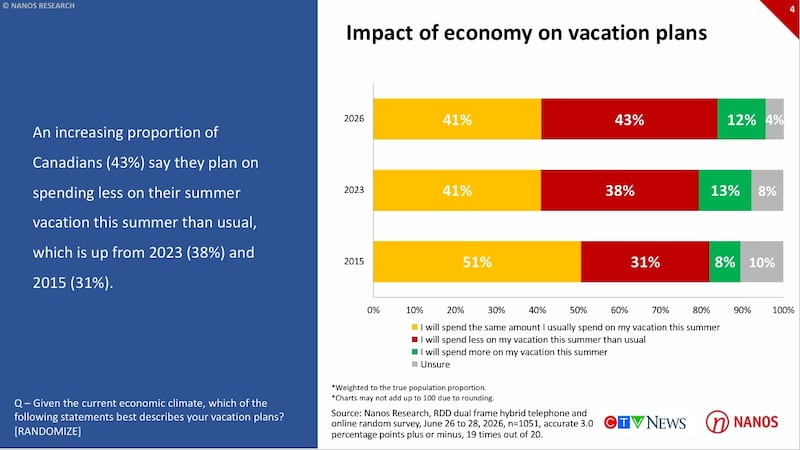
A growing number of Canadians — nearly half — are looking to spend less during their vacations this year, according to the survey by Nanos Research for CTV News.
That survey suggests 43 per cent of Canadians are looking to save money during this vacation period — up slightly since 2023 but considerably since 2015, when just 31 per cent of Canadians were looking to cut back.
The findings suggest a tightening of budgets that could spell trouble for tourism destinations like Newfoundland and Labrador, where visitors from other Canadian provinces have become a key part of the summer economy.
“Customers are like fish in the water, we need to get as many of them as we can,” said Todd Perrin, chef and operator of Rabble in downtown St. John’s.
He argues the restaurant business in Newfoundland and Labrador has become as seasonal as the fishery, since it has become more and more reliant on visitors from other Canadian provinces.
“If we don’t catch as many tourists as possible, then it makes for a long winter for sure.”

The summer season has just begun in St. John’s, but Perrin has already noticed changes in his clientele, such as fewer customers at his downtown restaurant, though they are each spending a bit more money per visit.
So far, it has evened out, but Perrin says food and beverage businesses like his are uniquely vulnerable when tourists try to save a few dollars during their vacations.
“There is only one way to go on a boat tour,” he said. “But there’s a thousand ways to have a bite to eat. You can order something in, you can go through a drive-thru, you can go to a grocery store.”
Visitors from Ontario are among the most prized in the Newfoundland and Labrador tourism market. Research compiled by the provincial government shows about 40 per cent of visitors to Newfoundland and Labrador are from that province, more than any other.
Tighter budgets could spell further trouble in the restaurant industry in St. John’s, which has seen a number of restaurants close since the COVID-19 pandemic.

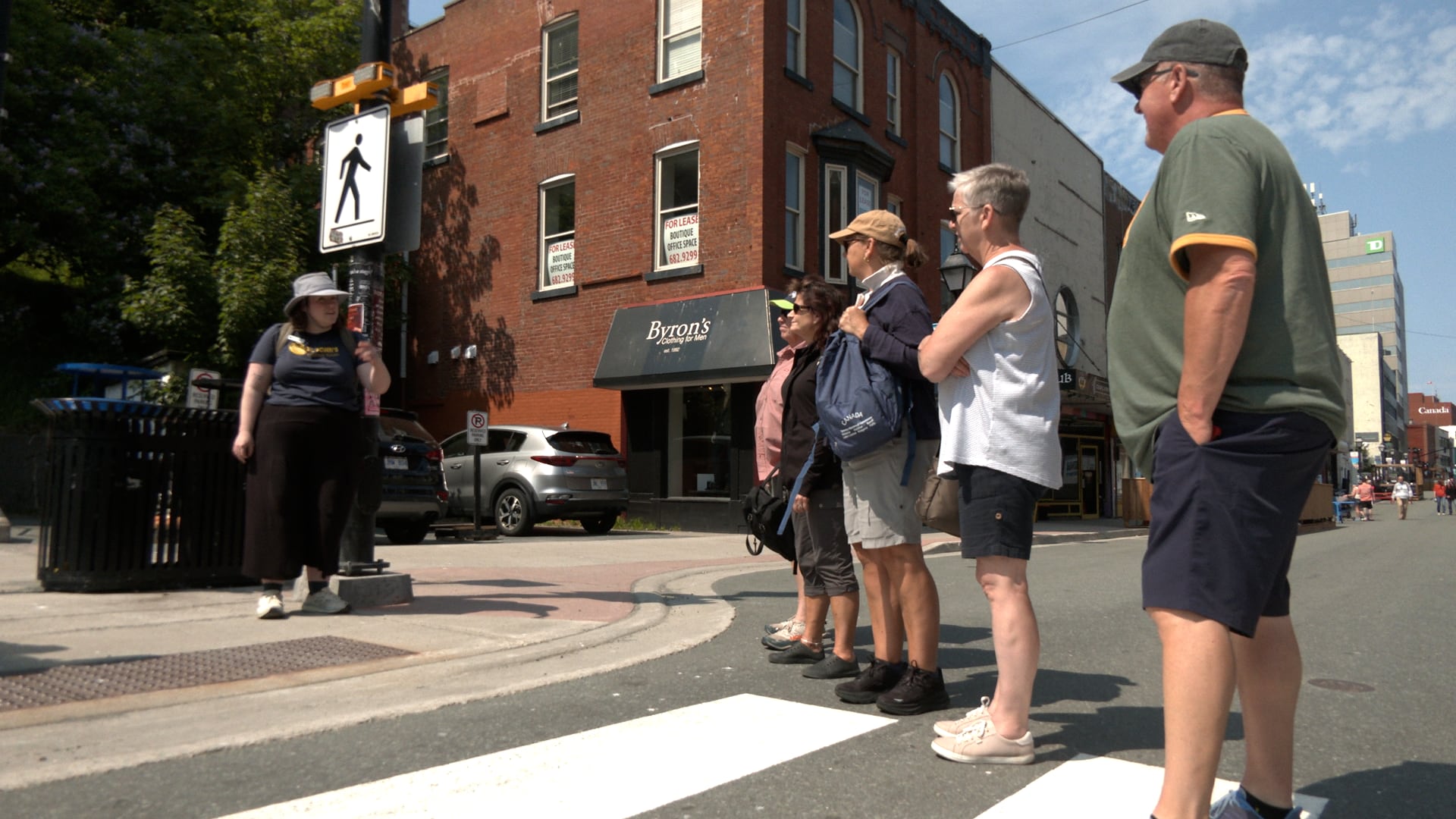
But some downtown St. John’s businesses are showing resilience, and even growth, so far in 2026. Pierre Trowbridge said his St. John’s Walking Tours has brought on some new offerings, buoyed by cruise ships arriving earlier in the city this summer and high demand for his products.
“Whether you’re going to a place for fish and chips or you’re going for a pint … people are still spending money on those things, it seems,” he said. “From our perspective, we seem to have more guests that are doing multiple tours with us as opposed to doing a single tour.”
The summer has been a full-on sprint for Trowbridge and his employees.
“We had two ships in last week on the Friday … it was an absolutely crazy day,” he said. “Just wake up in the morning, you throw the covers back, and you start running.”
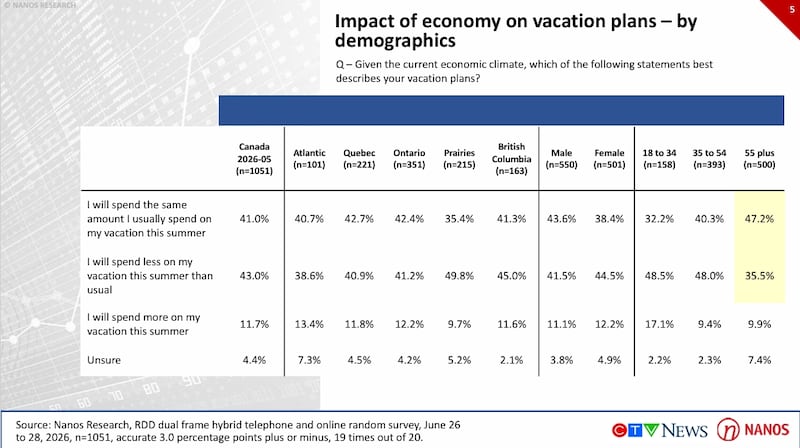
Canadians living in the Prairies are most likely to be cutting back their vacations, according to the poll’s findings — 49.8 per cent of respondents said they would spend less on vacations this year, and 25.2 per cent of respondents in that region said they would take less time away from work this summer compared with last year.
The frugal impulse appears more concentrated among younger Canadians — 48.5 per cent of respondents between 18 and 34 said they will spend less this summer, compared to just 35.5 per cent among respondents over the age of 55.
Younger Canadians are similarly cutting back on vacation time too, with 27.2 per cent of respondents between 18 and 34 planning to take fewer days away from work this year than in 2025.
Methodology
Nanos Research conducted a dual frame (land- and cell-lines) hybrid telephone and online random survey of 1,051 Canadians, 18 years of age or older, between June 26 to 28, 2026. Results were statistically checked and weighted by age and gender to the latest census. The firm says its survey results carry a margin of error of plus or minus-three percentage points, 19 times out of 20.

