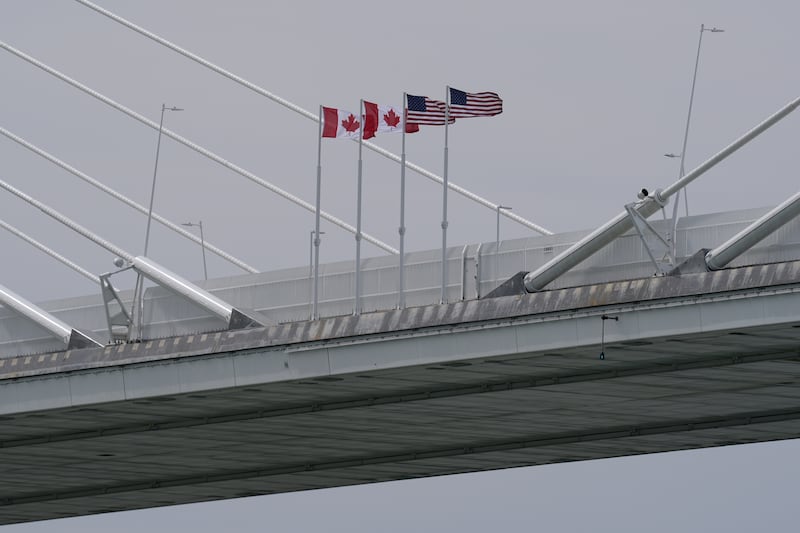
After weeks of delays and public criticism from U.S. President Donald Trump, the Gordie Howe International Bridge is set to open at the end of the month, but Canada is set to forgo more revenue than initially agreed upon.
Housing, Communities and Infrastructure Canada confirmed the long-awaited opening in a statement late Friday.
“Canada and Michigan have agreed to open the Gordie Howe International Bridge on July 27, with the support of the United States Government,” the statement reads in part.
“The bridge will be a major economic driver in the region and will also provide options for commuters, tourists, and businesses.”
The new crossing between Windsor, Ont. and Detroit, Mich. is expected to significantly ease congestion at the nearby Ambassador Bridge and streamline cross-border trade.
In Friday’s statement, the federal government says Canada and the U.S. have agreed to “a series of cooperative measures focused on toll governance and transparency” and the “establishment of a 15-year economic development fund tied to a portion of profits from bridge operations.”
The Windsor-Detroit Bridge Authority will also work with the U.S. on an agreement for “certain non-market related toll changes.”
According to a senior government source, Canada will get 50 per cent of the bridge’s toll profits in the first 15 years, with the other 50 per cent going into that economic development fund announced on Friday. But who runs that fund has yet to be determined.
The source also tells CTV News that both countries agreed that the U.S. will need to be on board if Canada wants to increase bridge tolls by more than 10 per cent or lower them below compared regional averages.
Michigan Republican Senate candidate Mike Rogers, meanwhile, posted on social media Friday that he spoke with U.S. Commerce Secretary Howard Lutnick about the bridge. He also confirmed a “financial deal” where he said the U.S. will see “up to half the revenue.”
The toll change is a major shift in the agreement first signed in 2012 as part of the Canada-Michigan Crossing Agreement. In that deal, Canada agreed to front the full construction costs, which grew to $6.4 billion, and later collect 100 per cent of toll profits until it recouped its investment.
The agreement estimated that recoupment would take at least fifty years after which Canada and Michigan would equally split toll revenues.
Trump takes credit for deal
In a post to Truth Social on Saturday, Trump took credit for the deal, which he described as a “MUCH BETTER DEAL for America.”
He also called the original agreement “unacceptable” and said he hopes both countries will have “many years of success with this wonderful new development!!!”

Plans to open bridge postponed in June
The bridge has been ready for months, and there was expectation it would open last month after Prime Minister Mark Carney appeared to confirm reporting from U.S. media outlets.
But days later, a ribbon-cutting ceremony and the opening was put on hold with Carney insisting at the time that there was “no big drama.”
When asked on Thursday in Jeddah, Saudi Arabia if he’d be open to renegotiating the terms to open the bridge, Carney said “I think we’re willing to clarify aspects of the current arrangements.”
Earlier this year, CTV News reported that both sides were trying to quietly negotiate an opening date after Trump complained in February that Canada was not treating the U.S. fairly on trade. Trump went on a lengthy tirade that included the construction of the bridge as part of his grievance.
The New York Times had also previously reported that Matthew Moroun, who is the owner of the nearby Ambassador Bridge and a Trump donor, met with Lutnick hours before Trump’s post in February.
But in an interview with Global News last week, U.S. Ambassador to Canada Pete Hoekstra denied donations from the Moroun family were behind the delayed opening of the bridge.
Construction on the bridge began in 2018. The cable-stayed bridge will have three Canadian-bound and three U.S.-bound lanes and will be among the top five longest bridges in North America.
With files from The Canadian Press

