The Government of Saskatchewan says it’s prioritizing Canadian ownership and furthering Canadian data sovereignty with its new policy on data centre developments.
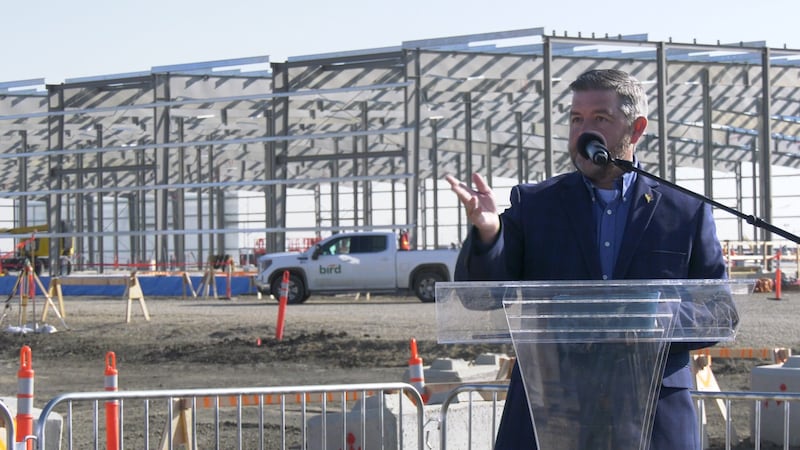
“The reality is that AI is here, and it will play a significant role in our lives and our economy,” Minister Jeremy Harrison told reporters Thursday. “The real question is where the infrastructure that powers AI will be built and whose laws will govern it.”
Harrison made the announcement at the site of Bell Canada’s AI data centre currently under construction near Regina.
The province identified six key principles guiding its policy.
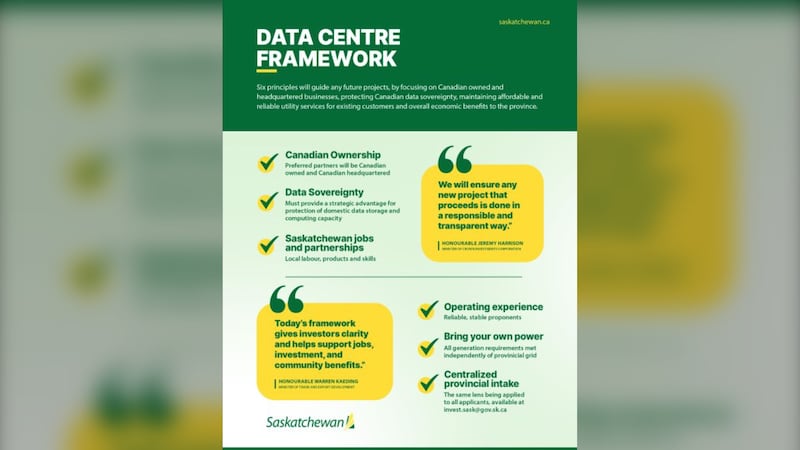
In addition to domestic ownership and sovereignty, the policy includes the creation of Saskatchewan jobs, industry experience, a centralized provincial intake process and self-supplied power generation.
The province hopes the framework will create a “streamlined” process for evaluating proposals and provide clarity for investors.
There are more than 30 applications for data centre developments currently under consideration by the province. All of which will be considered with the newly unveiled framework.
While SaskTel owns and operates six data centres for cloud storage, Bell Canada’s $1.7 billion AI data centre project marks the first major outside investment in the sector in Saskatchewan.
The project is expected to create $12 billion in economic activity and provide around $720 million in provincial revenues – while creating around 800 jobs during construction and 80 long-term operational positions.
“AI and data sovereignty is going to be as important as energy security as we move into the future, and that really is that central issue,” Harrison added.
“If it’s not going to be here, it’s going to be somewhere else, and it’s likely going to be in the United States, or it could be in other countries around the world. We’re choosing Canada. Subject to Canadian law, subject to Canadian regulations, this is what makes sense for this province and, I think, for the country.”
Supporting Canadian
John Watson, group president with Bell Canada, stressed the collaboration with local businesses that’s led to the fast-paced construction of the facility.
“We need to create jobs here in Canada. We need to create engineering, fabrication, and permanent construction advantages here, not somewhere else,” he told reporters.
Watson highlighted several local firms, including Prairie Steel, that have benefited from the project.
According to the president, the manufacturing firm out of Clavet has invested in $20 million of new equipment to deliver on the project.
“This is a permanent change in Saskatchewan steel fabrication capabilities,” he noted. “… Each building going up here of the four, requires 1.2 million pounds of structural material, 70 per cent of the manufacturing work, and 80 per cent of the labour is performed at Clavet.”
‘Bring your own power’
The question of where the 300 megawatts (mw) needed to power Bell’s AI data centre will come from has become a topic of heated debate in recent months.
Concern from residents and criticism from the Saskatchewan NDP has led the province to defend the project — claiming Saskatchewan’s grid has the capacity to power the facility.
It was a defence repeated on Thursday by Harrison.
“This particular project is unique because we actually were in a position to supply that power from SaskPower,” Harrison noted.
“But any further investment into data or AI infrastructure will be a requirement that companies bring their own power and produce that power at their own cost, behind the fences.”
Watson confirmed that diesel generators are being installed at the site for the purpose of backup power.
“So, on the site, you have to have backup generation in case you lose your grid power, or you need to furlough that power,” Watson explained. “So that’s the backup for it.”
‘No groundwater’
Watson also took a moment to respond to a popular concern surrounding data centres - water usage. The concern mostly stems from reports from the United States, where data centres have led to increased water usage in some localities.
“I was getting a taxi ride out, the driver asked me, ‘So, how much water are you going to use here?’” Watson recalled.
“I can tell you, 16 months ago, well before we thought about building here, we made the decision that there would be no groundwater used. Zero. It’s a closed-loop system. It’s technical water. Zero consumption.”
In Bell Canada’s initial proposal, the company noted the data centre will utilize air-cooled, closed-loop chilling technology that does not consume or evaporate water to reject heat.
Once the system is filled during commissioning, it will remain sealed, according to the proposal.
As a result, the facility’s water connection to the municipality will be sized to support “standard domestic use and essential fire protection requirements.”
In a statement to CTV News, Bell shared its support for the province’s policy, adding that it looks forward to continued collaboration with the provincial government.
Public consultation
While the province will weigh each individual proposal through this new policy, public consultation is not a written addition to the framework. Instead, it is leaving it to rural municipalities.
The government will still allow individual RMs to conduct its own public consultations and assess area compatibility through discretionary use approvals.
“It should be left to the RMs,” Saskatchewan Association of Rural Municipalities president Bill Huber told reporters following Wednesday’s announcement.
“If there [are] concerns, we can usually work through them in consultation with our members and our partners; we’re very fortunate that way.”
Huber added the largest concerns are about land use and environmental impact, but having the process laid out publicly in this way should ease nerves for ratepayers.
“When there’s a development like this, if it’s a data centre or something similar, we want to make sure they respect all the rules and bylaws of each municipality; that they have setbacks and they’re not going to be built right next to a yard site or an acreage,” he said.
“Certainly, discuss it and make sure it’s open and transparent.”
CTV News is a division of Bell Media, which is a wholly owned subsidiary of BCE Inc.