


Anthropic, the company behind the AI chatbot Claude, is looking for someone to manoeuvre the venture’s enormous hunger for energy.
“We are hiring a Gas Supply & Transport Lead to own natural gas supply for Anthropic’s non-cloud data center portfolio in the United States and Canada,” reads the job description.
“Some of our campuses will run on gas-fired, behind-the-meter generation. … If gas does not arrive, in the volume and at the pressure the plant needs, the compute does not run.”
- Anthropic clinches biggest IPO ever with US$81 billion offering
- How to set CTV News as your preferred source on Google
It’s a high-stakes job – and a considerable salary. A successful candidate could earn up to just over half a million per year, in Canadian dollars (US$320,000 to US$405,000). Energy capacity will define Anthropic’s ability to produce artificial intelligence – a technology that it broadly believes can usher a cure for cancer, or design biological weapons if misused.
Whatever its use, Anthropic’s staffer will need to source a lot of energy. The company predicted earlier this year that the U.S. AI sector will need at least 50 gigawatts of capacity “over the next several years” to operate.

Where will the power come from?
When asked by CTVNews.ca, the company did not provide a prediction for what the Canadian AI sector would need. Canada’s overall generation capacity was just about 156 gigawatts in 2025.
“We all know that AI requires vast amounts of energy, and so the questions that we have are: where will that energy come from? How will it get to these sites? And what will the impact be for the average consumer?” asked Gitane De Silva, former CEO of the Canada Energy Regulator. These days, she’s the executive director of the Peter Lougheed School of Politics and Democracy at the University of Alberta.
“Canada is blessed with every single form of energy out there. We’ve got tremendous oil supplies, gas supplies, wind, solar, all of it,” she said in an interview with CTVNews.ca. Canada also has the fortune of a colder climate, potentially reducing the need to artificially cool data centres. Cooling has historically accounted for 40 per cent of a data centre’s energy suck.
But, she added, if Canada wants to meet the moment, it will need to build up energy sourcing, generation and transportation infrastructure. That could range from something as complex as pipeline capacity or as straightforward as road access to new sites.
Canadian energy: Asset or constraint?
Canada’s official AI strategy calls energy both “an asset and a current constraint.”
“Canada’s grid is among the cleanest in the world, but available power for large-scale AI buildout is limited today,” reads the strategy, which calls Canada “vulnerable” on infrastructure.
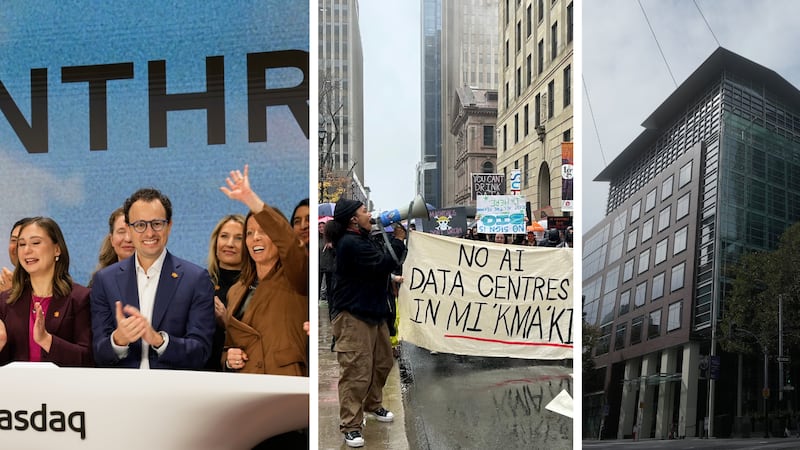
But that hasn’t stopped American companies from increasing their footprint across the border. Meta, Mark Zuckerberg’s tech conglomerate that owns Facebook, Instagram and WhatsApp, is building a $13-billion-plus data centre in Alberta’s Industrial Heartland.
It could be the largest outside the U.S., once finished, and consume one gigawatt of power. It takes about 1.4 gigawatts to power Edmonton.
The company hopes to power it with a bespoke gas plant, which won’t be operational before the data centre is up and running. Meta has rights to connect to Alberta’s grid in the meantime.

Do they have to be gas guzzlers?
Anthropic is hiring a gas supply leader. A gas plant will power Meta’s centre. What about renewable energy?
“The reality is that AI data centres need 100 per cent reliability,” said De Silva. “There’s no point in time when the electricity cannot flow to the centre. And so, that becomes the limitation of renewables. … If the wind is not blowing or the sun is not shining, then there needs to be a backup.”
“The reality is that the world remains very, very addicted to fossil energy, and … consumption is not declining at a rate that would be necessary to meet those climate targets,” she also said.
Posed with that assertion, Martin Karsten, computer science professor at the University of Waterloo, pushed back.
“I would challenge this notion that all these AI services really need all this, sort of, extremely high reliability and availability,” he said.
Karsten contends that there are two principal functions of AI. First, AI companies need to train their models to make them smarter. But that kind of work is “asynchronous,” according to the professor. It “can happen any time of the day.”
On the other hand, there are the queries, when a user inputs a command and the AI model responds with some sort of action, such as analysis, calculations, or media content. Society – as a group of people using AI – must determine how quickly it expects that sort of service.
“If I submit an X-ray for advice, and I get a response within 12 to 24 hours. Are we happy enough? If, of course, I’m on Instagram and watching the cartoons or whatnot … then I need it right away, right?”
For its part, Anthropic has signed a 20-year lease for a N.S. data centre in collaboration with EverWind Fuels – a wind and green hydrogen developer – according to the Canadian company.
‘Damned’ either way
David Duvenaud, who led a team at Anthropic examining model safety, has called for a moratorium on new model training and increased development transparency.
In an interview with CTVNews.ca, he argued AI’s potential impact on the labour market should raise alarm bells for countries that are looking to integrate it into their economies. On the energy side, he said, Canada finds itself in a difficult position.
“I basically see it as we’re sort of damned if we do and damned if we don’t. In the sense that, if we don’t build a whole bunch of power in data centres, unless there is giant global co-ordinated slowdown, which I think would be a great idea, then the U.S. will just have insane economic growth, and Canada will basically be left in the dust.”
On the other hand, rapid growth could lead to an undesirable downstream effect on labour, should employers opt to replace human workers with AI agents, said Duvenaud.
“If we stay relevant by building tons of power plants and data centres and robot factories, … the relative worth of human capital is just going to go down, and we’ll all just end up either with sinecures or just be dependents of the state forever.”

