U.S. President Donald Trump vowed sharp taxes on AI companies that build data centres outside the United States.
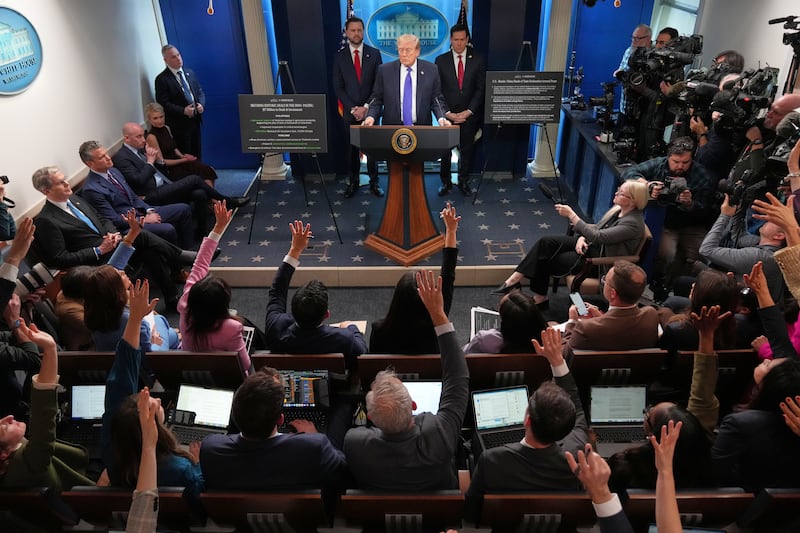
Speaking to reporters in Washington, Trump described a more protectionist plan for what’s largely considered to be a quickly growing and transformative industry. He said he had not yet shared his plans with his own officials.
“We’re going to put a tremendous tax on them,” he said, referring to AI companies that build outside American borders.
“We want them to build it here … We’re not allowing data centres to go into other countries (because) China will take all of them.”
Trump unveiled the plan following his trip to China for the Asia-Pacific Economic Cooperation (APEC) summit. Prime Minister Mark Carney met the president on the sidelines of that event to talk trade.
Data centres in Canada
At least two major American AI companies have plans to expand into Canada.
Meta, Mark Zuckerberg’s conglomerate that owns Facebook, Instagram and WhatsApp, has plans to build a large data centre north of Edmonton. Anthropic has signed a 20-year lease for another centre in Nova Scotia, according to EverWind Fuels, which is planning to develop the campus.
Anthropic, which launched the largest IPO in history this week, is hiring a Gas Supply & Transport Lead to source fuel for its technology in Canada and the U.S.
Trump did not immediately clarify what his plan would mean for companies that have already started building them.
Meeting with Carney
Trump and Carney spoke briefly on the sidelines of the APEC summit to discuss “a mutually beneficial trade agreement,” according to a Canadian readout released earlier this week.
On Friday, Trump reiterated his feeling that, while Carney was “very nice,” Canada is a difficult partner to deal with.
“For some reason, they feel emboldened, and we can’t let them feel that way anymore.”
The two countries have been sparring through a trade war since the start of Trump’s second term. Trump claimed Friday that the U.S. carries a US$80-billion deficit with Canada. So far in 2026, U.S. Census data suggests it is US$39 billion.
The American president was able to “move the ball forward” toward a trade agreement, according to U.S. Secretary of State Marco Rubio, who spoke after Trump.
Speaking to reporters on Wednesday, prior to his encounter with Trump, Carney said “Canada is building more ambitiously and rapidly than at any time in our history.”

