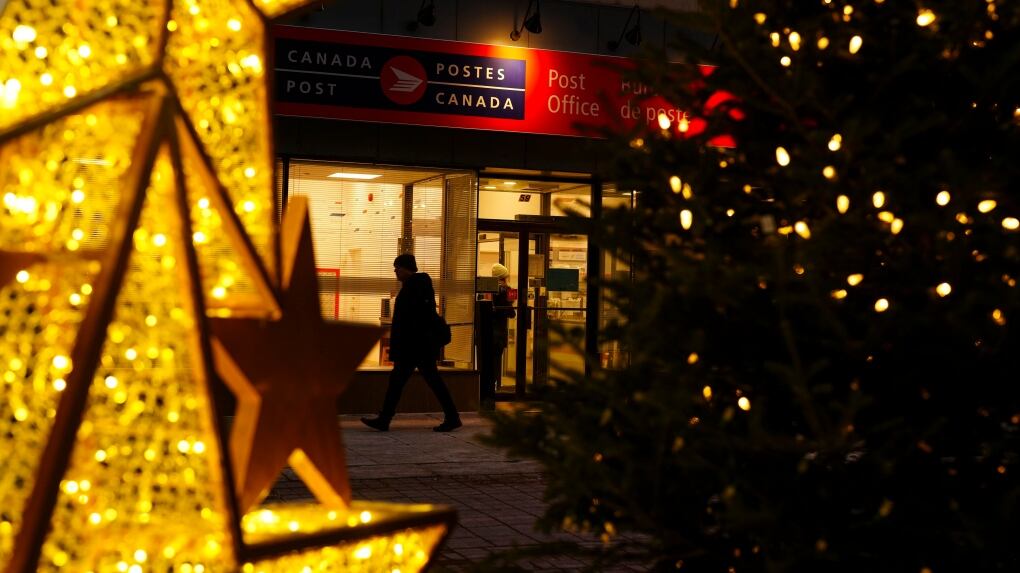
A year after a Canada Post strike brought mail and parcel delivery to a halt during the busy holiday season, postal workers remain at odds with their employer but now face bigger existential questions amid intervention from the federal government.
The Canadian Union of Postal Workers (CUPW) walked off the job in September after the Liberal government announced a series of reforms to Canada Post aimed at revitalizing the Crown corporation, which has struggled financially for years.
The union shifted to rotating strikes last month, which are ongoing. But CUPW, whose members were ordered back to work by the feds last December, doesn’t have the same negotiating leverage this time around, an expert says.
“The postal workers’ union obviously was in a much better position last year at this time than it is now. It’s been through a terrible year of several government interventions,” Adam D.K. King, assistant professor of labour studies at the University of Manitoba, told CTVNews.ca.
“(The union) I’m sure is getting pressure internally from its own membership who are quite exhausted with this process and would like to see ratifiable collective agreements.”
CTVNews.ca reached out to CUPW for comment but did not receive a response before publication.
King said that since workers were legislated back to work last year, Canada Post has taken an “even more aggressive approach” towards the union in bargaining talks, using the federal government’s intervention to its advantage.
“We could be in a situation where the union is maybe considering escalating again up to a full strike. They moved to rotating strikes, I think, to preserve their strike fund and to offer some relief to members who could go back to work and start earning their regular incomes,” he said.
“But also, it could have been to preserve some energy so that it could be redeployed toward the holiday season, when your bargaining position or your leverage, at least your strike leverage, improves somewhat.”
In an emailed statement to CTVNews.ca, Canada Post said the two sides have “continued their dialogue” in recent sessions with the goal of moving negotiations forward.
“We are committed to reaching negotiated settlements and understand the importance of providing certainty for employees and Canadians,” the statement read.
King argues, however, that since the federal government announced proposed structural changes to Canada Post, there’s been very little bargaining between CUPW and the Crown corporation.
“I think from CUPW’s perspective, it’s become clear that they’re not really bargaining with Canada Post at this point, they’re bargaining with the government,” he said.
“Not only (was the federal government) previously intervening in all of these unhelpful ways … but now they’re even more involved, in a sense, by changing the very structure of Canada Post.”
‘The union has a death wish’
Some Canada Post users, meanwhile, feel that the union isn’t properly grasping the situation it finds itself in. They argue that changes, like the ones the federal government is proposing, are long overdue.
“CUPW has long been viewed as the most militant union within the federal public service,” Dan Kelly, president of the Canadian Federation of Independent Business (CFIB), told CTVNews.ca.
“They seem to operate on a different planet than is reality. The union has sadly convinced many of its employees that everything is just fine at Canada Post … and it’s just the awful management and awful government that is causing their problems.”
Kelly said the union is largely ignoring the fact that Canada Post currently loses more than $10 million per day, according to the company. Were it not a Crown corporation, Canada Post likely would have gone bankrupt around five years ago, Kelly argued.
“The federal government, until (Mark) Carney became prime minister, has been unwilling to allow Canada Post to make any changes to try to get its cost picture in shape. The union has ignored this, and it’s made Canada Post’s ability to get back on track a thousand times more difficult,” he said.
“By refusing to make any of the critical changes that are necessary to be able to operationalize … Canada Post (has put) workers’ jobs in jeopardy. It feels like the union has a death wish, and that’s what they’re presiding over.”
Thousands of small- and medium-sized businesses in Canada rely on Canada Post to ship goods and promotional materials to customers, but between last year’s strike and the ongoing labour dispute, many have lost trust in the postal service, Kelly said.
“The challenge that I think we have now in Canada is that nobody trusts Canada Post. … If anything’s important, you don’t send it by Canada Post, because you don’t know whether they’re going to be operational from one day to the next,” he said.
Still, most small business owners want Canada Post to remain operational, even if it looks different than it has in the past, Kelly said.
“We want Canada Post to survive, and there’s no reason it can’t, but I think everybody can admit that nobody needs five day a week letter mail delivery to their address and to their home,” he said.
“Canada Post needs to invest more in (gaining) back a foothold in the package delivery market, and to do that, they need the union to allow for flexible working hours … in more environments at a reasonable cost profile. If it just makes those changes, the company should be fine.”
‘Not the fault of labour’
According to King, CUPW is fighting not just to protect the jobs of its current members but also to protect a vital public service.
The proposed changes to Canada Post’s current business model include ending a moratorium on closing rural post offices in areas that are often neglected by private couriers, CUPW says.
“I think (CUPW has) a broader set of concerns than just even the jobs of their members,” said King.
“Whether or not the changes are necessary, I think is debatable. Canada Post was turning over surpluses every year up until 2018 and then all of a sudden, they’re in the red. That’s not the fault of labour.”
King said the union has tried to put forward other plans to help Canada Post dig itself out from the financial hole it finds itself in, but neither company management nor the federal government has been willing to entertain them.
“(It’s) really unfortunate, and I think what that points to is just a lack of commitment from both of those parties about preserving public services, and instead, what they’re suggesting is that the only way out of this are cuts,” he said.
“I think the union is trying to push back on that. Whether they’ll be successful, it’s hard to say.”

