This is part one of a W5 investigation into the phenomenon of “stock spoofing,” a market manipulation tactic that a Canadian biotech company says nearly derailed a promising medical treatment.
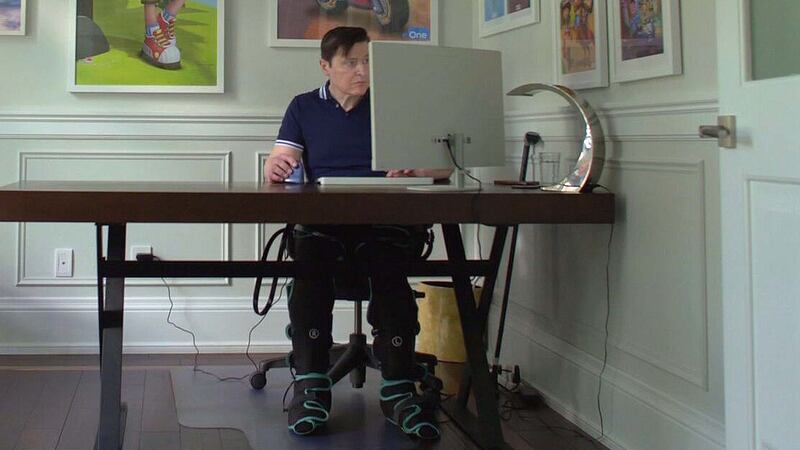
Alexander Bar is an award-winning animator who creates engaging cartoons for kids from behind his desk in Burlington, Ont.
He spends hours forming the plots and the characters in his latest show, “Polly Can Do” — a commitment that would be much more difficult, were it not for a machine that slowly works under that desk.
His legs are wrapped in what looks like a blue, half-body pump that whirs as it creates pressure, pushing blood from his toes to his core – something he can’t trust his body to do anymore.
“Basically, it inflates my feet, my calves, my thighs, and then it will just keep going,” Bar explained in an interview at the desk. “Basically, it’s kind of replicating circulation.”
Bar has multiple sclerosis, or MS. The disease attacks his nerves, so his muscles don’t properly clench to help blood return from his legs.
“It has a huge impact, day by day. I have to be very resilient to push through the pain of doing simple chores that everyone else takes for granted,” Bar said.
He spends a great deal of time at a home gym to make sure his body is in top shape. But MS is a progressive disease, and he knows that even these measures may one day fail him. But he finds a way to stay positive.
“Hope makes you positive, you know. It’s the hope that there will ultimately be a solution,” he said.
One source of hope was offered by a Canadian biotech company, through a drug called Lucid-MS. The company says it has the potential to change the lives of the roughly 90,000 people who live with MS in Canada.
But that drug faced huge barriers in getting to patients — not because of the science, but because of the stock market. The company, Quantum Biopharma, alleges in a $700-million lawsuit it has been the victim of a massive stock manipulation.
It’s a case that raises big questions about the protections that are in place on major exchanges in this country and elsewhere, as regulators battle people looking to profit quickly and anonymously through cutting-edge technological tools.
Bar didn’t know about any of that when he first saw what Lucid-MS could do. It was through a video online, of a mouse whose nerves had been artificially damaged, just like with MS. It was pulling itself using only its forelegs.
“You can see that the hind legs and tail of the mouse are still paralyzed,” intones an announcer in the video.
Then, after 42 days of treatment, the video shows the mouse again – this time, walking around, apparently normally.
“After a couple more days, the mouse appears to recover completely,” the announcer said.
For Bar, it was a revelation.
“It was incredible. It was the Holy Grail. And I thought to myself, ‘I want to be that.’ I’ve never wanted to be a mouse. I never wanted to be a mouse so much in my life when I saw that video,” he said.
The drug he took was called LUCID-MS, from a company called Quantum BioPharma, based in Toronto. And its mouse video got a lot of other people’s attention too.
One of those people was Atul Dhadwal, who lives just east of Toronto and runs a chain restaurant franchise. He put some $300,000 into what would become Quantum BioPharma stock.
“That was one of the reasons we decided to invest more,” Dhadwal said. “It was lots of money for people like me. We invested further because we saw its potential.”
But as Lucid-MS moved through stages of its clinical trials, its stock value seemed to go anywhere but up.
According to Quantum’s documents, by June 2020, as “favourable test results” came in for another drug in its portfolio, its stock price dropped, from $7.39 to $2.76.
As it received regulatory clearance to proceed with clinical trials of Lucid-MS, its stock dropped from $1.84 to $1.56.
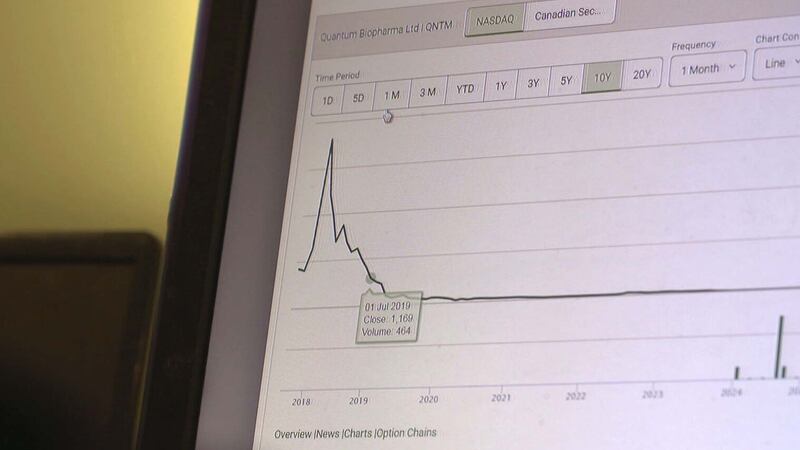
The crash continued, and soon, Dhadwal says, he lost 98 per cent of his investment.
“It just kills you,” he said in an interview. “It buries you 98 per cent down in the Earth. You cannot come back and see the light.”
It’s the kind of loss that affected his health and his relationships, he said.
“You’re just not the same anymore.”
One thing stuck with him: he thought the news was consistently good about Quantum MS and its products. So how could the stock be dropping?
“There appears to be something very wrong,” he said.
Alex Bar had believed in the product so much that he got in touch with the company and joined its board. So he had a front-row seat as the plummeting share price sent the company into a tailspin.
“As a result of that, it means that it’s much harder to raise money. And if they can’t raise money, they can’t do the trials to prove that the research works. And for people like me, that drug will never become accessible to people who need it,” he said.
A situation that the company, Quantum BioPharma, couldn’t accept. Their executives believed there was another reason their stocks were collapsing. They started their own investigation – an investigation that would spark a nearly three-quarter-billion dollar lawsuit.
Tomorrow: How the Canadian Biotech company uncovered signs it says indicates its stock price was manipulated, and the major Canadian institutions it accused of being involved.

