Shareholder confidence in Groupe Dynamite Inc. took a hit Tuesday as the company’s share price plunged almost 36 per cent, despite the retailer recording a significant jump in profit and revenue during its most recent quarter.
The Montreal-based apparel company’s share price closed the trading day down $26.70 to $47.74, after it reduced its net new store openings and missed some analysts’ expectations.
The disappointment didn’t escape CEO Andrew Lutfy.
“I could feel the energy on the line is certainly a little less enthusiastic than prior calls, but I just want to put it out there — listen, I mean we’re delivering on the guidance,” he said as he wrapped a call with analysts.
“As a matter of fact, we’re raising the guidance.”
The outlook he was referring to raised Groupe Dynamite’s expectations for its adjusted earnings before interest, taxes, depreciation and amortization margin to between 38.25 and 39.50 per cent compared with earlier expectations for 37.75 to 39.25 per cent.
But it also dropped the number of net new store openings to between eight and 10, rather than the previously forecast 10 to 12, and was coupled with the closure of two more stores.
“Now to be clear, those two stores were profitable. They simply were not profitable enough to our standards,” Lutfy said. “So we’ve decided to do the right thing for our business and close those two stores a little bit sooner than expected.”
The move will bring the brand’s closures to 16 this year, which he admitted is “certainty on the high side,” but he said the number will decline in the next couple of years.
Chris Li, a Desjardins analyst, pointed out the brand had “modestly lowered” its net new store openings, but he still considered the company’s financial performance recently “a strong start to the year.”
RBC analyst Irene Nattel also categorized the results as “strong,” but said they left some wanting more.
“Markets were generally expecting better-than-forecast results, although concern had recently been creeping in around magnitude of better-than-expected results/momentum,” she wrote in a note to investors.
Groupe Dynamite’s first-quarter profit was $51.7 million or 45 cents per diluted share, up from $27.3 million or 24 cents per diluted share in the same quarter last year.
On an adjusted basis, the company earned 50 cents per diluted share in the period ended May 2, up from 25 cents per diluted share a year ago.
Revenue for the quarter totalled $310.6 million, up from $226.7 million in the same prior-year quarter.
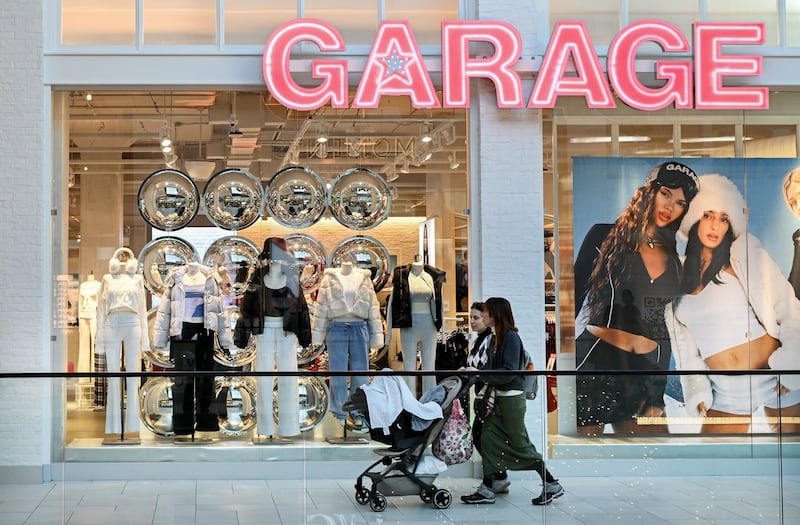
The increases came as customers increasingly scooped up dresses and tops from Dynamite and fleece, activewear, camisoles and bootie shorts from Garage, president and chief operating officer Stacie Beaver said.
“The only category I would say is soft … is denim and there’s just not much new in that category right now,” she said on the same call as Lutfy. “Denim shorts is picking up with the weather, but as a trend, we’re not seeing much in long-leg denim right now.”
Despite the softness in denim, average customers are overall pretty resilient, she argued.
“She’s coming back more. She’s spending more. Her lifetime value is more to us,” Beaver said.
The strength of the brand’s customers is showing up at a time when shoppers have every reason to pare back purchases or become more discerning about price.
That’s because many brands are passing on the cost of U.S. tariffs and the wars in the Middle East and Europe to customers. Others who haven’t been hit yet are raising prices as they brace for the free trade agreement between Canada, the U.S. and Mexico to be renegotiated or scraped altogether this summer.
Meanwhile, Groupe Dynamite has been able to make its historically small markdown rate even lower without angering customers.
“There doesn’t seem to be any pushback in terms of pricing, supply, demand, all that kind of stuff,” Lutfy said.
The top 20 per cent of his company’s customer base is “still seemingly in a good place in terms of disposable income” and the overall shopper is “still in really good shape,” he said.
---
Tara Deschamps, The Canadian Press
This report by The Canadian Press was first published June 16, 2026.

