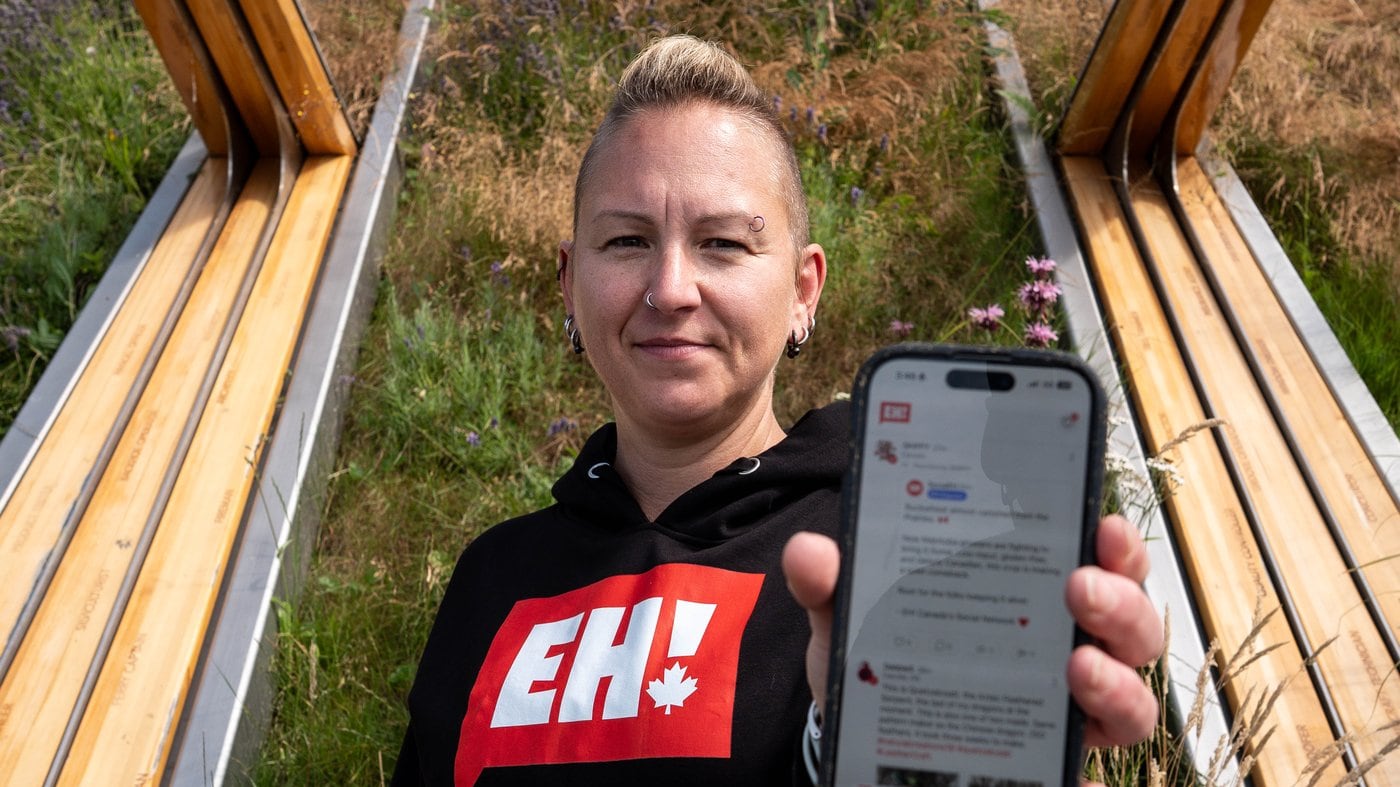
When U.S. President Donald Trump began his second term and mused publicly about making Canada the 51st state, it inadvertently became a call to action for Jessica Glowacki and Ben Waldman.
Amid the presidential barbs, the entrepreneurs each realized there was something lacking from the many available social media platforms — Canadian values.
Most social networks Canadians use are U.S.-owned or run on American infrastructure.
“With all the executive orders that (Trump) was signing in rapid succession, it became clear that with a stroke of a pen Canada could literally be shut down overnight,” Waldman said.
“Would that happen? Probably not but the possibility was there ... and so was the realization that our reliance on U.S. tech had to change.”
Independently of one another, Parksville, B.C., program manager Glowacki founded social network Eh! and Ottawa creative director Waldman developed competitor Gander. While each has its own idiosyncrasies, the mission is much the same: give locals a more patriotic alternative to household names like TikTok, Instagram and Facebook.
The rookie sites are under no illusion that they’ll overtake their more established rivals, but they say that doesn’t mean Canadian platforms aren’t worth building and nurturing.
“It’s really important for me to protect our culture and our diversity and all that sort of stuff,” said Glowacki, whose platform has 31,000 users who have been sharing news, photos and thoughts since last August.
“Allowing people to have their own space to talk to other Canadians without being drowned out by U.S. platforms really gives Canadians a space to be seen.”
It also offers a layer of protection.
That’s because Eh! and Gander are both striving to make their platforms sovereign. That means the platform runs on Canadian infrastructure, user data is stored domestically and in compliance with local privacy laws. (Most other platforms are run by U.S. tech giants and sometimes out of reach of Canadian regulators.)
In the case of Gander, the platform says it does “everything we can to avoid collecting personal information in the first place.” When it does collect personal info, like email addresses and phone numbers that facilitate logins, it doesn’t make it available for sale. If you request the data be deleted, it will, only holding onto the information if the law requires.
All users — there are nearly 30,000 right now — also go through a process using Canada Post or institutional emails to verify they’re human adults and not bots, bad actors or kids.
Its moderation policies are shaped by the Canadian Charter of Rights and Freedoms, so users can express themselves but are banned from posting any content that attacks communities, glorifies hatred, denies the Holocaust or harasses people because of their bodies, political affiliations, socio-economic status or mental health. Algorithms are also built to prioritize conversation over clicks.
Meanwhile, Eh! is working to source Canadian alternatives to Amazon’s cloud computing services to run the platform. It also won’t go the usual route of drumming up cash by peppering the main feed with ads but is toying with ways to allow some local marketing, Glowacki said.
While Richard Lachman, a professor at Toronto Metropolitan University’s Radio and Television Arts School of Media, applauded the efforts to build Big Tech alternatives and introduce more competition to the market, he’s skeptical that their promises will endure.
He pointed to Google, which used the motto “don’t be evil” in its early days.
“Google today does not have the same moral stance because there was more money to be made and the investors wanted to recoup, so I would worry about the model,” he said.
Eh! is so far bootstrapping — tech lingo for self-funding the business — but intends to raise money in the fall. It also envisions launching in other countries.
Gander went looking for cash from the federal government and venture capitalists, but neither worked out.
Government funding didn’t suit their project and venture capitalists were turned off because it’s unlikely to be a quick exit for them, Waldman said. It also parted ways with one-time supporter “Dragon’s Den” star Arlene Dickinson.
Instead, Gander drummed up $140,000 from friends and family before raising $2 million from 2,500 Canadians, who will receive shares.
It’s still settling on a funding model but has allowed internet provider TekSavvy and CBC show “Murdoch Mysteries” to sponsor feeds. In the future, it may offer paid subscriptions to users who want more features like higher quality video.
Regardless of where their money ultimately comes from, both companies are “facing an uphill battle,” Lachman said.
They’ll have to convince people hooked on incumbent platforms to give theirs a try and will likely realize all their data sovereignty promises don’t mean as much to people as they think, he said.
“People who care a lot about privacy think about things like that. Most people don’t,” he explained.
Even if they do care, Canada has a much smaller potential audience of 41.5 million people. The U.S. has 342.7 million.
“We live in a world where there can be upsets, and they can achieve dominance, but it’s rare. Our market’s not the same size,” Lachman said.
“You can be as Canadian as you want ... but it’s still got to be a business, you’ve still got to get people there, you’ve still got to pay for services, you’ve still got to try and do marketing deals.”
Glowacki isn’t intimidated by the wealth and audience of incumbents nor more local rivals.
“Competition is always healthy,” Glowacki said. “It allows us to just compete against each other and learn from each other ... so I think there’s room for all.”
This report by The Canadian Press was first published July 20, 2026.
Tara Deschamps, The Canadian Press

