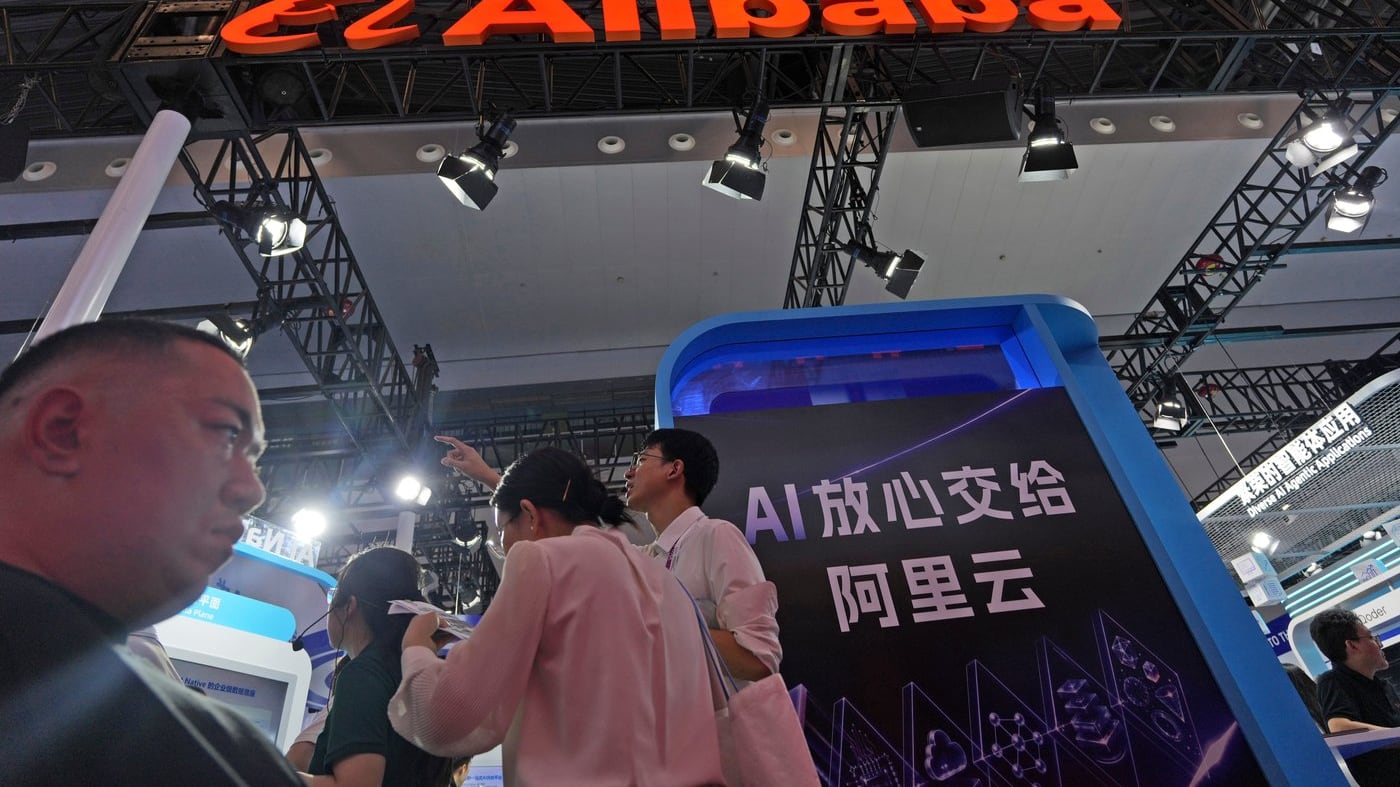
China’s Alibaba shares slumped in Hong Kong trade on Monday after it launched a US$10.2 billion share sale at a steep discount to fund its AI ambitions, with investors focused on stock dilution and execution risks.
The e-commerce and cloud computing giant said it would sell HKUS$80 billion (US$10.2 billion) of new shares at HKUS$112.70 each, an 8.4 per cent discount to Friday’s close, to fund chips, AI infrastructure and models.
AI has become Alibaba’s biggest driver of revenue growth at a time when e-commerce growth is stagnating, and its Qwen AI models are some of the most popular in China. Even so, some investors have reservations about how successful it will be.
“Alibaba’s DNA is in e-commerce, not advanced tech,” said Yang Tingwu, vice general manager of asset manager Tongheng Investment.
“No matter how much it invests in AI hardware, it will likely be outmaneuvered by competitors in tech innovation.”
Its Hong Kong shares fell as much as 10.5 per cent but pared losses in the afternoon to trade in line with the discount offered.
The sale of 710 million ordinary shares is equivalent to 3.6 per cent of enlarged total shares outstanding.
It drew strong demand, attracting US$28 billion of orders, including US$6 billion from long-only and sovereign investors, three people with knowledge of the matter said.
About 40 per cent of the book will go to long-only and sovereign investors, including major sovereign wealth funds in Europe, Asia and the Middle East, two of the people said.
Investors included the Qatar Investment Authority (QIA), Norway’s Norges wealth fund and Hillhouse, according to one person.
Alibaba, Hillhouse, QIA and Norges did not immediately respond to requests for comment.
Alibaba chairman Joe Tsai bought 720,000 Hong Kong shares at an average price of HKUS$112 apiece, for about HKUS$80 million in aggregate, while Eddie Wu, the group’s chief executive, bought 350,000 Hong Kong shares at an average price of HKUS$111.6 per share, totalling HKUS$40 million, according to the group’s stock exchange disclosures later on Monday.
CHINESE AI INVESTMENT STILL SMALL BY COMPARISON
As the U.S. and China vie for tech supremacy, investment in AI and related infrastructure such as data centers has reached dizzying heights.
The biggest Chinese AI names are, however, investing only a fraction of what their U.S. counterparts are spending. Most fundraising globally is also conducted via heavy debt issuance — a trend that has begun to test the limits of investor demand. Japan’s SoftBank on Monday announced it would issue US$6.3 billion in bonds to retail investors — its biggest debt offering to date.
Alibaba’s stock sale is the largest-ever follow-on offering of new shares by a Hong Kong-listed company and the third-largest globally this year after offerings of nearly US$85 billion from AlphabetGOOGL.O and US$20 billion from IntelINTC.O.
“Alibaba’s placement — landing alongside massive capital raises by Alphabet and Intel in the U.S. — proves that American and Chinese tech giants are operating off the exact same strategic playbook,” said Winston Ma, an adjunct professor at NYU School of Law and former head of North America for sovereign wealth fund China Investment Corp.
“The global sovereign investors aren’t blind to U.S.-China tech friction — they are compartmentalizing it,” Ma said, adding that they were more comfortable with compliance issues when investing in Chinese commercial cloud and open-weight AI plays over restricted semiconductor hardware.
Capital Group, one of the world’s largest active investment managers, estimates that AI-related capital expenditure by the biggest U.S. hyperscalers — Microsoft MSFT.O, Amazon AMZN.O, Alphabet, Meta META.O and Oracle ORCL.N — reached US$791 billion as of July 31. That compares with US$118 billion for China’s ByteDance, Alibaba, Tencent 0700.HK and Baidu 9888.HK.
CHINESE FIRMS BECOME NIMBLER WITHOUT NVIDIA
Part of the reason for the more subdued Chinese spending has been a lack of access to Nvidia’s NVDA.O most advanced AI chips due to U.S. export controls. That in turn has pushed Chinese firms to develop more efficient AI models and infrastructure that require less computing power and capital.
The share placement comes a week after Alibaba reported quarterly net profit that tumbled 75 per cent from a year earlier, primarily due to AI-related spending.
Underscoring how AI has leapt to become a key priority, Alibaba this year separated its AI operations from its cloud business, with the new unit to be led by CEO Eddie Wu.
In addition to positioning itself as a key AI partner for companies operating in China, it is preparing a listing of its chipmaking arm T-Head and developing AI agents linking services across its sprawling ecosystem, including shopping, food delivery, travel and entertainment.
Separately, Alibaba has helped train a large language model that Apple AAPL.Owill sell in the Chinese market, sources have said.
At earnings, Alibaba said it had committed nearly half of its three-year capital expenditure plan of 380 billion yuan (US$56.5 billion), but that AI computing investments have a “high certainty” of returns.
Wu said such investments are expected to break even within three years, possibly even 2.5 years, as margins improve and proprietary chips replace third-party hardware.
(Reporting by Kane Wu in Hong Kong, Casey Hall and Yiming Shen in Shanghai. Additional reporting by Sherin Sunny in Bengaluru and Federico Maccioni in Dubai. Editing by Christopher Cushing, Miyoung Kim, Edwina Gibbs and Mark Potter)

