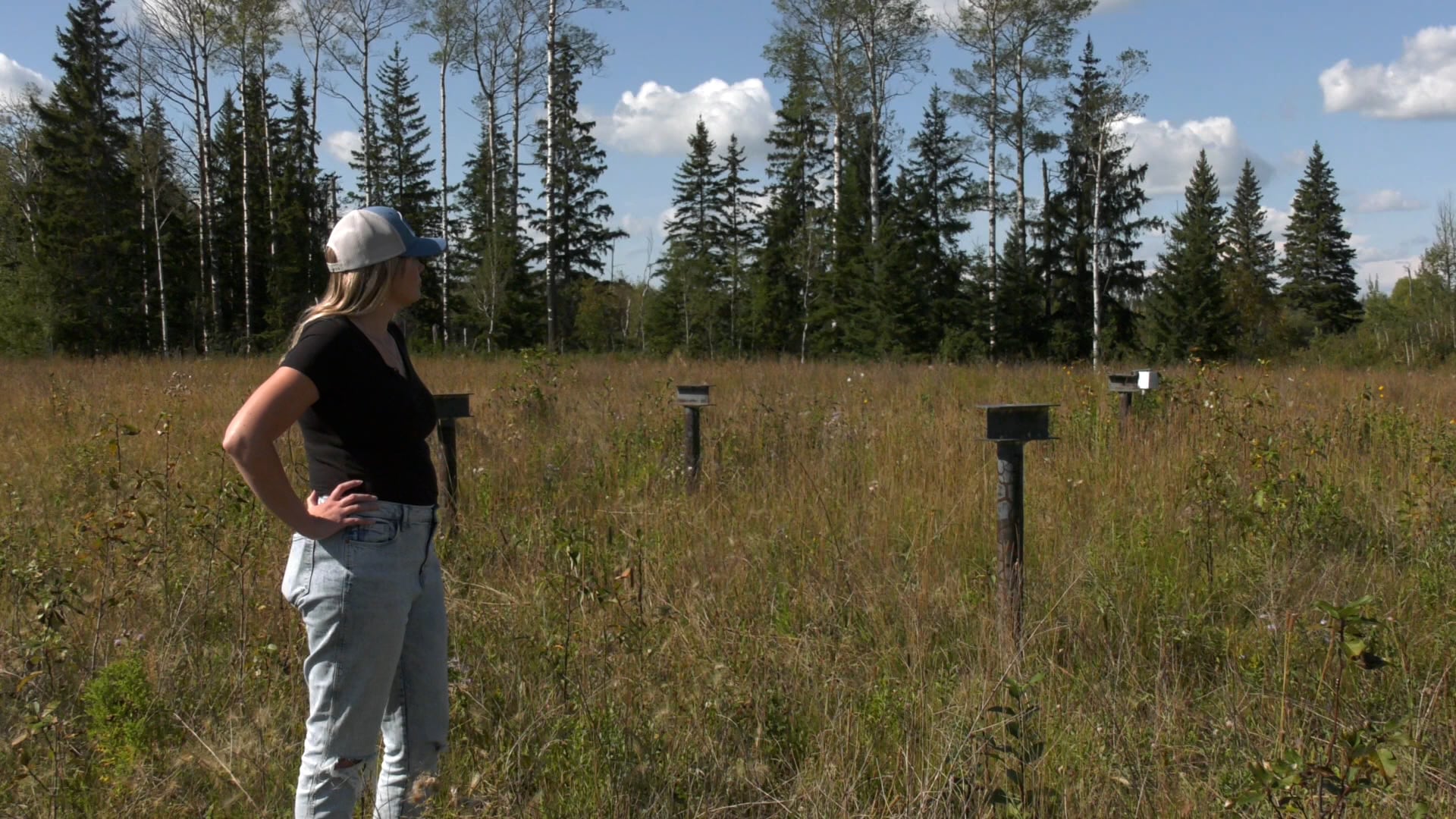
PONOKA COUNTY, Alta. - On more than 37 acres of central Alberta countryside dotted with ponds and wildlife, about two dozen steel pilings jut out of the ground — remnants of an orphan oil and gas site Amanda Kamps has been waiting years to see fully cleaned up.
Kamps bought the property seven years ago. Three months later, the company responsible for the site went under, she said.
“It has been a struggle basically the whole time that I’ve lived here,” Kamps said.
When an oil and gas site no longer has a financially viable company responsible for it, the Alberta Energy Regulator can designate it an orphan. The Orphan Well Association is then responsible for decommissioning and reclaiming the site and it is funded almost entirely by industry, primarily through an annual levy set by the regulator.
Kamps said her site was designated an orphan about three or four years ago, but she has received few updates about when the remaining work will be finished.
“I received a letter earlier this year saying that they were going to complete everything this spring or summer,” she said. “We’re going into fall now, and I haven’t heard anything else. So it’s really just a waiting game.”
Group takes regulator to court
Kamps’ experience comes as a group of Alberta landowners and organizations takes the regulator to court over how that system is funded.
The group has filed an application for judicial review in Alberta Court of King’s Bench, alleging the regulator has failed to adequately fund the system and has not followed requirements under the Oil and Gas Conservation Act when setting the annual orphan fund levy.
Dwight Popowich, a landowner from Two Hills, Alta., is one of the applicants. He said an orphan well remained on his property for eight years before it was cleaned up.
“We had a well sitting on our land that nobody was really responsible for,” Popowich said. “And every one of these wells have safety issues.”
The Orphan Well Association currently has more than 7,300 wells in its inventory. Its 2025-26 annual report estimates the cost of addressing its entire orphan inventory, which also includes pipelines and facilities, at about $1.66 billion.
For 2026-27, the orphan fund levy is $154.56 million, up from $144.45 million the previous year.
The applicants argue that increase has not kept pace with the growing number of orphan sites.
“The levy is far too low compared to what the inventory is that’s been coming in,” Popowich said. “This last year the inventory actually doubled while the levy only went up seven per cent.”
“This fund should never, ever be short,” he added. “It is the safety net for landowners and taxpayers so we don’t have to end up paying for these bankrupt producers.”
Ecojustice lawyer Susanne Calabrese, who represents the applicants, argues the regulator is required to set the levy based on the needs of the orphan fund.
“The law says that they are the only ones who should set this levy and that they should apply a needs-based formula,” Calabrese said. “They need to cover all of the costs, the operating costs for orphans for the year, any shortfall through the previous year, and that’s not what’s been happening.”
The Alberta Energy Regulator declined to comment on the court case.
It said the levy was increased this year to help the Orphan Well Association address the growing number of orphan sites and that the association’s work is “funded almost entirely by industry.”
Since beginning operations in 2002, the association has decommissioned more than 8,900 wells and received more than 4,100 reclamation certificates, according to the regulator.
Calabrese argues taxpayers have borne some of the costs associated with orphan sites.
“$330 million has been given in taxpayer funds, interest-free loans and grants to the Orphan Well Association,” she said.
“There’s many other ways that taxpayers have had to pay because of this shortfall,” Calabrese said, pointing to $150 million in surface lease payments and what she described as a $250-million shortfall in municipal taxes.
The applicants fear that without enough money in the industry-funded system, taxpayers could ultimately be left covering more of the cost of dealing with orphan sites.
‘Rapidly growing problem’
Mark Dorin of the Polluter Pay Federation says the growing inventory makes addressing the problem increasingly urgent.
“It’s a rapidly growing problem,” Dorin said. “We don’t get a handle on it, Alberta has no future financially or environmentally. It’s that simple.”
Kamps shares the concern that taxpayers could ultimately be left with more of the bill.
“I don’t know why it’s our responsibility as taxpayers to pick up the slack when these companies are making money hand over fist, but can’t pay the cleanup bill,” she said.
University of Calgary law Prof. Shaun Fluker says the current orphan well problem is the result of regulatory and policy decisions made over many years.
“It’s one of the biggest public policy failures in the history of this province,” Fluker said.
“I squarely point the finger at successive governments in Alberta that failed to address this problem when it was small enough that it could be dealt with without the magnitude of the work that needs to be done now.”
Fluker also criticized the Alberta Energy Regulator for allowing financially weak companies to accumulate oil and gas assets that later became liabilities when those companies became insolvent.
The Alberta government says it has made addressing orphan wells and aging oil and gas infrastructure a priority.
In an email to CTV News the Ministry of Energy and Minerals said the current orphan well levy is more than three times the approximately $45 million collected in 2019 and is reviewed annually.
It also pointed to Alberta’s Liability Management Framework, which requires the energy industry to spend at least $750 million annually to decommission and reclaim aging wells and infrastructure.
Large portion of land unusable
Back on Kamps’ property, some work has been completed, but she says a large portion of her land remains unusable.
“There’s a pipeline under here potentially. So I could never build on this property. I could never dig a well,” she said. “It makes it hard for having livestock here as well, which I would like to do eventually.”
She also worries about what may have been left behind.
“How am I supposed to trust that it’s been done properly and that things are actually capped and there’s nothing that’s going to harm the environment around here?” Kamps said.
“How do I know that it’s not poisoning something so close to my home and so close to other people’s homes and animals?”
Dorin said landowners may not have the expertise to recognize potential hazards associated with orphan sites.
“Landowners don’t know the nature — they don’t know how to identify these risks for the most part, because they’re not trained,” Dorin said.
Kamps said shesupports the court challenge and says she wants greater accountability from both industry and the provincial system responsible for overseeing cleanup.
“Landowners, they want accountability. They want their land back. They want their property rights back,” she said.
The Orphan Well Association declined to comment because the matter is before the courts.

