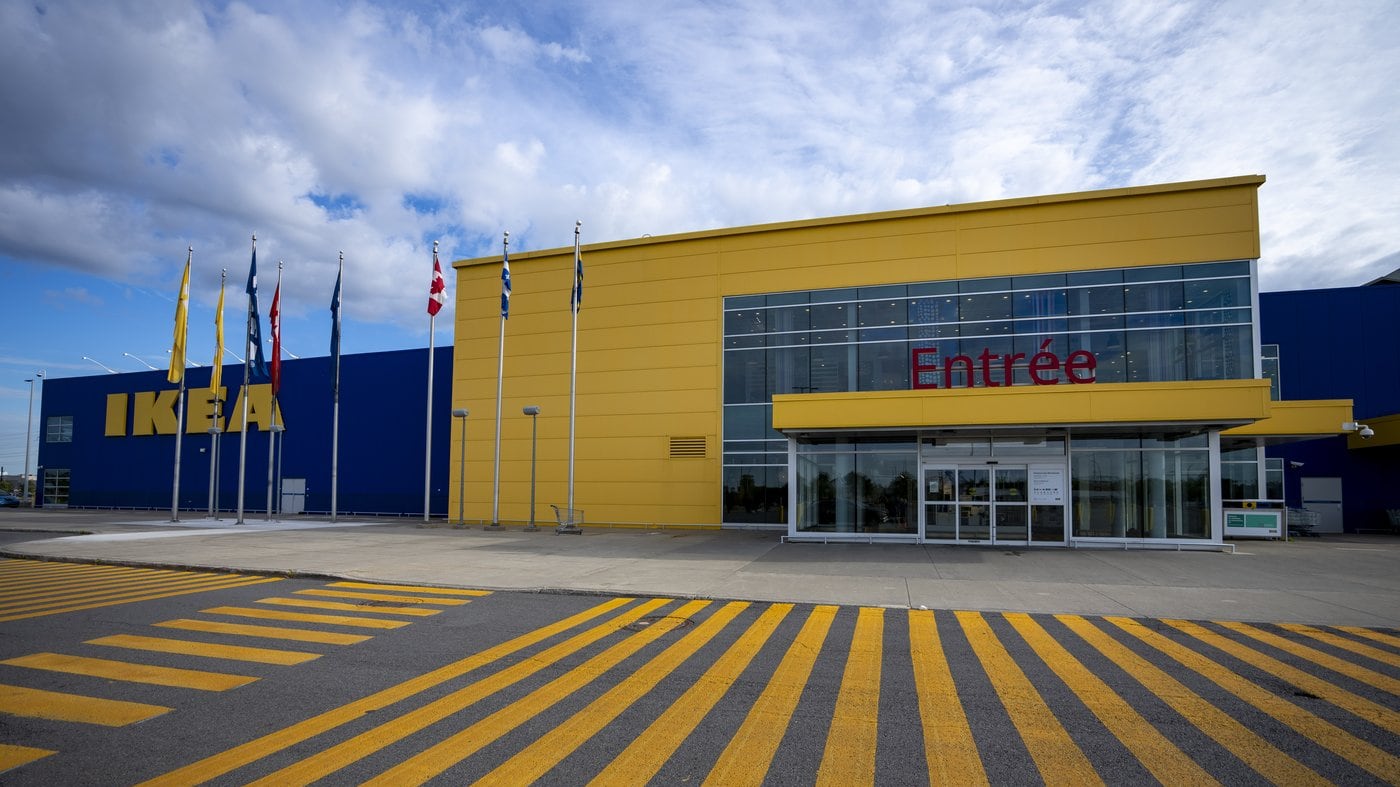
From second-hand Billy bookcases to cheaper meals, Ikea is leaning into its low-cost roots as cash-strapped Canadians look for more affordable ways to furnish their homes and feed their families.
The Swedish retailer says it’s doubling down on affordability by expanding its used-furniture business, keeping restaurant prices low and wringing savings from sustainable product design and supply chain efficiencies.
Two of Ikea’s top executives sat down with The Canadian Press to discuss how the retailer is trying to deliver more value as Canadians grapple with high costs for housing, food and other expenses.
Ikea Canada chief executive and chief sustainability officer Selwyn Crittendon said the retailer’s sell-back program, which gives customers store credit for gently used Ikea furniture that is then resold, is growing quickly.
The retailer is pushing for sales taxes on second-hand furniture to be eliminated in Canada, arguing it would encourage consumers to reuse and repair goods rather than send them to landfill.
“These goods are well loved, they’re well used and they probably have a couple blemishes,” Crittendon said. “Why do you also pay a second-hand tax on that good?”
The used furniture program is part of Ikea’s broader focus on so-called circularity, which includes the store’s as-is marketplace and developing products with more sustainable and recycled materials.
Juvencio Maeztu, president and chief executive of the Ingka Group, the largest global franchisee and operator of Ikea stores, says that stable, low prices remain at the core of the business.
“We don’t like these yo-yo prices based on an offer here and there,” he said. “We want to have as much as possible everyday low prices.”
In many markets, consumers are spending 40 to 50 per cent of their salaries on housing, with many people living in smaller homes or shared living situations, Maeztu said
However, just because people might not have a lot of money doesn’t mean they only want to buy cheap things, he said.
“You want things to be long-lasting,” Maeztu said. “You want to squeeze the value out of the money you have in order to have a better life at home.”
Ikea’s products are built around five dimensions: design, functionality, quality, sustainability and low price, Maeztu said.
“It’s not low price at any cost,” he said.
As household budgets are squeezed by high living costs, Ikea appears to be refocusing on its budget-friendly origins, built on flat-pack furniture and minimalist Scandinavian design.
“We sell umbrellas and we like — and we love — to reduce the price of the umbrella when it’s raining because this is when people need it the most,” Maeztu said.
Recent financial results show Ikea is bringing more shoppers into the store even as overall sales decline.
In Canada, retail sales fell 2.5 per cent last year while store visits rose 1.6 per cent and online traffic jumped 11.2 per cent. Globally, Ikea sales grew 2.6 per cent as retail sales slipped one per cent.
“Success is not made on revenue growth,” Maeztu said. “It’s also made on how many homes have Ikea products because this is a way that we can ... support a better life at home.”
Ikea opened its first store in Canada almost 50 years ago, on Oct. 2, 1976, in Richmond, B.C.
In the run up to its 50th anniversary, the retailer has introduced offers such as $1-breakfast.
Indeed, the restaurant appears to be a key draw as Canadians grapple with ongoing cost of living concerns.
“A family of four today can still shop at Ikea and for under $30 eat in our restaurant,” Crittendon said. “If you haven’t tried the new plant balls or the plant dog, come join us.”
This report by The Canadian Press was first published Sept. 18, 2026.
Brett Bundale, The Canadian Press

