PORT HARDY, B.C. -- Millions more of a species of salmon are returning to spawn up the Fraser River on Canada’s West Coast, but exactly why remains hotly disputed, and the answer could have major implications for wild salmon stocks and coastal communities.
Some First Nations, in concert with environmental groups, have attributed this surge to the shutdown of dozens of salmon farms and are urging the federal government to enact a promised ban of the remainder of those farms by 2029.
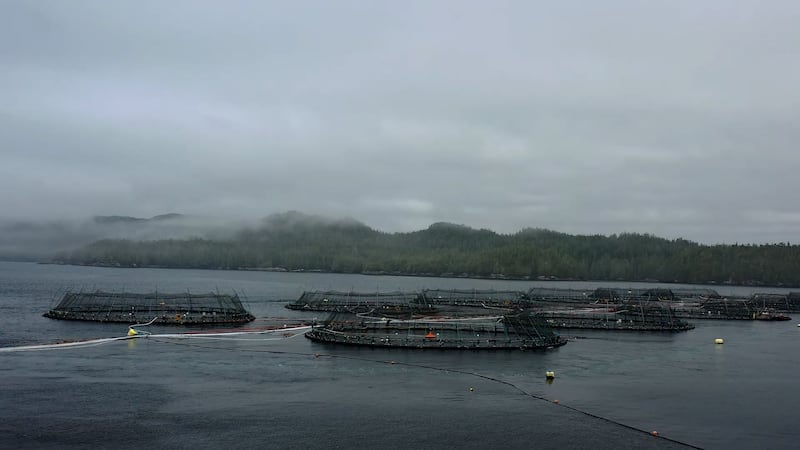
But a W5 investigation has revealed a confidential internal assessment where federal government scientists say salmon farming operations pose a “minimal risk” to wild stocks and recommended reopening some of them, as the government itself is not outwardly committing to that ban.
“Farm presence (or absence) is only one of many variables, and current evidence does not demonstrate a causal link,” the Department of Fisheries and Oceans (DFO) said in a statement to W5, as another scientist suggested that surging salmon species, the pink salmon, may simply be doing better than other species in warming oceans.
A lot hinges on getting the science right: coastal communities are bracing for the impact of more salmon farm closures that could shed hundreds more jobs in what was once a billion-dollar industry, affect a valued way of life for First Nations, and change what Canadian consumers put on their plates.
The Discovery Islands: a pink salmon surge
Aboard his motorboat in the waters off the Discovery Islands, about 200 km northwest of Vancouver between Vancouver Island and the B.C. mainland, researcher Jody Erickson says he has noticed something incredible.
A seine net dropped from his motorboat can catch hundreds of young salmon smolts at a time, and Erickson draws up a few of them in a clear plastic case to see several different species: pink, chum and Chinook.
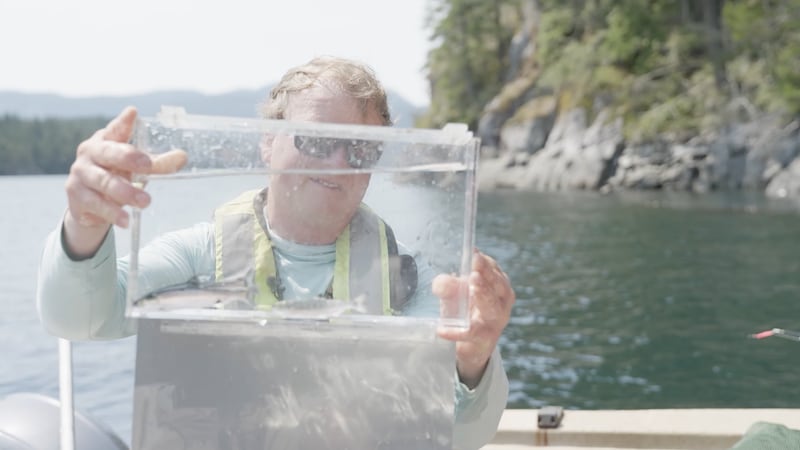
“What I would call very happy and healthy-looking fish right now,” he said. “No lice.”
It’s a far cry from what Erickson says he used to see in these waters a decade ago: juvenile salmon laden with parasites sticking to their skin, Erickson said. He still carries with him samples from those days that show small fish pockmarked with the parasites.
“They’re dying near fish farms. That’s what I see,” he said.
The Discovery Islands are a crucial thoroughfare for young salmon, who breed far up the freshwater rivers on B.C.’s coast, including the Fraser River, and then swim through these waters, around Vancouver Island, before making it out to sea.
Those islands, and the salmon farms that used to be there, were singled out by the Cohen Commission, a judicial inquiry that was called in 2009 after a salmon stock collapse.
Cohen pointed to many stressors that could affect the health of B.C. salmon, including warming waters, and recommended closing salmon farms in the Discovery Islands unless the federal fisheries minister is satisfied those farms pose at most a minimal risk to migrating sockeye salmon.
In 2019, the federal government followed through, refusing dozens of licences around the Discovery Islands, and then from the nearby Broughton Archipelago as a precaution. About half of all B.C. salmon farms are now gone.
A study by the Salmon Coast Field Station concluded that numbers of one species of lice dropped in the area once the salmon farms were removed, which could mean more salmon survive the long journey out to sea, said Research Crew Lead Kate Medcalf.
“As they out-migrate in these small sizes, they’re incredibly, incredibly vulnerable to parasitism and other stressors in the environment,” Medcalf said.
Erickson believes he is seeing the results of having fewer lice in the strait now.
“It’s very hopeful, because it shows that if we remove the fish farms, the fish can come back, really, really remarkably fast, faster than even I would have thought,” Erickson said.
Shuttered farms: the human cost
Nearby where Erickson cast his nets are what remains of several salmon farming operations. Some of them have been converted to other uses, while some have left no trace.
Those shutdowns meant lost jobs, and a narrowed future for the workers who hoped to launch long-term careers, said Kaitlin Guitard, a lab manager for one farm company, Mowi Canada West.
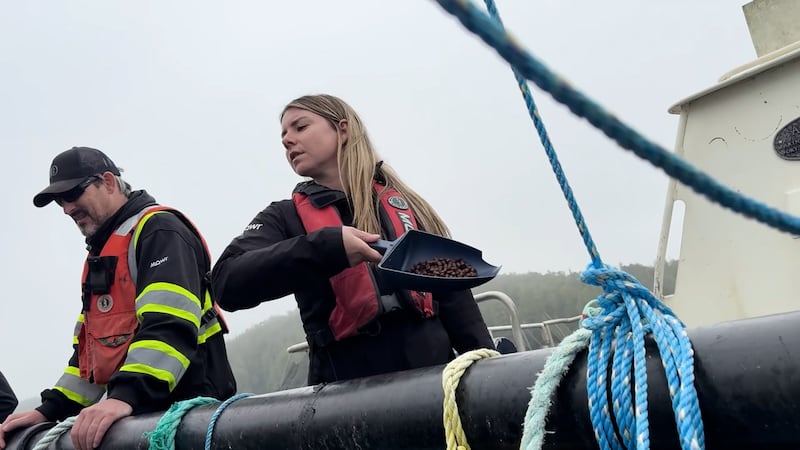
In an interview on the dock of one of the remaining farms, in the Queen Charlotte Strait near Port Hardy, she said she has lost hundreds of co-workers.
“It’s awful, it really is,” Guitard said. “I was relocated. But I think the hardest part for me was a lot of people that I worked with had either been laid off or could not wait around for certainty and had left.”
Guitard is among those fighting for the future of these farms, saying Canada needs the jobs and the food those farms produced.
Mowi Canada West’s production dropped from 40,000 tonnes a year, before the farms started to be removed in 2019, to 20,000 tonnes a year.
“The impact has been fairly devastating to the industry. We’ve lost 45 per cent of our production,” said Brian Kingzett, of the B.C. Salmon Farmers Association.
Kingzett says he’s aware that some farms have lice outbreaks, and that they do their best to manage them. But he doesn’t buy the connection drawn by researchers between his farms and the salmon collapse.
“We’ve had nine significant studies that have all identified that we can coexist with wild salmon, and we are continuing to innovate to further reduce any potential risks,” he said.
Rising numbers for salmon species; others are falling
Kingzett points to tracking by the Pacific Salmon Commission, a regulatory body run jointly by the Canadian and United States governments.
They use underwater sound waves and sonar to estimate the number of salmon passing the Mission hydroacoustic station in Mission, B.C., as they head up the Fraser River.
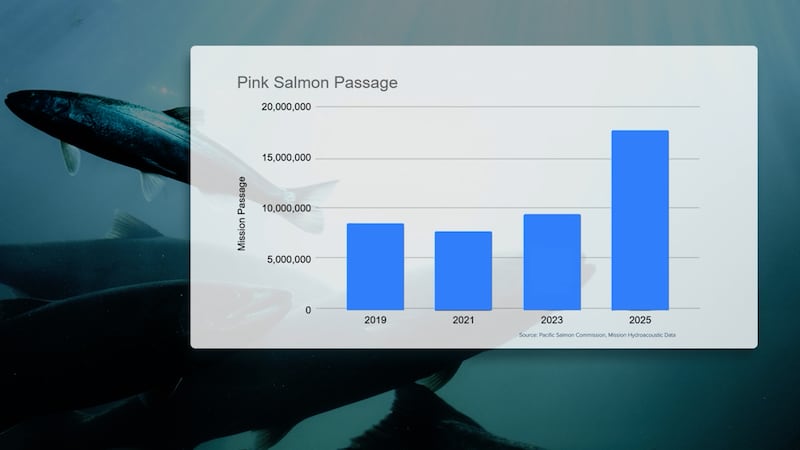
According to the commission figures, the number of pink salmon, which has a two-year life cycle, has doubled since 2019, from about 8.5 million to 17.7 million in 2025.
But the picture for another species of salmon, which has a four-year life cycle, is much less clear.
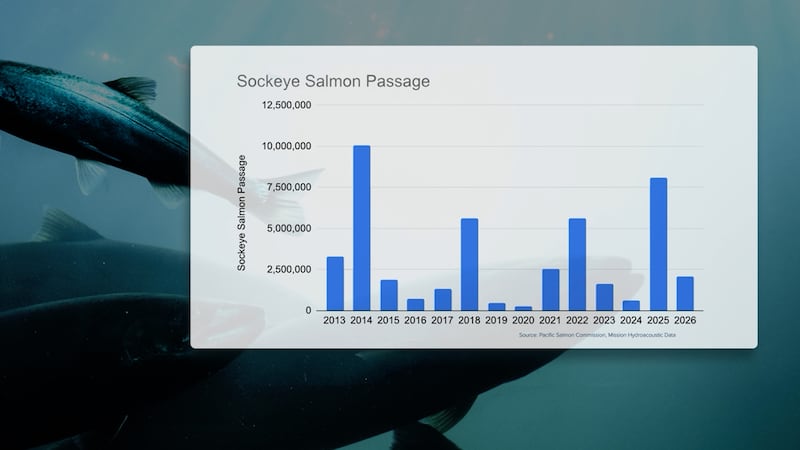
Promising returns of 8.1 million sockeye passing its station in 2025 were followed by disappointing returns under 3 million in 2026.
That figure was lower than 2022, when the Discovery Islands farms had been removed, and lower than in 2018 and 2014, when all the salmon farms were operating.
The DFO also monitors salmon escapement numbers by region along the coast. In region 13, which includes the Discovery Islands, coho and pink salmon are increasing, but chinook and sockeye salmon are not.
The connection between salmon farms and the health of wild stocks was also doubted by the DFO, which advised the fisheries minister in 2023 that its preferred option was to re-licence all 15 salmon farms in the Discovery Islands.
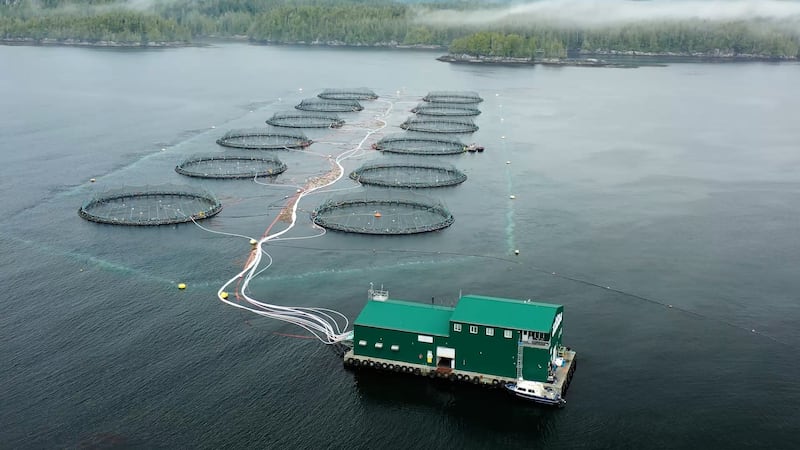
“Current Departmental science advice includes nine risk assessments that were completed specifically to advise the Department on the issue of licencing in the Discovery Islands, found that pathogen transmission from Atlantic salmon farms in the Discovery Islands poses minimal risk to Fraser River sockeye salmon population abundance and diversity under existing fish health management practices,” the department wrote.
The licenses were not re-issued. In 2024, the federal government proposed a draft transition plan that would ban open net pen salmon farming by 2029.
However, there has been no final transition plan released since.
In response to questions from CTV News about whether the federal government plans to follow through with the 2029 ban, a statement from Fisheries Minister Joanne Thompson didn’t mention it.
“Pacific salmon are iconic to the West Coast and protecting and rebuilding wild salmon populations is a priority for our government,” the statement said, pointing to investments the government has made in three new salmon hatcheries, and consultation with stakeholders in B.C. this summer.
“There is no single solution to the challenges facing wild Pacific salmon, which is why we are taking a comprehensive approach to protecting and rebuilding these stocks,” she said.
Another school of thought
In his home in Nanaimo, B.C., retired fish scientist and winner of the Order of Canada Dick Beamish is convinced the answer to the mystery of the salmon returns lies farther out in the Pacific Ocean.
He points to studies that show pink salmon are surging not just in B.C. but worldwide, because they are better able to handle warming ocean temperatures.
“There will be populations in the north Pacific that are adapting to the ocean warming conditions better than others,” Beamish said in an interview.
Some species are coming back from their time in the ocean much smaller, on average, than in previous years, he said.
“What is probably happening with the warming that we’re seeing in the ocean is that there’s less food being produced that’s allowing salmon to accumulate the energy that they need to survive ocean winters,” Beamish said.
“That’s just a hypothesis. What we really need is scientific studies that are going to take a look at how this ocean warming is changing the overall food availability for salmon once they get into the open ocean,” he said.
Raising salmon on land?
Environmental groups are convinced that salmon farms are a threat and are pushing for alternatives to raise salmon on land.
In Port McNeill, in a cavernous warehouse only about a kilometre from where the Nimpkish River flows into the Queen Charlotte Strait, there are fish who will never see the ocean at all.
They’re grown in large circular tanks in a facility called Kuterra, built by the Namgis First Nation in 2013 for $10 million as a demonstration project to prove that a land-based aquaculture industry is possible in B.C.
More than 10 years in, the project is still going, with some changes. The facility used to produce salmon but has found it’s easier to produce trout, said Chief Don Svanvik of the Namgis First Nation.
“It’s incredible. It’s a big investment,” Svanvik said in an interview in Port McNeill. “But it’s happening. If it was easy, everybody would be doing it.”
A study commissioned by the B.C. government in 2021 found that the experience of Kuterra may be hard to replicate, warning of high capital costs, difficulty obtaining power, and regulatory uncertainty.
“The results are not promising,” said the report, by Counterpoint Consulting, saying the estimated rate of return is too low at 8.7 per cent for a large farm and 5.8 per cent for a medium-sized farm.
“Those rates of return are far too low to attract the investment required to incentivize the development of a recirculating aquaculture system (RAS) salmon farming industry in British Columbia,” the report said.
“We have concluded from our research and analysis that RAS development in BC is possible, but at smaller scales and not in isolation from the larger aquaculture sector currently operating in BC,” the report said.
Tony Allard, a businessman who is the chair of the environmental group Wild First, admits land-based farms can be “capital-intensive.”
But he said there are other advantages, pointing to another land-based farm near Tokyo, which he said saves on transportation costs because it’s right next to its market.
Allard said that there is investor interest in making these work, especially if the open net pen farming is shut down.
“It has proved the concept. It’s grown fish, and it’s sold them at a premium,” he said in an interview.
“And that’s where the growth of this industry is. So, keep the ban, no half-measures, and let’s grow this industry safely, sustainably, on land,” he said.
Imports filling the gaps
Canadian consumers may not be waiting around as foreign fish farms have rushed in to fill the gaps left by shuttered West Coast fish farms.
One major grocery chain, Loblaws, told CTV News in a statement that it sources salmon from a variety of Canadian and international suppliers, and prices vary based on a number of factors.

“Reduced domestic supply in recent years has meant we are relying more on imported salmon; however, Canadian salmon remains an important part of our assortment, and we will continue to source domestically where supply and market conditions allow,” the statement said.
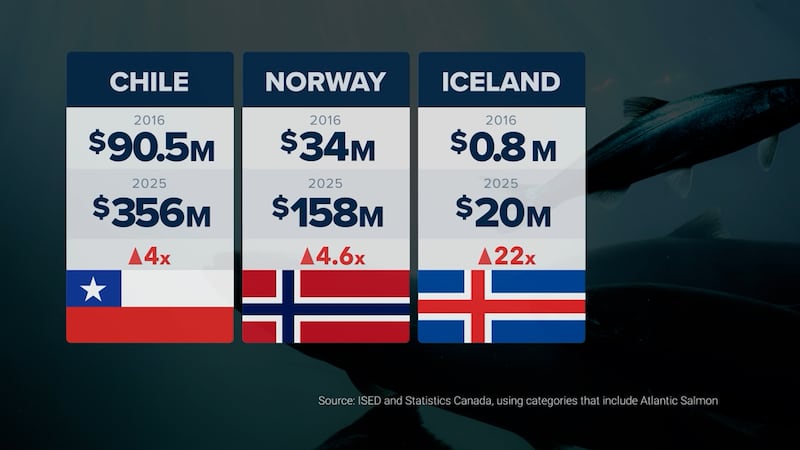
In 2016, Canada imported about $90.5 million in fish categories including Atlantic salmon, according to Innovation, Science and Economic Development Canada and Statistics Canada. That number quadrupled to $356 million in 2025.
It was a similar surge from Norway, whose exports to Canada rose from $34 million to $158 million.
And Iceland’s exports surged 22 times, from $0.8 million to $20 million in the same time period.
“I think that’s a challenge for Canadians to wake up and turn around and look and say, is this something that we want? Do we want to import fish?” asked Richard Opala, a regulatory affairs manager at Mowi Canada West.
“Well, we can grow it here. Do we want to support jobs in other countries when we don’t have them here?” he said.
But critics of the fish farm industry say that Canadian wild stocks could be better protected if Canadians order from farms in ecosystems without competing salmon.
“The stakes are higher here than they are in Norway, where there are no longer any commercial fisheries,” said Kristi Miller, a scientist who used to work with the Canadian Department of Fisheries and Oceans.
“It’s different here in British Columbia, because we still have large, abundant populations of wild fish. We still have commercial fisheries. We still have recreational fisheries, we still have Indigenous fisheries,” she said.
Coastal community worries
Some First Nations groups are concerned enough about the potential impact of salmon farms they are calling for the eviction of remaining salmon farms near Port Hardy.
“What wild salmon mean to First Nations all across the province is beyond valuation. It contributes to food security across the province. It is the basis of our culture and traditions. And is not an item we wish to see impacted while others make profits,” said Bob Chamberlin, chair of the First Nations Wild Salmon Alliance, at a news conference this month on Parliament Hill.
In Port Hardy, on northern Vancouver Island, Mayor Patricia Corbett-Labatt is concerned about what losing the remaining salmon farms would mean for her community.
“We are a fishing, logging, mining community. We’re resource based,” she said in an interview.
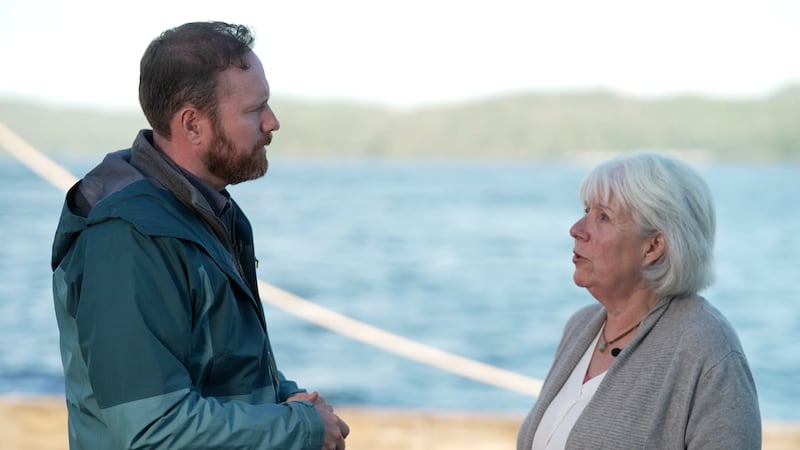
She said she is concerned about what would happen to the jobs, and by extension the community, if more farms are shut down.
“It would be very similar to when the mine closed here and there was a huge depression,” she said.
Over in the Queen Charlotte Strait, Guitard from Mowi takes a scoop of pellets and tosses it into an open pen. The fish respond by jumping.
She said she’s worried about what may be in store in 2029, when the ban is set to take effect, but is hopeful she can stay in her home in Campbell River.
“It’s awful, honestly. I’ve been here for six years. I have established a whole community, I have friends, it’s a lifestyle that I would love to live, but it really does rely solely on this industry continuing here.”