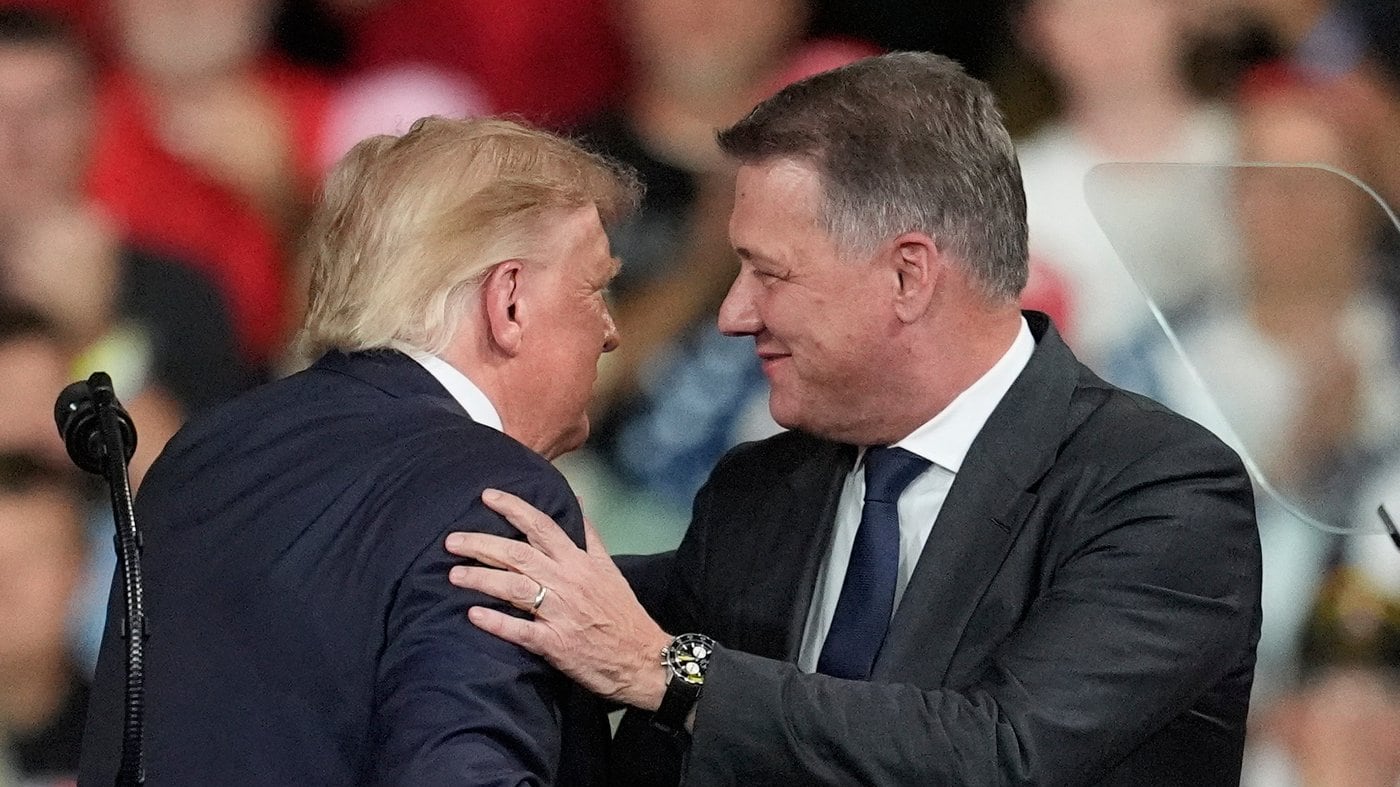
Audi chief Gernot Doellner drew heavy criticism on Monday for appearing alongside U.S. President Donald Trump at a campaign rally in the battleground state of Georgia, with the head of Germany’s top union saying it violated the automaker’s company guidelines.
Doellner appeared alongside Trump at the rally in Perry, near Macon in central Georgia, to announce plans to build a US$4 billion plant, the luxury carmaker’s first in the U.S., which would produce 200,000 SUVs annually.
Top VW committee must decide on U.S. plant
The announcement of the plan, which needs approval by the supervisory board of parent Volkswagen, including German labour representatives, follows lengthy considerations over launching U.S. production to escape import tariffs that cost Audi around €1.2 billion (US$1.34 billion) last year.
“Doellner is also in flagrant breach of his own company’s rules, which expressly require political neutrality in the run-up to elections,” said Christiane Benner, head of Germany’s IG Metall union and deputy chair of the Volkswagen supervisory board.
Audi had no immediate comment on the matter.
However, a person familiar with the matter said Audi’s management board had cleared an exception to the company’s code of conduct before Doellner’s appearance. Under the code, the board can allow deviations from the rules except in cases involving criminal offences, the source said.
The automaker’s top stakeholders discussed the matter during a meeting also attended by Benner and fellow labour representative Daniela Cavallo, with the latter expressing reservations about the appearance without formally opposing it, the person said.
A second person confirmed that Volkswagen’s supervisory board committee — which is already fraught with tension over the company’s sweeping restructuring — had discussed the issue on Friday.
Trump has voiced his support in the past for the far-right Alternative for Germany (AfD) party, raising concerns among Germany’s political and corporate mainstream.
German automotive expert Ferdinand Dudenhoeffer referred to Doellner as a “mini Elon Musk,” comparing him to the Tesla boss who has appeared on stage with Trump.
Audi’s code of conduct forbids “public engagements with political parties or politicians standing for election, nor any sponsorship of such events” in the three months leading up to an election.
Trump keen to promote impact of tariffs
Trump is in the midst of a nationwide campaign blitz to bolster his Republicans, who are trailing the Democrats in opinion polls ahead of the Nov. 3 midterm elections. One of his campaign messages is that his tariffs are creating more U.S. manufacturing jobs.
Olaf Lies, state premier of the German state of Lower Saxony, Volkswagen’s second-largest shareholder, said it was inappropriate that Doellner had become part of a political spectacle.
“A campaign rally cannot be the right place to announce an investment of this magnitude,” he said. “This appearance has caused consternation among employees who are worried about their jobs here, and far beyond. I can fully understand that — I feel the same way.”
The U.S. investment plan coincides with Volkswagen’s push to cut 100,000 jobs and cut excess production as it grapples with heavy losses in China while absorbing steep tariffs and the costly transition to electric vehicles.
The group’s German production sites have been under particular pressure to reduce costs, with Audi’s factory in Neckarsulm one of four plants threatened with closure from early next decade.
“The optics are not great, jobs are being created in the US while Audi is reducing the capacity globally,” Metzler analysts said of the US plan. “Still, we would argue the decision to produce in the US is right.”
Reporting by Christina Amann and Rachel More, additional reporting by Christoph Steitz, Writing by Friederike Heine, Editing by Ludwig Burger, David Holmes and Tomasz Janowski

