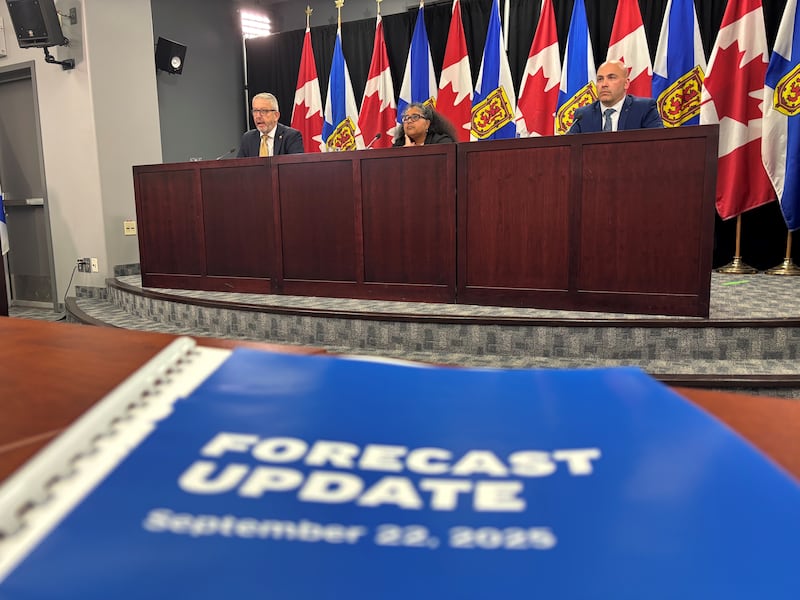
Nova Scotia’s 2025 budget update is forecasting a $1.225-billion deficit for the 2025-26 fiscal year.
Although it’s still a forecast, it represents the largest annual deficit in the province’s history, and $528 million in additional spending over the February budget.
The province says health-care costs remain the biggest driver of spending, with 46 per cent of the overall budget being directed towards improving health-care services.
Health-care spending has increased seven per cent over original estimates, at a cost of $411 million, which is largely due to staffing and inflationary pressures at Nova Scotia Health and the IWK Health Centre.
The province says the removal of tolls from the Halifax Harbour bridges also added $318 million to the deficit, while $157 million in debt owed by the Bridge Commission was forgiven.

Premier Tim Houston’s Progressive Conservative government has forecasted in previous budgets that it would run deficits, like in 2024-25, but when that budget year ended, the numbers showed the province ran a surplus instead.
Figures released Monday by the government’s finance department showed the province ran a $264.8-million surplus for the 2024-25 fiscal year, which was largely driven by a $203-million settlement from a tobacco lawsuit, according to the province.
The province expects to collect $785 million from tobacco companies over the next 20 years, though the legal fees fighting the case in court cost the province $16.9 million.
Revenue and spending
General revenues in 2024-25 grew to $17.17 billion, which represents $1.3 billion more revenue than was anticipated.
While total expenses climbed to $17.28 billion, that’s up $1.6 billion from the previous year’s budget.
Economic pressure
The province points to weaker global growth, ongoing tariffs, and extreme weather risks as some major uncertainties.

The province doesn’t yet know the cost of the Long Lake Wildfire, which has been burning in Annapolis County since Aug. 13.
Amid all the uncertainty surrounding trade and tariffs with the United States, exports to the U.S. increased by 1.6 per cent so far this year. The finance department said that was buoyed by the fact that 85 per cent of exports to the U.S. are still covered by the Canada-United States-Mexico Agreement (CUSMA).
Economists also point to slower population growth as an impact on revenue, as Nova Scotia’s population is expected to climb by 0.9 per cent in 2025 and 0.8 per cent in 2026.
As of April, 1,080,418 people called Nova Scotia home.
For more Nova Scotia news, visit our dedicated provincial page