Prime Minister Mark Carney has now climbed into two submarines on two continents - one on a production line in Germany, the other in the water in South Korea - yet the 2025 federal budget, which allocated more than $80 billion toward defence, made no mention of funding towards the much-needed vessels.
The Royal Canadian Navy is in the market to buy 12 conventional diesel-electric powered submarines and the federal government has narrowed the competition to two companies: ThyssenKrupp Marine Systems (TKMS) and Hanwha Ocean.
Canada currently has four aging submarines, only one of which is operational. The entire fleet is at risk of becoming obsolete by 2035, held together by parts that can’t be replaced, because they’re no longer being produced.
At a Saturday news conference in Ottawa to promote the budget, Defence Minister David McGuinty said “it’s hard to book money when you haven’t got a price on acquisition.” He insisted the procurement is on track, and that funding the new submarine fleet will be part of Canada’s NATO military spending commitments.
“We’re well on our way to achieving the 2 per cent (GDP) target by March 31 and we’re laying track for the 3.5 and 5 per cent by 2035.”
When asked by CTV News if a decision can be expected by the end of the year, McGuinty said he didn’t want to “prejudge the outcome of that negotiation” and did not want to add extra pressure to the negotiating team.
“Once we have a negotiated deal and an acquisition - we’ll move to lay out the plan.”
Some defence analysts found it unusual that Budget 2025 did not give any indication about how much the government was earmarking for submarines.
“At this point they should have an initial idea of roughly what the budget is,” said David Perry of the Global Affairs Institute, in an interview with CTV on budget day. “The way a government contract works is you need to have a source of funds before you can sign a contract. Technically, there is no budget and no source of funds to buy a submarine.”
New Carney-appointed negotiator starts work
Although there was no money for submarines in the budget, there were proposed funds to create the new Defence Investment Agency (DIA), which will be responsible for big military purchases.
On Nov. 12, the newly appointed CEO of the agency, Doug Guzman, will start his job. Guzman, a former banking executive, will spearhead negotiations with the German and South Korean companies for the purchase of the submarine fleet.
The contract for the Canadian Patrol Submarine Project, which will encompass both building and maintaining the submarines is expected to be the largest overseas procurement in Canadian history.
The broad strokes of what the Royal Canadian Navy requires are already known. The navy wants a fleet that is deployable in the Arctic with extended range and endurance. It needs to have stealth, persistence and lethality and be able to operate in all three of Canada’s oceans.
McGuinty says the company that wins the contract must provide industrial benefits such as the use of Canadian steel and utilize homegrown technology and expertise. The winning bidder must also deliver the submarine within timelines, as well as demonstrate that the submarine has interoperability with vessels from other countries.
Multiple procurement experts CTV News spoke with say the submarine contract could be worth more than $100 billion. The bulk of the investment will be allocated toward maintaining the vessels.
Building domestically could delay replacement
But while the contract requires that the vessels be maintained in Canada, there is no requirement that the submarines will be built domestically because that could delay delivery. One submarine takes about six years to build from start to finish.
“I don’t think at this point we’ve got the capacity to build submarines in Canada,” said Vice-Admiral Angus Topshee, the country’s top naval commander. Topshee emphasized his point by using the example of how German technology was transferred to South Korea.
“Their first submarine was built in Germany, then they built their second submarine here in Korea to a German design … that process to get them to where they are now - it took over 35 years,” said Topshee.
“I need submarines quickly.”
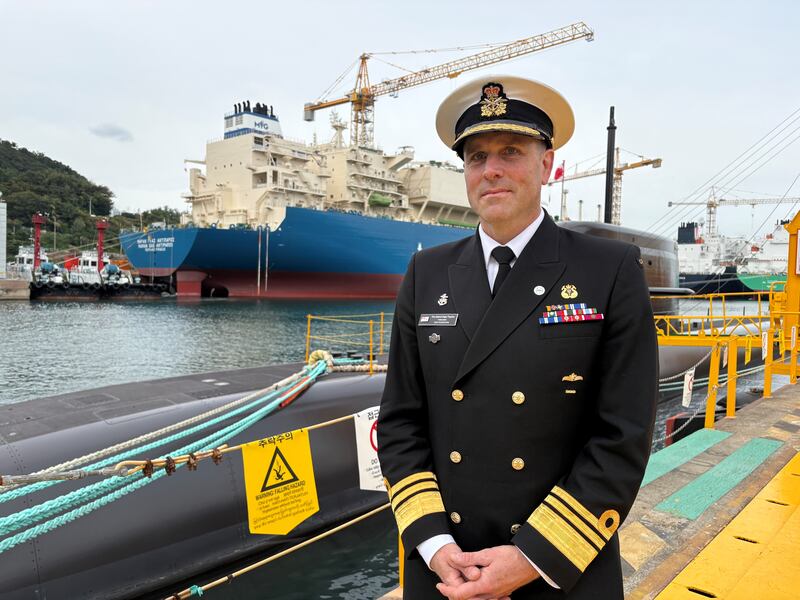
Topshee said both Germany and South Korea have existing production lines that can deliver Canada at least one replacement submarine by 2035.
McGuinty, along with the Prime Minister has visited shipyards in Germany and South Korea to see the vessels up close.
The Hanwha pitch
In October, the two politicians climbed down seven metres into the belly of Hanwha’s KSS-III submarine, the model the South Koreans are hoping that Canada will buy. Hanwha officials told the Canadian delegation that they can deliver submarines before 2035.
South Korea is still on a war footing. In the weeks before and after APEC, North Korea fired multiple missiles into the sea. The persistent threat requires the country to be efficient in its military production.
During the prime minister’s visit, Hanwha officials emphasized that its Geoje shipyard, which is the size of 900 football fields and employs 31,000 people in conjunction with robotic technology, builds 40 naval and commercial ships a year. Submarines are coming off the assembly line at a rate of one a year.
The company’s pitch to Carney was that it could deliver the first boat by 2032, and three more by 2035. That will allow the navy to retire its aging vessels earlier and “save a lot of money going into the maintenance and repair,” said Hanwha representative Steve Jeong.
Hanwha says retiring the vessels earlier would save Canada $1 billion on maintenance and support costs. It would then deliver the additional eight submarines at a rate of one per year, meaning the entire fleet of 12 submarines can be delivered to Canada by 2043.
Hanwha estimates the price of building one submarine for Canada will cost about $2 billion. It has also proposed joint training with Canadian sailors aboard Korean submarines before delivery and says its competitor can’t match its timeline.
The South Korean company has also signed memorandums of understanding with more than a dozen Canadian companies to use their technology in its submarines and ships. In Geoje, Canadian partners from Babcock Canada, CAE, Gastops and others were on hand to greet Carney after he surveyed the KSS-III that was just put in the water a week earlier.
The German-Norwegian counter
Two months earlier, Carney visited the TKMS shipyard in Kiel, Germany. In August, he climbed into a submarine not in the sea, but on the production line. He was photographed holding a miniature model in his hand.
TKMS is pitching its latest Type 212CD submarine model, which won’t be complete until 2027. The company has the backing of both the German and Norwegian governments.
TKMS says by 2027-2028, it should be able to produce at least three submarines a year.
So far, Germany has put in an order for six vessels and Norway, four.
But while Hanwha has provided cost estimates, TKMS is hesitant to disclose its projected price tag.
“We Germans are quite serious. We don’t do calculations and shouting out any ballpark prices,” said TKMS CEO, Oliver Burkhard.
During a visit to Ottawa in October, Burkhard sat down with CTV News for an interview.
He says he wants to see what requirements are listed in the official request for proposal from the Canadian government before he begins his calculations.
Burkhard says a submarine is the most complex weapon to build. It has “300,000 security relevant” parts, and if one of them is lacking, lives are put at risk.
“What does the customer want (in the submarine)? What capabilities? So for us it’s too early to shout out a price range.” Burkhard said, adding he expects to receive the RFP document before the end of November.
Burkhard accompanied the German and Norwegian defence ministers in their pitch to the federal government. The politicians and the TKMS boss are willing to move manufacturing of the submarines to Canada to win the contract.
Burkhard said it would take between three to five years to build a manufacturing plant in Canada, and additional time to train personnel. To make sure the navy gets its submarines before they fall apart from old age, Burkhard says it’s possible to build the first six boats in Germany and the next six in Canada.
Norway has also offered to provide Canada with its blueprints for the maintenance facility to bring down costs. There are also reports, that Germany has offered to buy a Canadian combat management program for its naval fleet and civilian aircraft from Canada.
Although Burkhard was hesitant to provide an estimated cost of its subs, German Defence Minister Boris Pistorius conceded the 212CD could be more expensive.
“The Koreans build excellent submarines, but we build better ones,” Pistorius said to reporters after his meeting with McGuinty two weeks ago.
“To consider - one thing is the price. Maybe (Korean subs are) one dollar cheaper or two - the other one - what is your reliable partnership?”
Old vs. new relationships
In their meeting with McGuinty, ahead of his trip to Asia, the Europeans emphasized bonds with NATO would be strengthened if Canada joined their submarine project.
“We will maintain them together. We will develop them together, train the crew together and hopefully also we will sail together,” said Norway’s Defence Minister Tore Sandvik.
But South Korea has NATO ties as well. Poland buys rocket launchers and missiles from Hanwha. It’s also considering buying the KSS-III to patrol the Baltic Sea.
And in just the past two weeks, Canada has strengthened its defence relationship with South Korea. The two countries signed a new Security and Defence Cooperation Partnership.
In addition to more cooperation in military training, the partnership aims to boost defence industrial collaboration between Canada and South Korea.

