As Canadians begin budgeting for the new year, grocery prices remain the top financial concern across the country, according to a new Nanos research survey conducted for CTV News.
The survey highlights where Canadians are feeling the largest financial pinch as they head into the holiday season and the coming year.
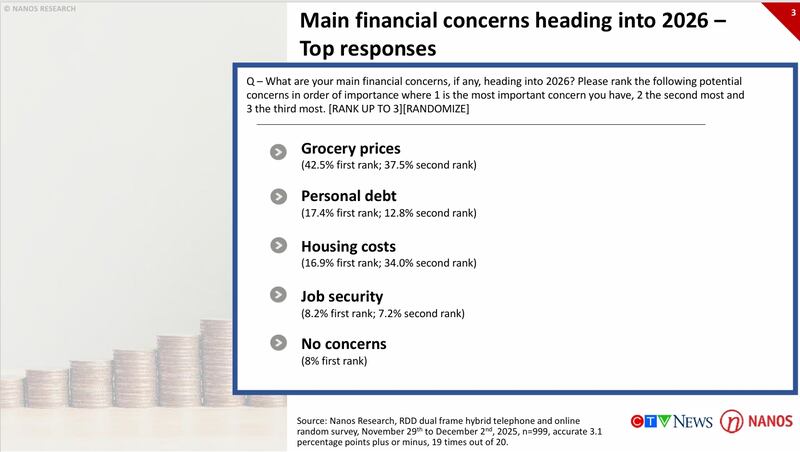
The growing costs of grocery bills proved to be the primary concern across Canada, with 42 per cent of respondents ranking it as their highest financial stress point and 37.5 per cent ranking it as second.
Regionally, the concerns were highest in the Atlantic and Prairie provinces, where more than half the respondents said food prices were top of mind.
Personal debt followed, with 17.4 per cent calling it their key concern, while 12.8 per cent ranked it as second. Close behind was housing costs, an issue that 16.9 per cent of Canadians polled said was their main worry, then job security was top of mind for 8.2 per cent.
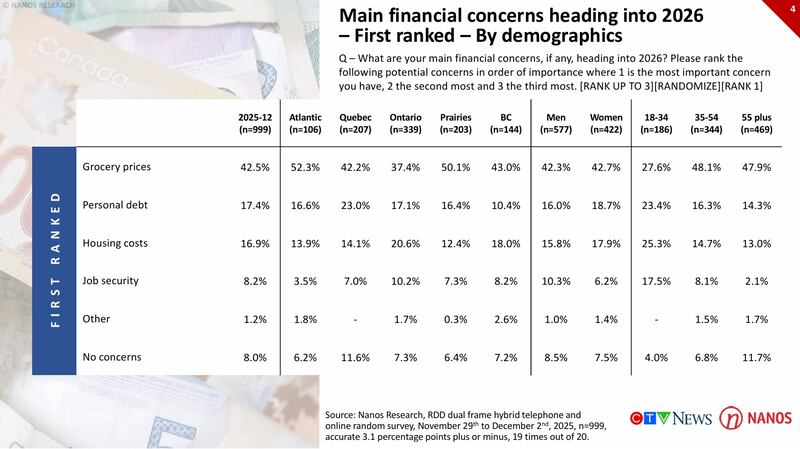
Responses, however, varied most in Ontario, where heightened anxieties around housing costs rose to 20.6 per cent of participants’ key stressors, while those around the price tag of groceries fell slightly to 37.4 per cent.
Across age demographics, those between 18 and 34 showed the most divide, with 27.6 per cent pointing to food costs, 23.4 per cent to personal debt and 25.3 per cent to job security as their top concerns.
The remaining eight per cent polled said they had no financial concerns as they get ready to ring in the new year.
Methodology
Nanos Research conducted a dual frame (land- and cell-lines) hybrid telephone and online random survey of 1,009 Canadians, 18 years of age or older, between Nov. 29 and Dec. 2, 2025. Respondents were recruited by live agents by telephone and completed the survey online. Results were statistically checked and weighted by age and gender to the latest census. The firm says its survey results carry a margin of error of plus or minus 3.1 percentage points, 19 times out of 20.

