From fast-food counters to self-checkout kiosks, Canadians are seeing more tip prompts than ever before — and experts say this constant nudging is reshaping how people tip.
While national data on tipping habits remains limited, several recent surveys point to a clear shift in how often Canadians are being prompted to tip — and how they feel about it.
Eighty-two per cent of Canadians say tipping is expected in more places than ever before, while 90 per cent believe tips are too high, according to a 2025 H&R Block Canada survey.
The survey also found that nearly 60 per cent of Canadians said they’re tipping more than they were just a year ago.
Wayne Smith, professor of hospitality and tourism management at Toronto Metropolitan University, said rising tip percentages are part of a larger pattern often referred to as “tip creep.”
“We’re tipping in more places than people traditionally ever did,” he told CTVNews.ca in a Zoom interview. This shift has sparked mounting frustration among diners and complaints of “tip fatigue,” Smith said.
About 64 per cent Canadians aged 55 and over say they tip “all the time,” compared to 56 per cent of those aged 35 to 54 and 41 per cent of those 18 to 34, according to a separate 2025 Research Co. poll that surveyed nearly 1,000 Canadians.
While the surge in tip requests has many Canadians confused and frustrated, two Canadian experts say the trend is no accident – it’s being shaped by inflation, technology and social desirability pressures.
‘There’s a social anxiety’
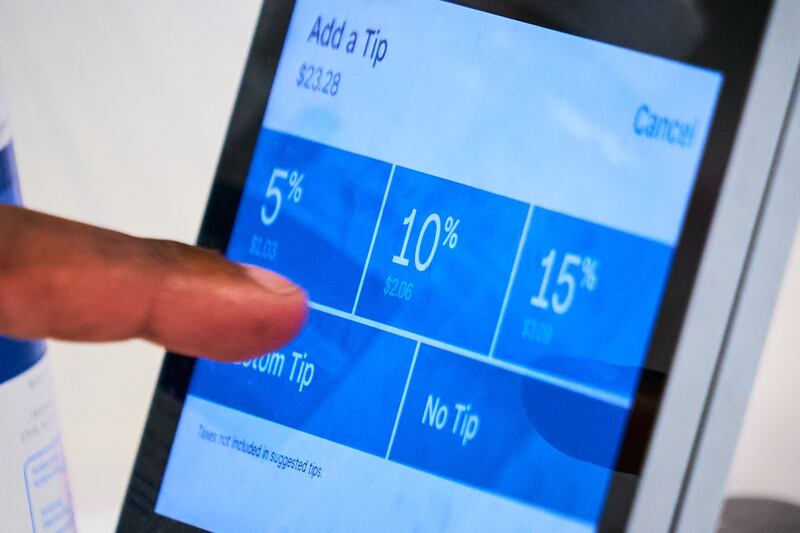
Between delivery services that rely on tips and digital payment systems that prompt percentages, tipping has become a built-in experience, Smith said.
“When they used to bring the bill to your table, you signed and left. Now with the machine, they’re standing and watching. There’s a social anxiety,” he explained.
During the pandemic, delivery apps such as SkipTheDishes and Uber Eats became more necessary, embedding tipping directly into the checkout process. As digital payment terminals proliferated, Smith said, tipping became frictionless and more psychologically charged.
Smith said it’s referred to as “social desirability bias” — the pressure to appear generous when the worker is watching as you tap a tip option.
“You’re not seeing your money going across the table. It’s the easiest way to increase tipping without even thinking about it,” he said.
Marc Mentzer, a professor at the University of Saskatchewan’ Edwards School of Business agreed that digital prompts have fundamentally shifted consumer behaviour.
“Everywhere we go, you’re handed a chip card reader. From my experience, the lowest percentage option is almost always above 15 per cent, it varies from restaurant to restaurant,” Mentzer said in an interview with CTVNews.ca.
About 1.2 million employees — or 6.9 per cent of the work force — received tips or commissions in 2024 with the rate highest in accommodation and food services at 43.1 per cent, according to data released in January and provided to CTVNews.ca by Statistics Canada.
A Restaurants Canada spokesperson told CTVNews.ca in an email that “suggested tip amounts should be calculated based on the pre-tax subtotal,” to ensure customers are tipping based on the cost of service rather than taxes.
Minimum wage vs. living wage
Some Canadian businesses have eliminated and replaced tipping with a living wage in order to tame customers’ frustration with tipping culture. But both Smith and Mentzer say the reality is more complicated.
A key part of the tipping conversation is the gap between legislated minimum wages and the so-called “living wage.” Advocates say workers need a living wage to cover basic costs and the two terms are not interchangeable.
As of 2025, the federal minimum wage for federally regulated employees is $17.75 an hour and applies to banks, airlines, federally regulated transportation and more. Provinces set their own rates: Ontario’s general minimum wage moved to $17.60 on Oct. 1, 2025, British Columbia’s general rate is $17.85 (effective June 1, 2025), Quebec is at $16.10 and other provinces range from roughly $15 to $18 depending on jurisdiction.
By contrast, the calculation for a living wage places it much higher.
For example, the Ontario Living Wage Network estimates the GTA living wage at about $27.20 an hour with most smaller communities falling between roughly $21 to $27 an hour depending on local rent and costs.
Why does the gap matter for tipping? When base pay is low, employers and industry models have historically relied on customer tips to top up workers’ income.
Advocates like Smith argue that moving to a wage-inclusive model — where staff are paid a living wage directly by employers and menu prices are higher — would remove the arbitrary, mood-dependent element of tipping and deliver steadier incomes.
“It’s just widely accepted that customers will make up the difference between what the employer pays and what the employee ought to get paid,” Mentzer said.
But Mentzer said raising wages likely won’t eliminate tipping.
Ontario is a key case study, according to Mentzer. The province abolished the lower liquor-server minimum wage in 2022, raising servers’ base rate by several dollars per hour. Mentzer said if any province were going to see tipping decline, it would have been Ontario.
“(It) did not have any effect,” Mentzer said. “Servers are getting more money through the minimum wage,” meaning their base pay went up - but customers continued tipping at roughly the same rates.
Even more surprising? Mentzer said provinces with the lowest minimum wages often see the lowest tipping rates.
Rising menu prices, inflation
The higher tip percentages have also collided with rising menu prices. However, Mentzer said increases in menu prices haven’t slowed tipping.
“The percentage (of) tip is gradually edging upwards but not as fast as restaurant prices going up,” he said.
According to Statistics Canada, the Consumer Price Index (CPI) for food purchased from table-service restaurants rose 3.3 per cent in 2024, driven largely by labour, ingredient and operating costs that continue to push restaurant prices higher even as overall inflation began to moderate.
In October 2025, Canada’s total inflation rate was 2.2 per cent. Over the same period, food-price inflation was 3.4 per cent and food prices have now outpaced general inflation for nine consecutive months.
Over the pandemic years, menu price inflation has been especially steep. According to Restaurants Canada, menu inflation peaked at around five to 5.6 per cent in 2024, pushing dine-in costs higher for Canadians.
Meanwhile, the value weight of food in the CPI basket has grown with food accounting for 16.72 per cent of the inflation basket in 2024, up from 16.13 per cent just a year earlier. This includes a 5.90 per cent share for food purchased in restaurants.
As menu prices increase, even if tip percentages remain the same, the absolute dollar amount expected from diners continues to climb — compounding the pressure already felt in their wallets.
Where does your tip go?
The typical customer may also be surprised to find out how their tip is distributed, Mentzer said.
In Ontario, for instance, the Employment Standards Act explicitly prohibits employers from withholding gratuities or demanding that employees hand over their tips – unless there is a legally sanctioned tip pool.
Crucially, under that system, employers, directors or shareholders are generally not allowed to participate in the tip pool unless they perform substantially the same work as tipped employees.
The legislation does not require the tip-pooling arrangement to be formalized in writing or have an employee vote.
In B.C. under the BC Employment Standards Act, employers cannot withhold gratuities from workers unless they are re-distributed through a tip pool.
In addition, employers may only participate in the tip pool if they perform the same front-line tasks as their staff. This limits “house tipping,” where management takes a cut for back-of-house or non-serving roles.
In Quebec, tip-sharing, or “tip pooling,” is legally permitted but only when it is voluntary and agreed to by the majority of employees who typically receive gratuities. Employers also cannot force tip-sharing – these polices must be freely accepted and not imposed.
“The typical customer is not aware of how tipping money is redistributed behind the scenes and might be surprised. You feel you’re giving money to the server. You’re actually giving money to many other people,” Mentzer said.

