


As Prime Minister Mark Carney gears up for a meeting with Chinese President Xi Jinping this week – the first visit to the country by a sitting prime minister since 2017 – an expert warns that the stakes are high and hypervigilance is advised.
Carney announced the trip last week, saying that the decision was made because Canada is looking to build a “competitive, sustainable and independent economy.”
“We’re forging new partnerships around the world to transform our economy from one that has been reliant on a single trade partner, to one that is stronger and more resilient to global shocks,” Carney said in the statement.
Vina Nadjibulla, the vice-president of research and strategy at the Asia Pacific Foundation of Canada, called this meeting a significant test of Carney’s “pragmatic diplomacy.”
“He will have to strike a difficult balance between pursuing economic engagement with China, especially in sectors like energy, with the serious national security and economic securities that we still have to manage when it comes to China,” Nadjibulla told CTV News Channel on Monday.
Nadjibulla, an expert on international security and peace-building, emphasized that the prime minister must find a way to avoid strategic dependence on this single trading partner.
“With China, we have a history of economic coercion,” Nadjibulla added. “China uses economic dependence, like in the case of canola, for political leverage.”
While Nadjibulla says it is important that Carney engages with China pragmatically, she points out that it will be “interesting” to see how he will navigate the conversation surrounding both Canada’s national and economic security.
“We should not confuse economic engagement with trust or with strategic alignment,” Nadjibulla said, calling Canada’s relationship with China “complex.” She added there are several economic opportunities to explore like oil, gas and agriculture.
“Pragmatic engagement is fine. Diplomatic amnesia would be a mistake,” she said.
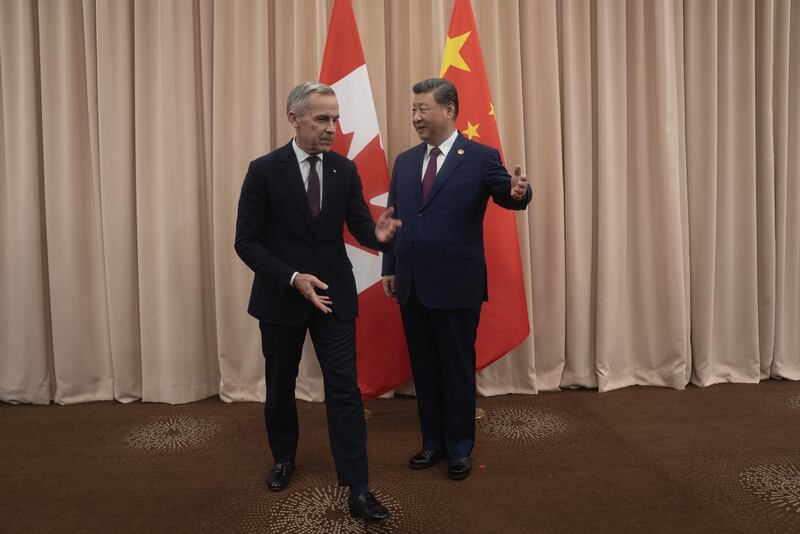
Nadjibulla says that it was a significant occurrence that this trip was even taking place.
The relations between the two nations started souring between the two countries in late 2018, when Canada detained Chinese telecommunications executive Meng Wenzhou at the request of the U.S.
China responded with the arrest of two Canadians – Michael Kovrig and Michael Spavor – on spying charges, until a deal was struck to facilitate the release of both the Canadians and Wenzhou in 2021.
The relationship between the two nations further deteriorated after Canada, following the lead of the U.S., imposed a 100 per cent tariff on electric vehicles and a 25 per cent tariff on steel, aluminum coming from China.
However, a spokesperson for the Chinese foreign ministry said China was looking forward to Carney’s visit for “improvement in China-Canada relations.”
“If there is a way to manage getting some things on energy, getting some movement on the tariffs on canola, while at the same time signalling that Canada continues to see the challenges that emanate from China on issues around human rights, foreign interference … I think that would be evidence of success,” Nadjibulla said.
Meanwhile, she says that despite this being Carney’s attempt to diversify Canada’s economic engagement, it is imperative to keep in mind that most of the Asia and the Indo-Pacific exists outside China.
“We need see China as part of that broader Indo-Pacific strategy, rather than as the totality of our engagement with Asia,” Nadjibulla said.
With files from The Associated Press

