OTTAWA — Fears that a reigniting trade dispute with the United States could hamper business and consumer confidence loomed large over the Bank of Canada’s interest rate decision earlier this month.
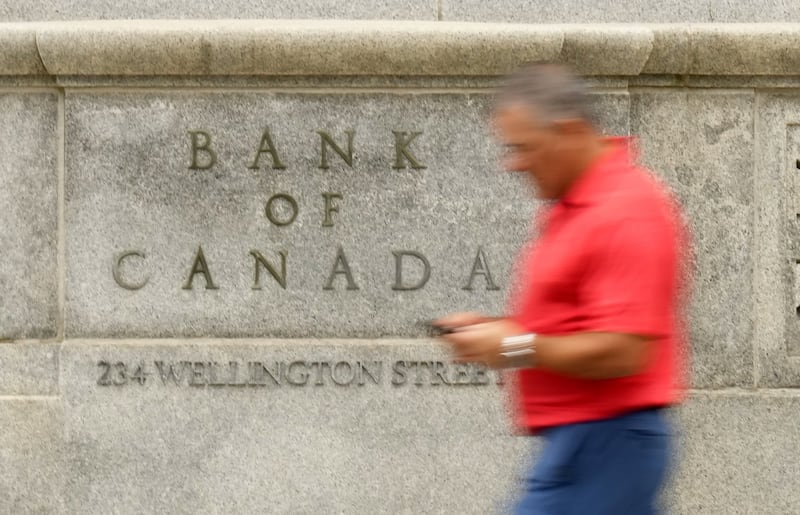
The central bank on Wednesday released a summary of the deliberations that led to its decision to hold the key policy rate steady at 2.25 per cent on Sept. 2. The hold — the bank’s seventh in a row — had been widely expected by economists.
The Bank of Canada governing council’s meetings began on Aug. 25 — just a few days after the United States imposed 50 per cent tariffs on roughly $28 billion worth of Canadian goods on Aug. 22.
That move kicked off a series of retaliatory actions in the weeks after the central bank’s rate decision, including counter-tariffs from Canada and planned import bans from the United States.
Monetary policymakers felt at the time that the Aug. 22 tariffs would hit targeted sectors hard but the impact on the overall economy would likely be modest.
The economy and labour market had been showing signs of strength heading into the latest tariff wave. The housing market seemed to be picking back up after an extended slowdown, exports and business spending were picking up, the private sector was adding jobs and consumers looked to be in a solid position, monetary policymakers observed.
But the deliberations show the governing council was worried a re-escalating trade dispute could put a chill on household spending, business investment and hiring.
“While the government’s fiscal response and businesses’ ongoing efforts to adapt to tariffs and trade uncertainty should help mitigate some of the impact, members agreed that the latest developments made the sustainability of that recovery more uncertain,” the deliberations read.
The central bank did not view Canada’s counter-tariffs as a significant inflationary risk. Because the retaliatory duties targeted intermediate inputs like steel and goods that had Canadian substitutes, “the impact on inflation would likely be muted and spread out over time,” the deliberations said.
Eyes on Iran war
The Bank of Canada is keeping an eye on high energy prices tied to the war in Iran, however.
Monetary policymakers discussed the possible need to adjust the policy rate in future meetings if cost pressures start to spread beyond the gas pumps.
“While there was little evidence thus far that high gasoline prices were passing through to other goods and services, members agreed that the longer they were high, the more likely they would be passed through. This increased the upside risks to inflation,” the deliberations read.
Monetary policymakers also noted that if the tariff dispute did hamper growth, that could offset some of the inflationary pressures coming from the energy price shock.

The governing council concluded its meeting by agreeing to stress that future rate decisions would be guided by its inflation outlook and a commitment to maintain price stability for Canadians.
The bank will update its forecasts for the economy and inflation at its next interest rate decision on Oct. 28.
October will also mark one year since the Bank of Canada’s last interest rate move — a cut of 0.25 percentage points.
The U.S. Federal Reserve raised its policy rate by a quarter point on Wednesday in an attempt to rein in inflation pressures festering south of the border. The unanimous decision was the Fed’s first hike in three years.
In Wednesday’s deliberations, the Bank of Canada’s governing council noted global financial conditions had tightened since its last decision in July.
“Long-term bond yields have moved up amid concerns about sovereign debt levels and expectations that central bank policy rates would need to increase to restrain inflation,” the deliberations read.
“Canadian bond yields also rose, albeit by less than yields in several other advanced major economies.”
Bond yields are used as a benchmark for key domestic lending rates and mortgages, and tend to move in correlation with expectations for the Bank of Canada’s policy rate.
For much of 2026, financial market odds have been weighted toward rate holds from Bank of Canada. But bets have shifted lately to favour a rate hike sooner than later.
Odds of a hike from the bank next month stood at 60 per cent as of Wednesday afternoon, according to LSEG Data & Analytics.
This report by The Canadian Press was first published Sept. 16, 2026.
Craig Lord, The Canadian Press

