MIRABEL, Que. — Executives from the U.S. based manufacturer of F-35 fighter jets landed in Mirabel, north of Montreal, to confirm plans for a maintenance facility for its jets in Quebec.
The event also served as a message about what the American aerospace giant is selling as the benefits of its aircraft, as Ottawa continues to weigh which jets will make up its Armed Forces fighter fleet.
Lockheed Martin signed a memorandum of understanding (MoU) with Mirabel-based MAS, a company of L3Harris, to establish an F-35 maintenance depot.
“This partnership that we are here to celebrate today just continues an extension of the trust and the relationship that we have established and really builds upon the foundation that we have with Canada as one of the prime partners on the most amazing multi-role fighter to take to the skies,” said Lockheed Martin vice-president and director general of the F-35 program Chauncey MacIntosh.
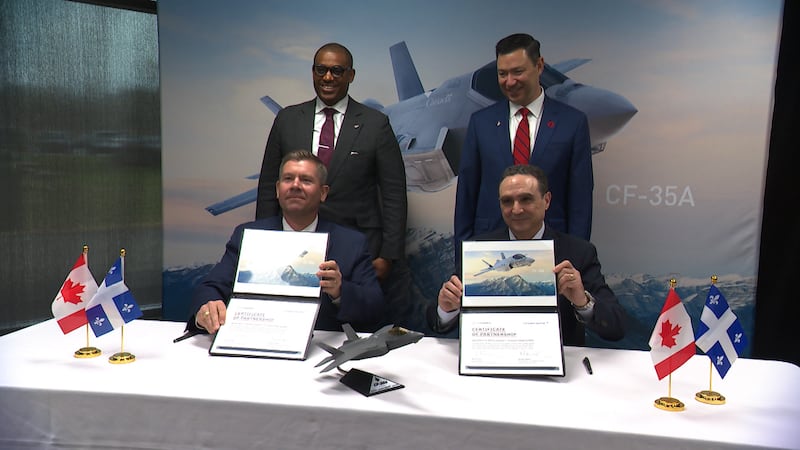
MAS has maintained Canada’s fleet of CF-18s for decades but is now setting its sights on using that experience for the maintenance of F-35s. The company says that is necessary to maintain and even create jobs at the facility.
While Lockheed Martin says the MoU focuses on the maintenance of the jets Canada buys, MAS aims to convert facilities into a maintenance depot that would also serve other F-35s flying worldwide.
“Certainly, the original contract is what we hope to be able to support up to 88 F-35s,” said MAS General Manager Ugo Paniconi. “At the same time, by establishing a regional sustainment depot, it means that aircraft from other countries, notably from the U.S. and other countries, we can accommodate those aircraft into our facility and do maintenance and support of those aircraft.”
MAS L3Harris says it estimates that re-tooling infrastructure to maintain F-35s will cost at least $200 million and is lobbying the federal government for an investment.
Reassuring news for union representatives
Union representatives say the announcement is reassuring news. Workers have been concerned about what will happen to their jobs between the end of the maintenance of the CF-18s and the beginning of work on F-35s.
“Certainly, we are lobbying the government about investments that are to be made for military contracts,” says International Association of Machinists and Aerospace Workers Philippe Comeau. ”We are hopeful that our workers will be able to do maintenance of whatever aircraft Canada picks.”
In 2023, Ottawa unveiled its plan to purchase 88 F-35 fighter jets to replace its ageing fleet of CF-18s. The government ordered 16, but a year ago, it triggered a review of the rest of the purchase as tensions flared up between Canada and the United-States. The Canadian government is now weighing whether to run a dual fleet and replace some of the planned F-35s with the Swedish-made Gripen.
Ottawa has steered clear of announcements on the file during negotiations of the Canada-U.S.-Mexico Agreement, (CUSMA). It has also not confirmed when it might unveil its final decision on which fighter jets will make up Canada’s fleet.
“We are very excited about the full 88 airplane buy of Canada, knowing what having a single fleet means,” said Macintosh during an interview with CTV News. “What that does with the interoperability with NATO, the need for one training program, one infrastructure program. There are a lot of advantages to running a single fleet.”
But MacIntosh also said that the MoU signed today would move forward based on the purchase that Canada makes.
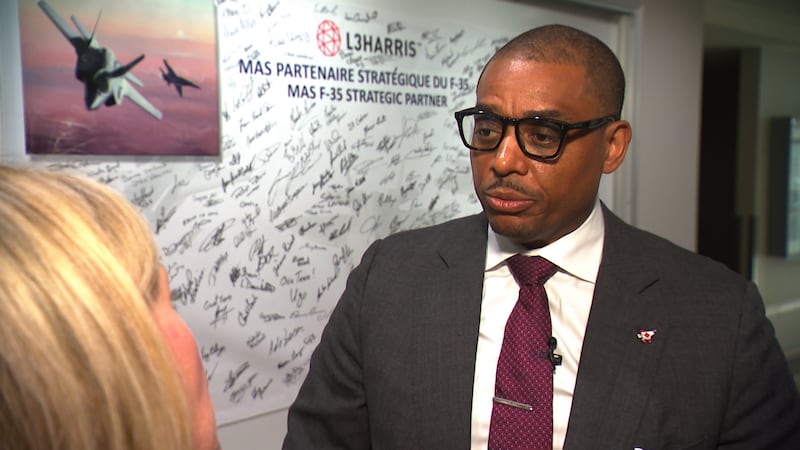
“When Canada has an airplane, it needs to ensure that Canada can maintain that airplane [and] maintain fleet readiness.” said MacIntosh.

