


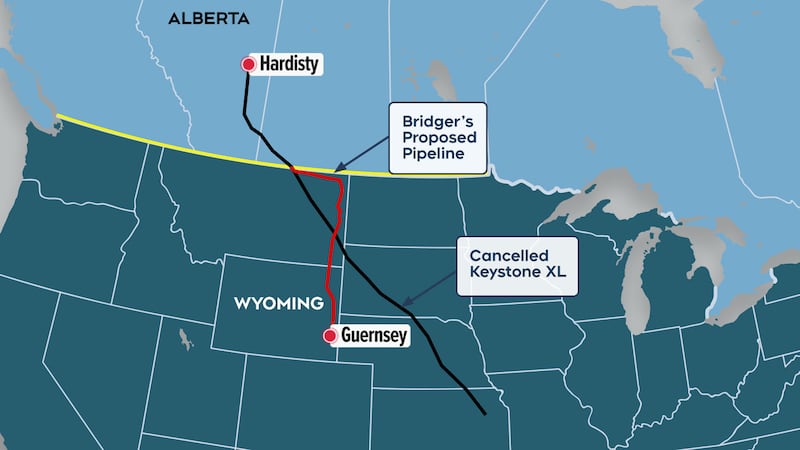
U.S. President Donald Trump on Thursday signed an order authorizing the Bridger Pipeline’s proposed project to transport Canadian crude from the U.S.-Canada border to Wyoming.
The pipeline, a joint proposal from Canadian pipeline company South Bow and the U.S.-based Bridger Pipeline, could increase Canada’s crude exports to the U.S. by more than 12 per cent.
Here’s what you need to know:
‘A huge deal’ for energy ‘dominance’
“It’s a huge deal in terms of long-term energy dominance and energy security,” White House staff secretary Will Scharf, speaking over Trump’s squeaking sharpy as the president signed the executive order.
“Slightly different from the last administration,” Trump told the room of White House executives and journalists. The politicians standing behind him laughed.
“They wouldn’t sign a pipeline deal and we have pipelines going up. And by the way, they’re way underground. They’re not a problem. Nobody even knows they’re there.”
Bridger Pipeline’s project would have the capacity to move more than 1 million barrels of oil per day, according to the company. If built and connected, analysts told Reuters it could increase Canada’s crude exports to the U.S. by more than 12 per cent.
Luca Caruso-Moro, CTVNews.ca journalist
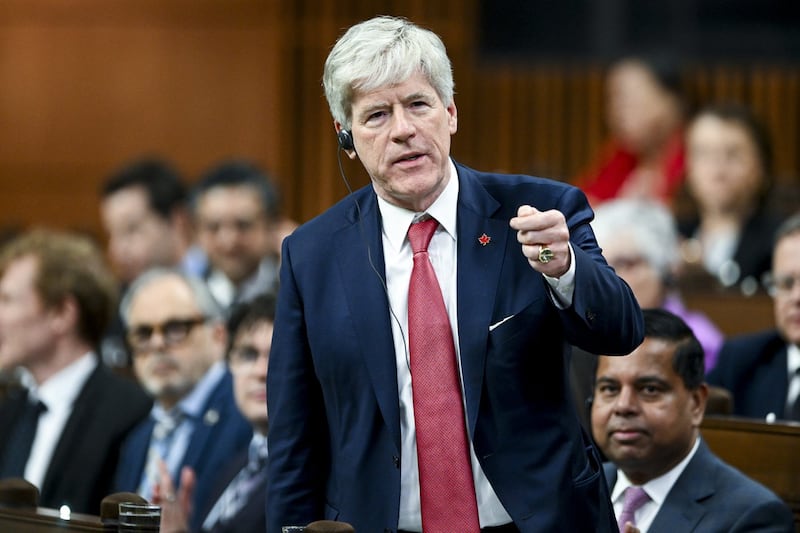
Trump has said U.S. doesn’t need Canada’s oil
Trump’s authorization of this Canada-U.S. pipeline appears to contradict previous rhetoric around petroleum imports.
In January 2025, Trump told the World Economic Forum that the U.S. does not need Canada’s oil and gas, adding “we have more than anybody.”
He also suggested the same regarding auto and lumber imports, and that Canada should join the U.S. as a state.
Canada supplies more crude to the U.S. than any other country in the world. In 2025, Canada exported 1.64 billion barrels of crude oil and products to the U.S.
Luca Caruso-Moro, CTVNews.ca journalist
Canada, South Bow aware of Trump statement
A spokesperson for Energy Minister Tim Hodgson’s office told CTV News that they are aware of the signing and that the government “remains focused on strengthening Canada’s position as an energy superpower, supporting North American and global energy security, and advancing the diversification of our trade partnerships.”
In a separate statement to CTV News, South Bow didn’t specifically mention the Bridger Pipeline that Trump signed off on Thursday.
Instead, the company said it would continue to evaluate the Prairie Connector project, a proposal that would start in Hardisty, Alta., and move crude oil to the border to various U.S. destinations.
CTV News’ Mike Le Couteur and Stephanie Ha
Pipeline would revive parts of Keystone XL
The new pipeline would revive parts of the Keystone XL pipeline that was cancelled by former U.S. president Joe Biden.
While the new project involves a different route through the U.S. than Keystone XL, it will use some of the previously built pipe on the Canadian side. South Bow, the Canadian pipeline company involved in the new project, was set up by former Keystone XL proponent TC Energy in 2024.
Reuters
Alberta’s Smith lauds pipeline approval
Alberta Premier Danielle Smith says a key approval for a cross-border oil pipeline project to deliver more of the province’s crude to the United States is coming after years of advocacy from her government.
Smith says the new project would deliver more than half a million barrels per day of Alberta oil to facilities and refineries throughout the U.S.
In a social media post Thursday, Smith said the U.S. is “our most important trading partner and we will continue to deliver energy to help secure North American energy dominance.”
“This means Alberta producers will be able to produce more of the oil that the world needs. It’s incredible to see that work already paying off with announcements like this,” said Smith.
The Canadian Press
You can read the full story here
Canada could send 1M barrels per day: energy expert
In an interview with CTV Power Play host Vassy Kapelos, Heather Exner-Pirot, senior fellow and director of energy, natural resources and environment at the Macdonald-Laurier Institute, said the pipeline follows the same line as Keystone XL in Canada, as we still have the permits and licences.
However, in the U.S., it is a dramatically different route, going through Montana and then Wyoming.
“It’s similar to other assets that Bridger already owned, so they know that region,” she said. “And then from there, it’s really a switch in trying to get to a place like Cushing or another centre for pipelines.”
Exner-Pirot added that while Bridger has previously said 550,000 barrels of crude oil could go through Canada to the U.S a day., it could go up to a million.
“So they’re going to wait to see what the market is expecting, how much the market can take,” she said. “But obviously, a half million barrels is significant egress.”
She suspects it will cost $100 billion to fill all those pipelines, and it will be another $100 billion to build a pipeline to the northwest coast of B.C.
“So somehow, we’re going to have to attract a lot of capital, be an attractive place for that upstream production,” she said.
Exner-Pirot said these projects all need to be paced, but added that if a final investment decision is made soon, the Bridger Pipeline could start being built by 2029.
Elianna Lev, CTVNews.ca journalist
‘Make up your mind Canada’: analyst
Canada needs to commit to a diversified oil export strategy, according to Roger McKnight, a petroleum analyst at En-Pro International.
“I think it’s time to turn our focus away from the United States,” McKnight said in an interview with CTV News Channel Thursday. “Get the oil out of the country from the West Coast, go up north, or go east, but certainly the south is not a friendly place to be right now.”
He pointed to four previous U.S. presidential administrations that he said had all floated potential U.S.-Canadian pipelines before abandoning the projects.
“We don’t know what’s going to happen with the next president,” he said, adding “make up your mind United States, and make up your mind Canada.”
Joe Van Wonderen, CTVNewsToronto.ca journalist
Canada, U.S. discussed pipeline in March
Officials from both Canada and the U.S. discussed the proposed pipeline at an energy conference in Houston last March.
Hodgson said at the time that Canada was framing the prospect of a new cross-border oil pipeline as a way it can help the U.S. achieve energy security, even as the war in Iran disrupts supplies and raises prices for consumers.
Hodgson said he also made it clear during the meeting that Canada is aggressively working to expand its oil exports to non-U.S. markets by completing a planned 300,000 barrel-per-day expansion of the Trans Mountain pipeline, which runs from Alberta to the Pacific Coast.
Hunter Crowther, CTVNews.ca journalist
Vancouver gas prices surpass national COVID-19 record
Just after 11:20 a.m. PT, Vancouver saw some of the highest gas prices in the country. Regular-grade fuel clocked in at $2.17/L.
That’s a chunk of change higher than the national average of $1.82/L, according to GasBuddy, which tracks prices across Canada and the U.S.
For context, $2.10/L is the standing record national average since 2008, a full seven cents less than Vancouver’s price on Thursday. That record was struck in late 2022.
Vancouver’s record is $2.39/L, which was also reached in 2022.
Luca Caruso-Moro, CTVNews.ca journalist
Gas prices will drop as soon as war is over: Trump
Trump on Thursday told reporters that gas prices would “drop like a rock” as soon as the Iran war ended.
Reuters
‘The whole world economy is paying’
During a Senate hearing on proposed budget cuts in Washington on Thursday, members of the U.S. Congress, including Senator Gary Peters of Michigan, questioned U.S. Defense Secretary Pete Hegseth on when the war in Iran will end.
“The whole world economy is paying a great deal for this war,” he said.
Peters told Congress that Americans are paying the prices of the war through higher fuel costs, while “farmers are paying because of fertilizer costs.”
Peters called on Hegseth to take immediate action to open the Strait of Hormuz saying “the world community needs it. We’re not going to bring this war to an end until we seize control of the Straits.”
In response, Hegseth said the “impenetrable” blockade of the Strait has been a solution because the Iranians “don’t have a conventional Navy to contest it.”
“We control the straits,” he said.
Kayla Thompson, CTVNews.ca journalist

U.S. wants to work with Canada on energy trade: sources
United States Trade Representative Jamieson Greer told Canadians looking for insights into the future of bilateral trade this week that “America First” is policy, not a slogan, and they should not expect a return to the way things were.
Sources who attended a roundtable with U.S. President Donald Trump’s trade czar in Washington on Wednesday told The Canadian Press that Greer was measured and pragmatic as he laid out the administration’s policy goals ahead of the coming review of the Canada-U.S.-Mexico-Agreement on trade, better known as CUSMA.
About 40 people attended the event hosted by the American Chamber of Commerce in Canada, including Conservative MPs Jamil Jivani, Michael Chong and Shuv Majumdar. Also in the room were multiple executives from oil and gas companies.

Canada’s Ambassador to the U.S. Mark Wiseman sat two seats away from Greer during the meeting. Alberta’s Washington trade representative Nathan Cooper and Manitoba’s trade representative Richard Madan were also in attendance.
Greer said the United States is looking to work with Canada on energy and critical minerals development in ways that would be mutually beneficial to both countries, the sources said.
One source said Greer cautioned that Canada should not attempt to use those resources as leverage in negotiations on the trilateral trade pact.
The Canadian Press
Canada is a major oil producer. Why are prices so high?
Canada is the fourth-largest oil producer in the world. It produced 5.13 million barrels of oil per day on average in 2024 and 5.19 million barrels per day in the first half of 2025, according to a snapshot released in December.
But if that’s the case, why are our fuel prices going up just like the rest of the world?
“Oil and gas are global commodities,” economist Moshe Lander explained during an interview with CTV News Channel.
Consider an oil exporter in Canada who sells to the domestic market and internationally, he said. Since every country in the world purchases oil, or some derivative, Canada’s local prices are influenced by whatever the highest price is elsewhere in the world.
And because oil is refined into so many different products, such as fuel for our cars, jets, plastics and more, all those prices stand to rise as well.
Luca Caruso-Moro, CTVNews.ca journalist
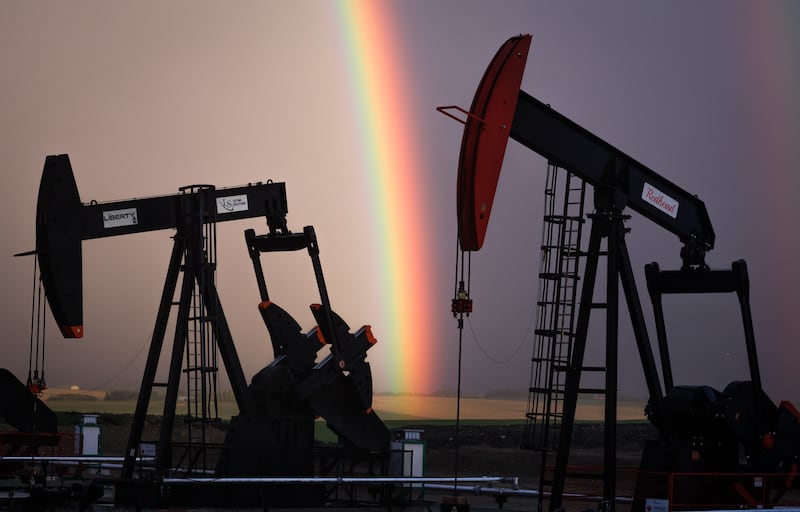
Litre of gas over $2 on west coast
Gas prices rose across the country Thursday morning. Just before noon ET, Canadians paid $1.78 per litre of gasoline at the pump, up nearly four cents from Wednesday, and nearly 15 cents from last week’s average.
B.C. had the highest prices as gas topped $2.02 per litre. Next door, Alberta boasted the lowest prices at $1.77 per litre.
Luca Caruso-Moro, CTVNews.ca journalist
Toronto gas prices expected to rise again
Drivers in Toronto saw a four-cent jump at the pumps Thursday morning as the conflict in Iran shows no signs of ending anytime soon—and one energy analyst says prices will be even higher on Friday.
Dan McTeague, president of Canadians for Affordable Energy, predicts that the price of gas in Toronto will climb another eight cents per litre before the weekend, pushing it to an average of 190 cents per litre.
“Supply gaps can only be resolved by higher prices until this matter is resolved. It’s going to take a long time for us to get through this, even after the peace deal is hopefully reached someday,” he told Newstalk 1010’s Moore in the Morning Thursday.
Phil Tsekouras, CTVNewsToronto.ca. Read the full story here.
Aren’t we in a gas tax holiday?
If you ask Canadians filling up their cars how the federal government’s suspension of the excise tax has helped at the pump, there is one answer that often surfaces: “What tax relief?”
Still, a look through the numbers shows that while prices continue to rise worldwide, the tax holiday has cut costs, at least by a few cents per litre.
Phil Gingues from Sherbrooke, Que., was in the Montreal area when his gauge indicated the tank of his pickup truck was empty.
“Well, it is going to be $200,” he said, looking at the numbers on the pump go up. “I am used to it at this point.”
When asked how he thought the tax holiday, which took effect April 20, was helping, Gingues said: “There’s supposed to be a tax holiday?”
On April 14, Prime Minister Mark Carney unveiled the plan to suspend the fuel tax on gasoline and diesel, which the government said it expected to save Canadians about 10 cents per litre on regular gasoline.
On that day, the national average price of gas in Canada was 176.2 cents per litre. When the tax suspension came into effect on April 20, the price was 169 cents/litre. One day later, the price was the lowest it has been at the pumps this month, at 164.2 cents per litre.
But on Tuesday, the national average was back up to 175 cents/litre.
Genevieve Beauchemin, Quebec bureau chief
Oil prices whipsaw in afternoon trading
Oil prices whipsawed on Thursday and surged toward their highest levels since the war with Iran began, only for the leaps to quickly vanish.
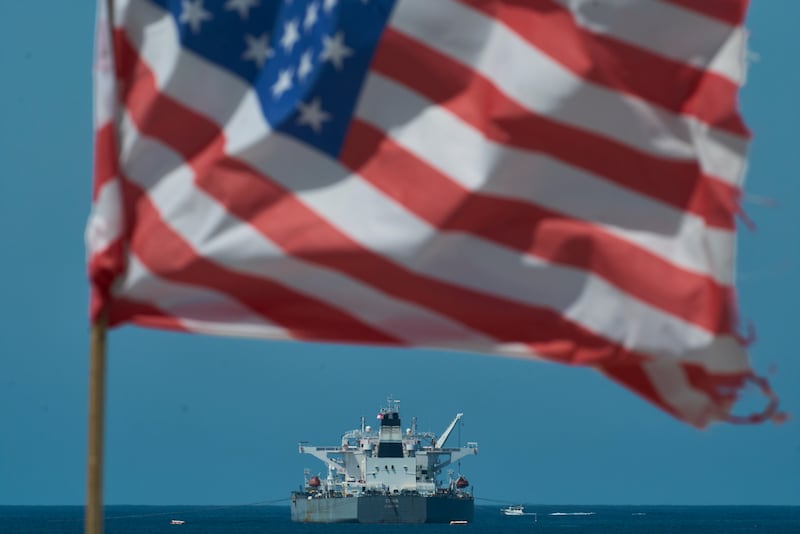
Prices surged overnight on worries the Iran war will affect the flow of crude for a long time. Iran has closed the Strait of Hormuz to oil tankers, keeping them pent up in the Persian Gulf and away from customers worldwide, while a U.S. Navy blockade is preventing Iran from selling its own oil.
In the most actively traded part of the market for Brent crude, for delivery in July, the price got as high as US$114.70 per barrel overnight. It then fell back toward $107 before sitting at $110.03, down 0.4 per cent. So far during the war, the peak price for the most actively traded Brent contract is $119.50, which was set last month.
The Associated Press. Read the full story here.
Markets open, oil prices retreat
Oil prices surged to their highest levels since the war began before retreating quickly.
Brent crude, the global benchmark for July delivery, spiked to US$114.70 a barrel before settling back to US$108.64 by late Thursday morning.
This volatility followed an overnight price spike triggered by fears that a conflict with Iran could close the Strait of Hormuz, potentially trapping tankers in the Persian Gulf and severing global supplies.
Meanwhile, the U.S. stock market rose steadily on the back of strong profits from technology giants Alphabet and Amazon, both of which beat analyst expectations.
These gains pushed the S&P 500 up 0.2 per cent, pushing it closer to an all-time high, while the Dow Jones Industrial Average rose 0.7 per cent and the Nasdaq gained 0.2 per cent.
In a quieter segment of the Brent market, June delivery prices briefly spiked over US$126 per barrel before retreating to around $114
Anam Khan, BNNBloomberg.ca journalist. Read the full story here.
Inflation hits 3% in Europe
Soaring oil prices from the Iran war pushed inflation higher in Europe in April, as growth continued to underperform in a worrying combination both for consumers and policymakers at the European Central Bank.
Annual inflation in the eurozone -- the 21 countries that use the shared euro currency -- rose to three per cent from 2.6 per cent in March, fueled by a 10.9 per cent increase in energy prices, the European Union statistical agency Eurostat reported Thursday. Crude oil is trading above $120 per barrel, up from around $73 before the outbreak of the war on Feb. 28.
Meanwhile, eurozone growth for the first three months of the year disappointed with a marginal increase in economic output of 0.1 per cent over the quarter before.
The Associated Press

Iran: Americans’ place in Gulf is ‘at the bottom’
Ayatollah Mojtaba Khamenei maintained his defiant tone since taking over following the killing of his father in the war’s opening airstrikes.
In a written statement read by a state television anchor, Khamenei -- who has not been seen in public since becoming supreme leader -- said the only place Americans belonged in the Persian Gulf is “at the bottom of its waters” and that a “new chapter” was being written in the region’s history.
The Associated Press
A ‘breakdown’
The U.S. has continued its blockade of Iranian ports while the Strait of Hormuz is closed, pushing oil prices higher in recent days. Reports Thursday suggesting a possible escalation by U.S. President Donald Trump doused hopes for a quick end to the conflict.
“The breakdown of talks between the U.S. and Iran, along with President Trump reportedly rejecting Iran’s proposal for a reopening of the Strait of Hormuz, has the market losing hope for any quick resumption in oil flows,” ING Bank strategists Warren Patterson and Ewa Manthey wrote in a research note.
Oil prices vary depending on the type of crude oil, where it is being traded and under what terms, for futures contracts. By some measures, Brent has hit its highest level since its peak of $147.50 per barrel in 2008 during the global financial crisis.
The Associated Press
Canadians drive less
Forty per cent of Canadians are spending less time behind the wheel due to high gas prices, according to a new study from Narrative Research.
The study, which polled 1,234 Canadians 18 years or older, found 40 per cent of respondents are limiting their trips or driving less after a sharp rise in gas prices in recent weeks.
Fourteen per cent of Canadians are walking or biking more often, while 12 per cent are buying smaller amounts of gas at the pump.
“Rising gas prices driven by global events are weighing heavily on Canadians, prompting widespread concern and noticeable changes to everyday behaviour,” the study reads.
“Our latest research finds that nine in 10 Canadians are concerned about the price of gas, with half saying they are extremely concerned, underscoring how sharply fuel costs are being felt across the country.”
Sean Mott, CTVNewsAtlantic.ca. Read the full story here.
Shell goes big on Canadian gas
Shell plc has signed a $22-billion deal to acquire ARC Resources Ltd., bringing together the lead partner in Canada’s first operating liquefied natural gas project with a major producer in one of the continent’s most profitable shale regions.
Wael Sawan, chief executive of the U.K.-based global energy heavyweight, said Monday that the transaction “establishes Canada as a heartland for Shell,” which had divested its once hefty footprint in the oilsands.
“We are accessing uniquely positioned assets and welcoming colleagues that bring deep expertise which, combined with Shell’s strong basin level performance, provides a compelling proposition for shareholders.”
ARC Resources is focused on the Montney, a shale formation that stretches through parts of northeastern British Columbia and northwestern Alberta.
The Canadian Press. Read the full story here.

