


DUBAI, United Arab Emirates -- U.S. President Donald Trump on Tuesday backtracked on plans to charge ships for using the Strait of Hormuz, saying Gulf countries would instead invest in the United States. Another wave of U.S. strikes on Iran, and Iranian attacks on shipping and American allies, left an interim peace deal in tatters.
That agreement was supposed to reopen a waterway that is key to world energy supplies and give negotiators time to hammer out a permanent end to the war. Instead, fighting has once again engulfed the region, threatened the global economy and brought warnings to commercial airlines.
The U.S. carried out another wave of strikes ahead of its planned reimposition of a blockade on Iran’s ports, a U.S. official told The Associated Press on condition of anonymity to discuss a sensitive military operation.
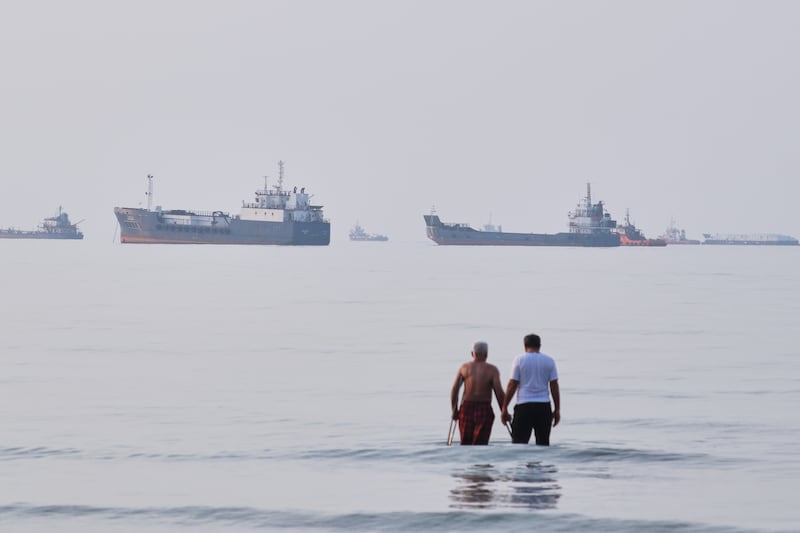
A fifth of all traded crude oil and natural gas passed through the strait before the war, when it was open to all without tolls. When the U.S. and Israel attacked Iran on Feb. 28, it effectively shut the passage by attacking and threatening ships -- a tactic that proved its greatest strategic advantage. That sent the price of oil, fertilizer and other goods soaring at a time when world leaders were already struggling to address rising costs.
Iran has more recently attacked ships moving through the strait on a route overseen by the U.S. military that is outside Tehran’s control, setting off tit-for-tat strikes. The U.S. has threatened to reopen the strait by force -- but experts say that would require a much bigger armada if not tens of thousands of ground troops.
Trump says he’s replacing the fees with Gulf investments
On Monday, Trump said the U.S. would reimpose a blockade on Iranian ports and begin charging ships fees equivalent to 20 per cent of their cargo to defray the costs of securing the strait. He backed off on the fees a day later, while the blockade is set to come back into force in the coming hours.
Trump said he was called by “kings and emirs” and other leaders who suggested an alternate arrangement.
“They said we’d love to do it a different way. We’d love to invest in the United States with billions and billions of dollars,” Trump told reporters in the Oval Office on Tuesday.
Trump said he preferred that arrangement to charging tolls “because I don’t think anybody should be able to charge a fee for the strait.”
It was unclear if the investment deals would be new commitments relative to what Trump announced after a visit last year to the Middle East.
Strikes and counterstrikes resume across the Mideast
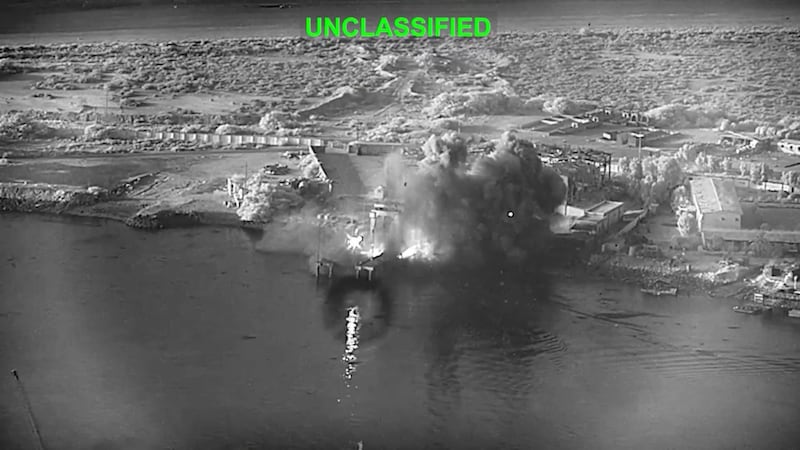
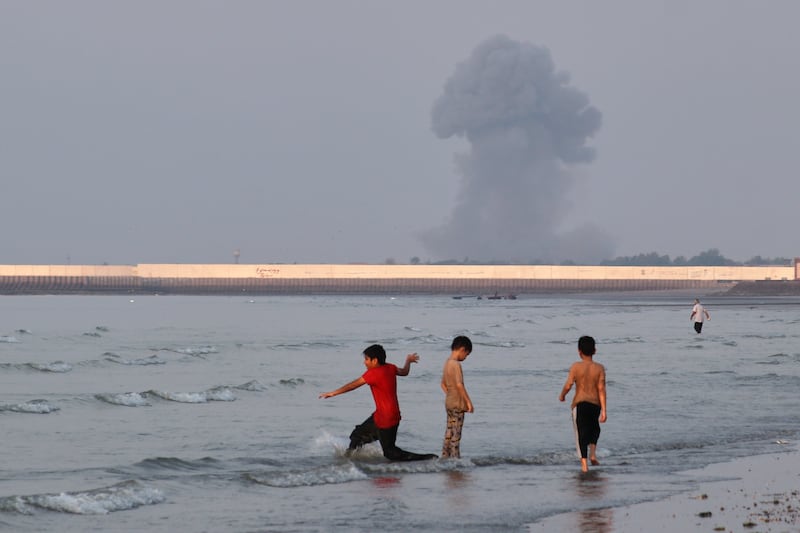
The U.S. military’s Central Command said it struck several areas in Iran, targeting “coastal defence systems, missile and drone sites and maritime capabilities.” Iran acknowledged the strikes but provided no immediate casualty or damage assessments.
“These strikes will continue imposing a heavy cost on Iranian forces and degrade their ability to attack innocent civilians and commercial shipping in the Strait of Hormuz,” the U.S. military said.
Iran responded with attacks targeting Bahrain, Kuwait, Jordan and three tankers that traveled through the strait.
Two of the targeted ships were associated with the United Arab Emirates and were set ablaze for a time. The International Maritime Organization said the attack on the tankers Mombasa and Al Bahiyah killed two mariners and wounded 14 others. The UAE threatened to retaliate.
Dutch shipping firm Stolt Tankers said that one of its ships came under attack. The attack on the Stolt Magnesium off Oman sparked a fire in the engine room, but the company said all the mariners were safe.
Iran’s paramilitary Revolutionary Guard said the Mombasa and Al Bahiyah “ignored repeated warnings.” Iran has targeted ships that use a route through the strait that passes near Oman outside of its territorial waters.
Hours after the U.S. said it ended its campaign of strikes, the Iranian city of Bushehr on the Persian Gulf was hit in at least four locations, the state-run IRNA news agency reported. The attacks again raised the possibility that Gulf Arab states were retaliating against Iran without discussing it in public.
The European Union Aviation Safety Agency warned airlines against operating in the airspace of Bahrain, Kuwait, Qatar and the United Arab Emirates, as well as over the Gulf of Oman.
The interim peace deal is in peril
Exchanges of fire in recent days had already cast doubt on the interim peace deal -- now almost halfway through the 60-day period in which negotiators were supposed to agree to a final accord, which also was meant to address Iran’s disputed nuclear program and other issues.
Washington lifted a blockade it imposed in mid-April as part of the deal. The U.S. military said it will resume it at midnight Wednesday in Dubai.
Trump’s plan to charge fees would have been a change to longstanding U.S. policy and a departure from recent U.S. promises that the strait would remain open to all without tolls -- recently offered by U.S. Secretary of State Marco Rubio on a trip to the region.
Under the interim deal, Iran agreed that passage through the strait would remain free of charge for 60 days -- but the agreement left open what would happen after. Iran asserts it has the right to manage traffic through the strait and potentially charge fees. The U.S. has disputed that.
The price for a barrel of Brent crude oil, the international standard, briefly topped US$87 early Tuesday, still well below the nearly $120 reached at the height of the war. The price dipped to $78 in the aftermath of Trump’s announcement that he had changed course. Mediators are trying to prevent a return to full-scale war
Regional mediators are still trying to get the United States and Iran back to the negotiating table, according to two regional officials.
The officials, speaking on condition of anonymity to discuss the delicate diplomatic process, said Pakistan-led mediation was working around the clock to reactivate the ceasefire.
Meanwhile, Lebanese and Israeli delegations were expected to meet in Rome on Tuesday to continue U.S.-mediated negotiations. Shortly after the U.S. and Israel launched the war on Feb. 28, the Lebanese militant group Hezbollah joined the conflict in support of its ally, Iran, and began attacking Israel. Israel responded with a ground invasion of Lebanon.
Last month, Lebanon and Israel announced a “framework agreement” outlining the withdrawal of Israeli forces from southern Lebanon in exchange for the disarmament of Hezbollah. Implementation has stalled.
Before the fighting around the strait intensified, Israel’s war against Hezbollah in Lebanon repeatedly threatened to derail the interim deal. A truce now exists in Lebanon, but it remains unclear whether it will hold if the U.S. and Iran return to full-scale war.
Jon Gambrell, Collin Binkley And Josh Boak, The Associated Press
Boak and Binkley reported from Washington. Associated Press writer Samy Magdy in Cairo contributed to this report.

