SHENZHEN, China -- China, Russia and the U.S. agreed Thursday to seek reforms at the United Nations, increase oil supplies and engage in dialogue to reduce nuclear risks at a three-way meeting, according to Chinese and Russian officials.
The three countries also took aim at the International Criminal Court, saying state officials should enjoy immunity from its prosecutions and warning that it should not abuse its jurisdiction. Russian President Vladimir Putin is wanted by the court -- and the U.S. has heavily sanctioned it and its officials for recent investigations.
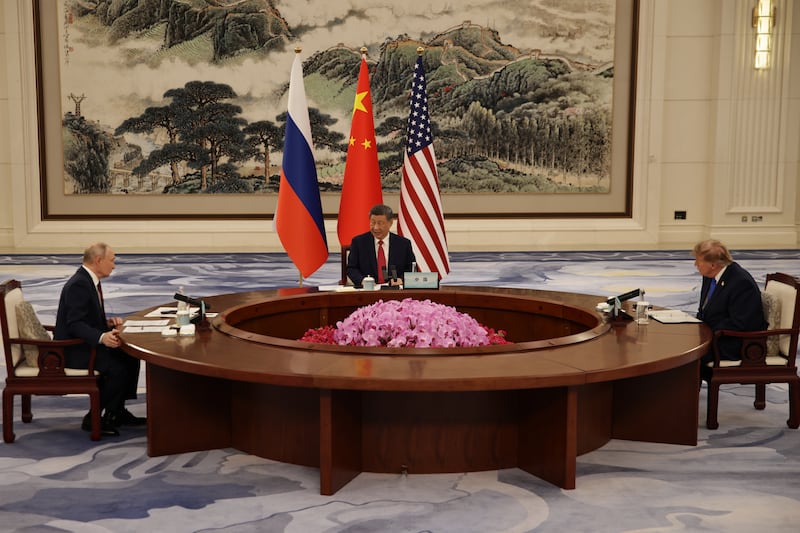
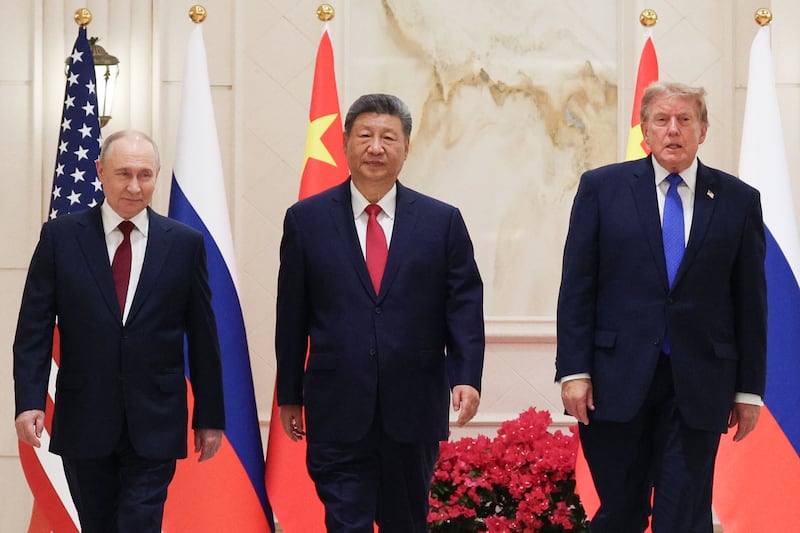
The declaration followed a historic meeting among U.S. President Donald Trump, China’s Xi Jinping and Russia’s Vladimir Putin, a moment that could mark a pivot in world history -- or become a quickly forgotten photo op. Experts have kept expectations low for major breakthroughs.
The declaration did not mention the wars in Ukraine or Iran, two issues that U.S. President Donald Trump said he raised with the leaders earlier in the day. The U.S. has not released the document.
Xi later called the meeting positive, constructive and “fruitful.”
The statement said the leaders are committed to advancing UN reforms “to more effectively address global challenges,” to increase the production and supply of oil products to ensure a stable flow of energy, and to work to reduce nuclear risks and prevent nuclear proliferation.
Trump has promoted this first-ever three-way meeting with Xi and Putin -- two of America’s leading rivals -- as a chance to hash out rules for controlling nuclear arms and to start resolving the wars in Ukraine and Iran.
“We are really making history,” Trump said. “The United States, Russia and China are uniquely positioned to discuss how to reduce the number of nuclear weapons on Earth and also to lessen the risk of those weapons being used.”
Xi, meanwhile, earlier said the meeting would focus on “promoting world peace.” Putin, for his part, harkened back to the three countries’ shared history as “victors in World War II,” saying that “we hold joint responsibility for maintaining international peace.”
The last nuclear arms pact between Russia and the United States, known as New START, expired in February, and Trump has said he wants “a new, improved and modernized” deal that includes China. But China has less motivation to accept limits given that its arsenal of more than 600 warheads is far smaller than the more than 5,000 warheads believed to be in each of the U.S. and Russian stockpiles.
Daryl Kimball, executive director of the Arms Control Association, said the meeting could at best start a process that would eventually lead to a sustained set of talks for reducing nuclear arsenals.
“We need more than diplomatic theater and photo opportunities between Xi, Putin and Trump at APEC,” Kimball said. “And one meeting will not likely produce dramatic breakthroughs.”
The leaders also talked about Iran and trade
Before the three-way meeting began on Thursday afternoon, the U.S. president had a separate one-on-one meeting with Xi — their third substantial meeting this year.
The U.S. president praised their friendship and their shared interest in having oil shipped through the Strait of Hormuz, which has become a key site of attacks in the Iran war. Trump suggested he would push Xi to buy more agricultural products from America.
Xi said that relations between the U.S. and China have been “generally stable and improved” during Trump’s presidency. The official Chinese news agency Xinhua reported that Xi discussed Taiwan with Trump and said the two countries needed to improve communication on economic and trade issues.
Trump also added a separate sit-down with Putin to his Thursday schedule, marking the first time the leaders have held talks since their discussions in Alaska last year that failed to broker a deal to ease Russia’s war in Ukraine.
“Wonderful things can come out of this — or at least start,” Trump said after joining Putin for the one-on-one meeting on the sidelines of the Asia-Pacific Economic Cooperation Summit, calling Putin “my friend.”
“We’ve had a great relationship for many years,” Trump said after shaking hands with Putin. Their meeting lasted roughly 40 minutes.
Trump has frequently boasted of his rapport with Putin, as relations between the U.S. and Ukraine appear to have cratered recently. Trump rejected new Russia sanctions, while Kyiv was undermined by disruptions in satellite support for its drones during the war.
The U.S. president also added that the trio would talk about ways to “protect our nation’s sovereignty from rogue globalist organizations such as the International Criminal Court.”
Trump’s administration has imposed sanctions on ICC officials and the institution itself as part of a campaign to dismantle the tribunal over investigations into the United States and its allies, including Israel.
Trump boasts about his relationships. But the ties between Xi and Putin are stronger
The U.S. president’s ambitions recall an era of great power politics when wealthier countries felt entitled to decide the fate of seemingly lesser nations. Trump is negotiating with China and Russia without the involvement of Ukraine — or countries like Germany, France, the United Kingdom, Japan and South Korea that also have stakes in the outcome of any talks.
Trump has long believed his ability to create personal connections gives him a diplomatic edge. Xi appealed to his ego Wednesday by greeting Air Force One on the airport tarmac, as the two leaders turned their handshake into a one-armed hug.
But Trump does not appear to always have the same deep relationship based on common interests that Xi and Putin share. For all the compliments the U.S. president has showered on the two autocrats, the warmth has not always been mutually effusive.
On Wednesday at APEC, Xi greeted Putin by calling him “my old friend.” The Russian leader responded by declaring Xi to be his “dear friend.” China has helped economically support Russia after its 2022 invasion of Ukraine, providing Putin with a financial lifeline after the U.S. and its allies imposed new sanctions.
By contrast, when Xi came to the White House for a state visit in September, he was far more restrained with Trump, saying they had built a “personal rapport and stayed in touch.” Trump and Xi plan to meet a total of four times this year, with their final time together coming in December at the G20 summit being held at the Trump National Doral Golf Club in Florida.
There were also signs of friction Thursday in the U.S.-China relationship despite Trump’s praise of Xi.
Chinese officials blocked a Bloomberg reporter, Annmarie Hordern, from the trilateral meeting after she asked a question at the earlier Trump-Xi session.
Chinese television showed a video of Trump appearing drowsy, while the White House posted a clip of Trump helping Xi up an escalator.
Conflicts on AI also hang over the meetings
While Trump views his relationship with China as a positive, it has not necessarily resulted in meaningful changes between the world’s two largest economies. China continues to run large trade surpluses with the rest of the world, while the U.S. has almost equally large trade deficits.
And the race between the U.S. and China to master artificial intelligence has grown tense over the past two weeks. Trump’s ally Jensen Huang resigned last week as the CEO of Nvidia after confessing to an extramarital affair with a woman, Alice Huang, whose company helped to give China access to the company’s advanced computer chips used to develop AI models. Beijing has denied that Alice Huang was a Chinese government agent.
Trump held off on imposing tougher restrictions on China’s ability to access the chips, suggesting he did not want to insult China and aggravate relations.
U.S. officials have said that China had not fully honoured its commitments made last year in a Trump-Xi meeting to buy more U.S. agricultural products and loosen restrictions on the sale of rare earth minerals needed for electronics.
The trade truce between the U.S. and China reached last year after dueling tariff hikes is set to expire by Jan. 10 next year.
Meanwhile, both China and Russia have used trade to support Iran, even during the U.S. war on that country, which has pushed up energy prices and reduced global economic growth.
___
Josh Boak, Michelle L. Price and E. Eduardo Castillo, The Associated Press
Associated Press writers Darlene Superville and Will Weissert in Washington, Huizhong Wu in Bangkok and Kanis Leung in Hong Kong contributed to this report.

