
Tom Mulcair is a former leader of the federal New Democratic Party of Canada between 2012 and 2017,and a columnist for CTVNews.ca.
Finance Minister François-Philippe Champagne boasted that his would be a “generational budget.”
It was the exact opposite.
Sustainable development is about taking into account the effect of government decisions on future generations. Champagne’s budget dumped a huge environmental debt into the backpacks of our children and grandchildren — on top of the economic debt already added by his massive new deficit.
A decade of deception
For the past 10 years, the Liberals have been pulling the wool over our eyes about their fight against climate change.
In Tuesday’s budget, the sleight of hand evolved into a crass con job.
The Liberals simultaneously killed off their two billion tree planting program — boasting that it will save “$0.2 billion over four years” — while signalling that they’d be removing oil and gas emissions caps, subject to certain “conditions.”
One of those conditions is the creation of new carbon-capture and storage devices to reduce greenhouse gas emissions.
Here in Canada, we already have an abundance of very old and highly effective devices for storing and capturing CO₂ — they’re called trees.
The forests we’ve lost
Unfortunately, the wildfires we’ve been experiencing have destroyed far more trees than the two billion we’d begun to plant.
Conservative estimates place the number of trees lost during the 2023 wildfires in Canada at 8.6 billion. Under the Paris Accord, we must account for that carbon production in our filings with the United Nations.
The numbers for 2025 are expected to be similarly devastating — again, far surpassing the two billion we’d promised to plant. We’ve blown well past any plausible possibility of meeting our international obligations. Those types of wildfires have been predicted and modelled by the best scientific minds in the world.
Tens of thousands of people have died or suffered severe lung injury as a result, yet we make no serious attempt to stop it.
We’re laggards—great at faking it.
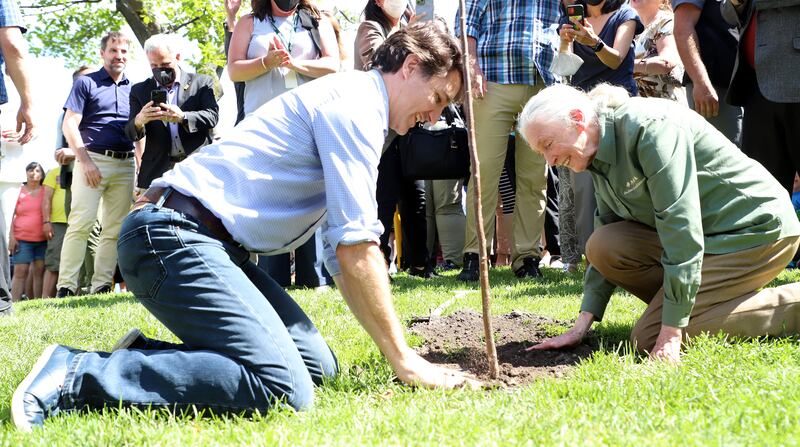
Civil servants doing their job — politicians not so much
Environmental and other groups I’ve spoken with have nothing but praise for the excellent work of the civil servants at Natural Resources Canada who’ve been handling the tree planting program.
An aspirational electoral announcement by Trudeau to plant two billion trees took a frustratingly long time to ramp up, but things had finally started going well. Now, out of the blue, the uncommitted portion of the money for the trees has been cancelled — with nothing to replace it.
That penalizes those groups as much as it harms the environment.
‘Canada is back’ Trudeau said. But was it?
When Justin Trudeau attended the Paris conference in 2015, together with Catherine McKenna, his newly appointed Minister of Environment and Climate Change, there was a lot of hope in the air.
I was in the room when Trudeau proclaimed that “Canada is back.”
I took that to mean that Canada would finally begin to do its part to reduce greenhouse gases and help fight the real crisis that is climate change.
Instead, I learned a lesson about Canadian politics: Canadians love to be told we’re doing great things — even when the facts don’t bear that out.
Shortly after returning to Canada — and with far less fanfare — Trudeau announced that he’d be keeping Stephen Harper’s targets and timelines for greenhouse gas reduction.
As successive reports by Canada’s Commissioners of the Environment and Sustainable Development would later show that we couldn’t even meet Stephen Harper’s targets — let alone produce a credible plan to meet our new international obligations under the Paris Accord.
We were great at preening and lecturing, not so great at actually getting anything done.
The carbon tax and political cowardice
Canadians, generally, felt better about Trudeau’s posturing than Harper’s stern admonitions, and the public didn’t seem to care much about the details — except when they were going to have to contribute.
Enter the consumer carbon tax.
Putting a price on carbon is the most efficient way to reduce the production of CO₂, the principal greenhouse gas. It’s the same type of mechanism that was used to handle acid rain: a price was put on SO₂ and a market created.
Lo and behold, acid rain was effectively stopped as industries gained both an obligation and an economic incentive to reduce emissions.
The industrial carbon tax remains in place in Canada, but the consumer tax, so effectively vilified by Pierre Poilievre, became a political hot potato that Trudeau began to dismantle before it really began — and that Mark Carney later eliminated altogether.
(He still sent people their compensation cheques for a tax they wouldn’t pay… just in time for the federal election. He’s a quick study!)
A generational test
Mark Carney is no Justin Trudeau. He knows more about the environment and climate change than any other leader in the G7 — so there’s really no excuse.
Elizabeth May showed admirable poise in holding back her decision on supporting a budget that she had clearly read, and found wanting. She said there was still time to change it before the vote.
Her support is desperately needed by the Liberals, and they’d be wise to pay attention to the environmental issues she raises.
Generational change requires it.
More from Tom Mulcair:

