


Prime Minister Mark Carney and Alberta Premier Danielle Smith signed a major new energy co-operation agreement on Thursday, outlining the conditions that need to be met for a new oil pipeline to the Pacific to proceed.
Signing a new memorandum of understanding (MOU), the federal and provincial governments are committing to a series of measures aimed at strengthening co-operation on major infrastructure projects, increasing energy production, and improving the country’s economic sustainability and export potential.
Among the terms that would see the Canadian government help fast-track an Alberta pipeline through the federal major projects process, is the province signing on to an industrial carbon pricing agreement that would implement an industrial carbon price of $130 per tonne to lower methane emissions by 75 per cent over the next 10 years.
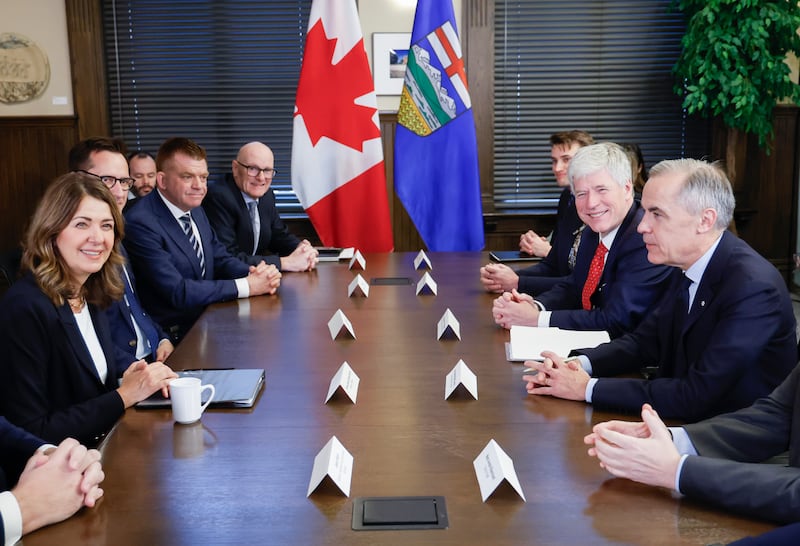
In return, the federal Liberals have agreed to suspend the clean electricity regulations in the province, not implement the oil and gas emissions cap, and if required, make an exemption to the federal tanker ban.
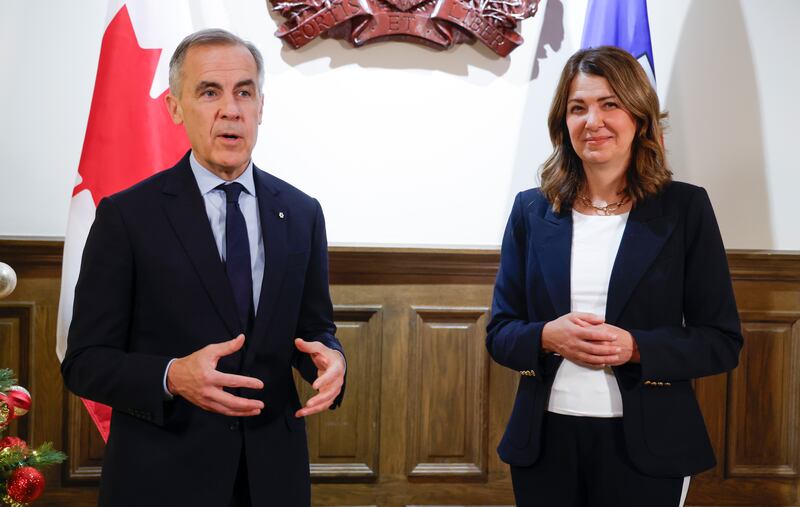
At the signing ceremony in Calgary on Thursday, the prime minister called it “a great day” for Alberta, for Canada, and for co-operative federalism, explaining that while there’s more work to do this MOU “sets the stage for an industrial transformation.”
Carney said that at the core of the agreement is the plan for a pipeline to Asia, and the requirement for the Pathways Alliance carbon capture project to be developed in tandem, but that “if there’s not a private sector component, there won’t be a pipeline.”
The prime minister also sought to emphasize how the MOU “is about much more than just a pipeline.” After meeting with unionized skilled trade workers in Calgary, Carney held a brief scrum in which he said Canada is only going to reach its greenhouse gas objectives through “massive investment.”
Then, speaking to a sold-out crowd of major players at the Calgary Chamber of Commerce, Carney noted the key conditions that need to be met for a pipeline to proceed, including a private proponent. He jokingly asked that if there were any proponents in the room, “please” come see him afterwards.
Calling the MOU “a first step” ahead of signing it, Smith said she was pleased that the prime minister heard her provinces’ concerns and that they could find a path forward together.
“In order for Alberta to find its way to prosperity within a united Canada, we need the federal government to partner with us instead of fighting against us,” the premier said. “We both know that Canada can never reach its true potential as a global energy superpower without a strong and thriving Alberta energy sector at the center of that effort.”
Tanker ban exemption possible
The new federal-provincial agreement marks a historic reset of relations between the two governments but has the potential to complicate dynamics with another.
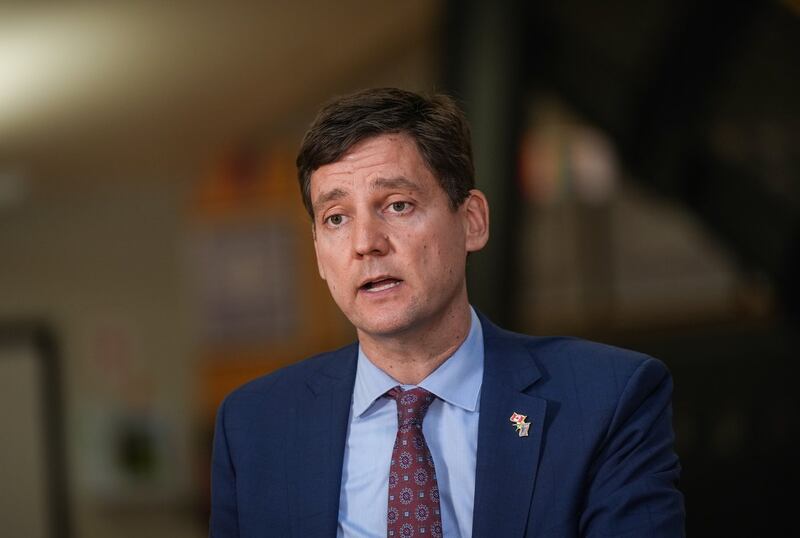
B.C. Premier David Eby has vehemently opposed the approval of a new oil pipeline to the west coast and has called it unacceptable that his province has been excluded from proposed pipeline talks.
The MOU notes the two governments have agreed to “engage” with British Columbia “to further the economic interests of B.C. related to their own projects of interest,” and involve B.C. First Nations, to ensure they share in the financial benefits, should the pipeline proceed.
Though, it also notes that if an Alberta bitumen pipeline does get approved by the Major Projects Office (MPO), the federal government will make any appropriate adjustments to the Oil Tanker Moratorium Act.
Responding to the MOU, on Thursday Eby cautioned that Alberta’s pipeline proposal is becoming an “energy vampire.”
“My anxiety about the pipeline proposal … is that it runs the very significant risk – that has already partially been realized – of taking our eye off the prize, of distracting the federal government, distracting resources, and pulling time away from real projects that can be delivered in the near term,” Eby said.
Eby said had he been at the table with Carney and Smith, he would have pressed for the MOU to address outstanding uncertainties around refining capacity and spill responses.
In a statement, the Canadian Chamber of Commerce called for all provinces to pull “in the same direction,” arguing that the current geopolitical shifts require “unprecedented levels of federal–provincial collaboration.”
What projects are part of the pact?
According to senior provincial and federal officials who briefed reporters early Thursday, the MOU is underpinned by a shared commitment to achieve net zero greenhouse gas emissions by 2050 and create hundreds of thousands of high-paying jobs. The federal and provincial governments are also committing to consult and “where appropriate” accommodate Indigenous peoples and rights.
The MOU unveiled Thursday focuses on plans to advance four specific projects:
- Constructing “one or more” pipelines, financed by the private sector with Indigenous co-ownership, moving at least one million barrels a day of “low emission Alberta bitumen” on a route prioritizing Asian markets, in addition to Trans Mountain pipeline expansion;
- Constructing and financing Pathways, the world’s largest proposed carbon capture, utilization, and storage project – a piece of this deal framed as necessary and a prerequisite to offset emissions;
- Constructing thousands of megawatts of AI computing power, with a “large portion” dedicated to sovereign cloud; and
- Constructing large transmission interties with British Columbia and Saskatchewan to improve western provinces’ ability to supply low carbon power.
“I don’t know that the prime minister would have agreed to a new bitumen pipeline without Pathways, and we wouldn’t have agreed to Pathways without a new bitumen pipeline,” Smith told reporters on Thursday, adding that she’s already met with the Pathways Alliance – five of Canada’s largest oil sands companies behind the proposal – about next steps.
Speaking to reporters on Thursday, Smith said she secured a commitment from Carney to address or adjust seven out of the nine “bad laws” as she calls them, but when pressed by CTV News’ Chief Political Correspondent Vassy Kapelos, the premier would not commit to increase the industrial price on carbon, if a pipeline doesn’t go ahead.
“There is some acknowledgement that the price has to go up, but there’s also an acknowledgement that that’s going to be a negotiation,” Smith said. “I’m looking forward to that.”
Timelines for key submissions
The provincial and federal governments will be appointing an “implementation committee” to deliver on the measures within the MOU.
This includes putting in place, on or before April 1, 2026: a carbon pricing equivalency agreement; a methane equivalency agreement; a tri-lateral agreement with the Pathways companies; and a cooperation agreement on impact assessments.
Then, on or before July 1, 2026, the parties must come to an agreement determining how Alberta can submit its pipeline application to the MPO as the proponent, and the federal government must provide feedback on Alberta’s policy framework for AI data centres.
Lastly, by Jan. 1, 2027, Alberta must finalize its nuclear power generation strategy.
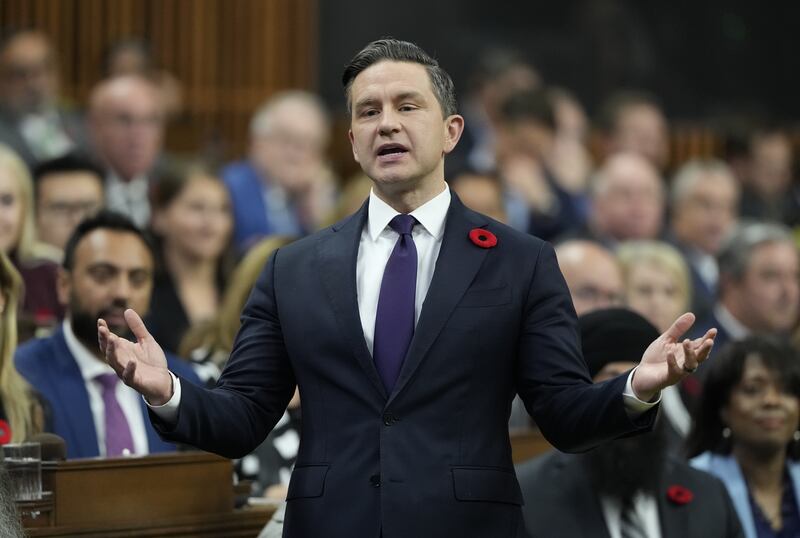
During question period in Ottawa, Conservative Leader Pierre Poilievre seized on these timelines, casting doubt on a new pipeline ever being built.
“They don’t know the year that construction will begin. They don’t know the decade that construction will begin,” Poilievre said. “Today’s deal allows a proposal for a pipeline to go to an office in seven months, which will then be studied for two years, after which the prime minister will give a pipeline veto to the B.C. NDP premier, who’s already said he’s against it.”
Environmental, Indigenous reaction
Despite the warm welcome Carney received from the Calgary business crowd, environmental and Indigenous stakeholders voiced strong opposition to the MOU.
“Coastal First Nations, along with the province of B.C., will never allow our coast to be put at risk of a catastrophic oil spill,” said Coastal First Nations President Marilyn Slett. “We have zero interest in co-ownership or economic benefits of a project that has the potential to destroy our way of life and everything we have built on the coast.”
The Canadian Climate Institute voiced concern over climate rules becoming “negotiable,” and this MOU opening up the possibility other provinces may try to emulate this approach.
“Such standards are essential to maintain economic cohesion and avoid a dysfunctional patchwork of provincial policies with conflicting market signals. Minimum standards also help ensure that provincial efforts add up to shared objectives, such as Canada’s emissions goals,” said the Institute’s president Rick Smith.
The Canadian Association of Physicians for the Environment (CAPE) called the MOU “a dangerous step backward.”
“Climate change threatens the health of humanity. It is beyond the pale to be doubling down on fossil fuel expansion at precisely the moment we need to be quitting oil and gas. The health impacts of this agreement will be profound and far-reaching,” said CAPE’s president, Dr. Samantha Green.

