


Canada could soon ramp up the amount of oil, natural gas and clean energy it exports to China under a memorandum of understanding signed in Beijing Thursday.
Speaking to reporters Thursday night, Canada’s Minister of Energy and Natural Resources Tim Hodgson said China has made it clear they want more Canadian energy.
“What we heard loud and clear is that China is looking for reliable trading partners, trading partners that don’t use energy for cohesion,” Hodgson said. “China is already a major consumer of Canadian energy.”
Prime Minister Mark Carney is scheduled to meet Chinese President Xi Jinping on Friday at 11 a.m. Beijing time (Thursday at 10 p.m. EST).
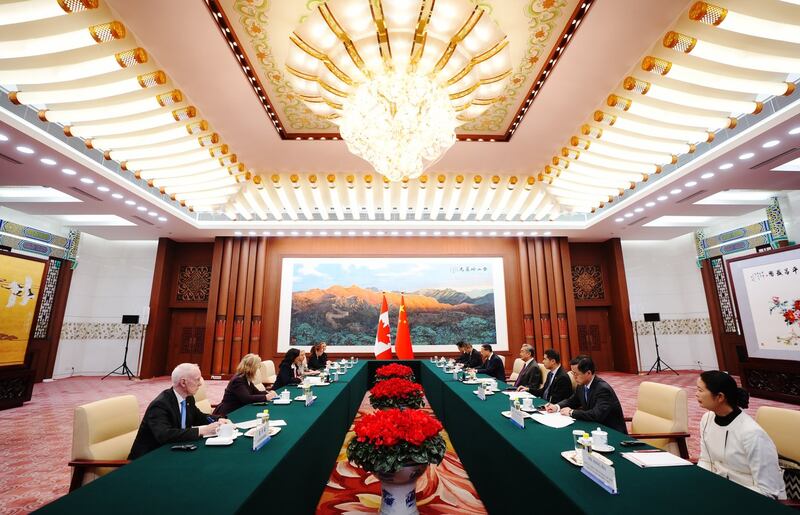
During a public ceremony at China’s Great Hall, Canada’s Minister of Energy and Natural Resources and his Chinese counterpart signed a renewed pact that promises greater cooperation on clean and non-renewable energy. The memorandum of understanding recognizes that “conventional energy” plays an “important” role in the energy transition in the short term.
“The participants recognize Canada as an important potential partner in responsibly produced and reliable global oil, LNG and LPG supply and will explore opportunities for mutually beneficial cooperation,” the memorandum of understanding reads.
Carney’s push to double non-U.S. exports has heated up the discussion around China’s role in Canada’s energy exporting future. Historically, Canada has sold the vast majority of its oil to the United States, but improved access to Asia ports since the Trans Mountain Pipeline came online in 2024 has helped expand Canada’s options.
In 2024, 96 per cent of Canadian oil exports were sent to the United States according to the Asia Pacific Foundation. Just 2 per cent of Canada’s crude oil was exported to China worth $2,448.47 million.
Right now, almost all of Canada’s natural gas is shipped to the United States. However, new LNG projects that are in various stages of construction, in addition to the start-up of LNG Canada, will make it easier to ship to Asian markets – including China, experts say.
Speaking on background, senior Canadian officials say China has said they need a lot of energy, especially clean energy. They also say the conversation has changed since LNG Canada started shipping to Asia.
“We produce the lowest carbon-intensity LNG in the world. They are an investor in our first LNG project,” Hodgson told reporters Thursday in Beijing. “They are going to be an investor in our second LNG project, and they are a major user of our conventional oil and gas.”
The official document signed Thursday launches a ministerial dialogue on energy that officials say hasn’t happened before and commits both countries to a meeting once every 12-18 months for five years. It also opens the door to Canada importing more clean tech from China.
It also recognizes the “potential” for renewable energy cooperation and pledges to explore opportunities for mutual benefit in areas of clean energy including offshore wind and solar.
While the document does not guarantee any additional investment, officials speaking on background say the pact is the beginning of what they call a very important conversation.
The MOU builds on a document signed in 2017 which affirmed that action on climate change, including steps towards low-carbon, climate-resilient and sustainable development is crucial. The 2017 pact also pledged China and Canada would seek ways to accelerate commercial progress in the nuclear energy sector, but the focus of the agreement is largely on combating climate change and clean and renewable energy.
When asked about the differences between the two MOUs, Hodgson said both focus on how to get to net-zero.
“This was a framing around how we work together, yes in conventional energy, but also in clean energy,” he said, adding that he was involved in a number of meetings with clean tech companies Thursday.
The Canadian ministers travelling with the delegation signed a total of eight agreements with their Chinese counterparts today on a range of topics from forestry and wood construction to culture, tourism and the health and safety of pet food. Some of the MOUs are new, while others either build or replace agreements put in place under previous governments.
What’s next?
Before heading to the Great Hall for meetings with government leaders, Carney spent the morning pitching Chinese business leaders in clean tech, fintech and energy to invest in Canada.
The prime minister met with the heads of six Chinese businesses on Thursday, including the investment firm Primavera Capital Group, the world’s largest electric vehicle maker Contemporary Amperex Technology (CATL), China’s state-owned energy company China National Petroleum, e-commerce platform Alibaba, and the tech company Envision.
Industry Minister Melanie Joly said the goal of the meetings was to see what types of investments could be made in Canada. On Friday, Joly said she will meet with leaders at BMO, Manulife and Magna.
New data shows that in 2025 Chinese imports of Canadian goods dropped by 10.4 per cent, the first drop recorded since the global pandemic struck in 2020. A key reason for the drop is likely China’s imposition of punishing tariffs on Canadian agriculture from pork to seafood and canola in 2025.
The move was widely seen as retaliation for Canada’s decision to follow the Americans lead by implementing a 100 per cent tariff on Chinese electric vehicles in 2024.
So far, there has been no specific talk about tariffs or their removal.
However, Saskatchewan Premier Scott Moe was seen walking into the Great Hall ahead of a closed-door meeting between the prime minister and Chinese Premier Li Qiang. Moe, who was invited to participate in meetings including the one with Premier Li, has repeatedly called on Carney to negotiate an end to the Chinese tariffs on Canadian canola that are wreaking havoc on the industry.
In that meeting, Carney praised President Xi and said the visit ushers in a new era of relations between Canada and China. He also said he was “heartened” by the leadership of President Xi and the speed with which the relationship has progressed in recent months.
“Under President Xi’s leadership, our teams have worked hard in the subsequent weeks and months to address some specific issues that had built up over time, but more than that to put in place the foundation for the new strategic partnership between our countries,” Carney said.
The prime minister went on to say that he sees pathways for Canada and China to become strategic partners in a wide range of issues including energy to agriculture and people-to-people ties.
“I believe the progress we have made in this partnership sets up well for the new world order,” Carney said during his brief opening remarks. “It’s a partnership with new focus, greater depth and a sense of purpose.”

