Saskatchewan Premier Scott Moe says he would have used different words to describe the changing global trade landscape than Prime Minister Mark Carney did on his recent trip to China.
During his trip earlier this month — the first visit to China for a Canadian prime minister in eight years — Carney said during a meeting with Chinese Premier Li Qiang that the partnership between the two countries “sets us up well for the new world order.”
The comment drew swift reaction, including from former Canadian diplomat Michael Kovrig — who was previously detained by China for more than 1,000 days — who categorized making such a statement in the presence of senior Chinese officials as “Orwellian.”
Moe was seated next to Carney when the prime minister made the comment in China.
“That’s not a statement I would use, because it’s interpreted in many different ways by many different people,” Moe said in an interview on CTV Power Play with Vassy Kapelos on Wednesday, when asked whether he agrees with Carney’s wording in the meeting.
“However, I would say this: when you look at the trade flux, the uncertainty that we have in those trading relationships around the world — including China, including the U.S., including we have tariffs from India that are on Canadian products right now — there very much is a change in how trade relationships (and) trade agreements are coming together,” Moe added.

On the trip to China, Carney and Chinese President Xi Jinping signed a memorandum of understanding that would see Canada ramp up the amount of oil, natural gas and clean energy it exports to China, and reduce barriers to Chinese investment in those sectors.
They also announced the two countries had inked a quid-pro-quo deal to reduce tariffs on the other’s products, though that agreement has faced criticism from some, including Ontario Premier Doug Ford, who says it risks the Canadian auto industry.
For months, Moe was one of the loudest voices calling for the federal government to scrap its tariffs on electric vehicles, so China would act in kind and remove its tariffs on Canadian agriculture products.
Moe said that how Canada approaches trade — in terms of individual sectoral agreements versus broader trade deals — is changing, and must continue to change, if Canada wants to expand its trade opportunities.
“Yeah, ‘new world order’ is not in any way something that I would have used in that term,” Moe said, when pressed on whether he explicitly rejects any notion of a new world order led by China.
“I believe there’s another opportunity for us as Canadians to engage from a trade perspective, as opposed to getting into broader discussions about who is the superpower when it comes to leading the world,” he also said.
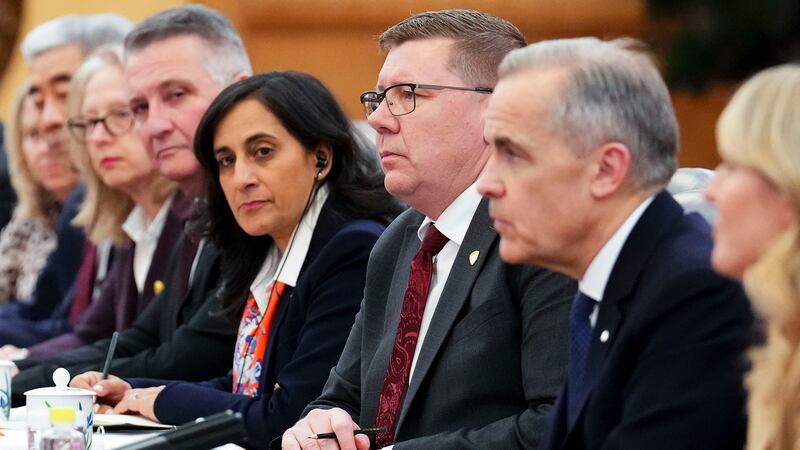
Moe added he wouldn’t use the term “new world order,” because “there are multiple definitions and interpretations that people are going to dive into on that.” The focus for him, he said, is on how to advance trade for the provinces and country as a whole.
While Carney did not repeat the phrase “new world order” on his trip, he gave a highly praised speech in Davos, Switzerland just days later, in which he asserted the old world order is over, calling out global hegemonies, and urging middle power to work together.
Premiers in Ottawa for meeting
Canada’s premiers, meanwhile, are in Ottawa Wednesday for a meeting of the Council of the Federation.
While they’re in town, a few are meeting with the prime minister separately, including Alberta Premier Danielle Smith and B.C. Premier David Eby, who are currently at odds over a potential pipeline project.
Later Wednesday, all of the premiers will sit down with Carney for a working dinner, before a more formal meeting on Thursday.

