


Prime Minister Mark Carney has announced Canada’s first national sovereign wealth fund, calling it the “Canada Strong Fund,” ahead of Tuesday’s spring economic update.
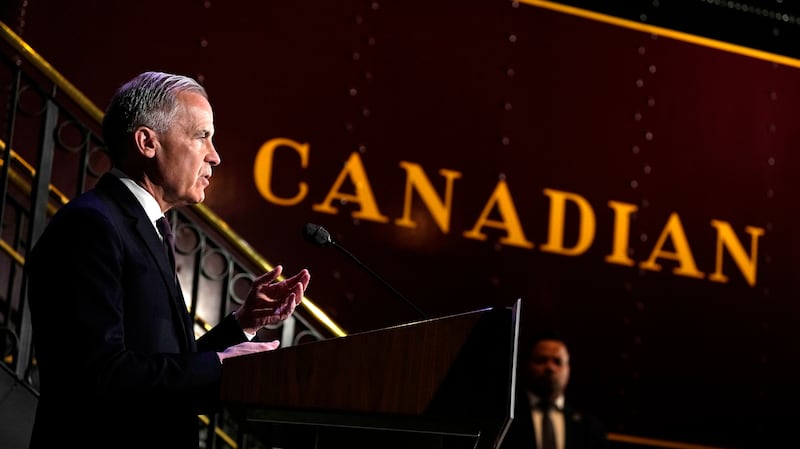
Carney officially made the announcement in Ottawa on Monday morning, saying it will allow Canadians who have “a bit of extra money” to invest into it directly, similar to a government bond.
The federal government will initially contribute $25 billion into the fund, which Carney says “will grow through asset recycling and reinvestment, creating even greater opportunities for future generations.”
A sovereign wealth fund is a state-owned investment fund that uses government surplus reserves to invest in financial assets like stocks and bonds but is independently managed. Alberta has its own sovereign wealth fund, called the Alberta Heritage Savings Trust Fund, that was established back in 1976.
According to Carney, the fund will be “professionally managed and operate as an arm’s length independent Crown corporation” and “will be accessible to everyone.”
The fund is also intended to complement and accelerate the work of existing institutions like the Business Development Bank of Canada and the advancement of projects through the Major Projects Office.
“Whether a project is in Alberta, Quebec, or in the far north, high north, all Canadians will have a stake because this is about ensuring that you and your children and your children’s children benefit from the prosperity that we are creating today,” Carney later added.
Asked by reporters why a new agency is required, Carney said the Canadian Infrastructure Bank “provides debt” and “helps make projects possible,” while the new fund “comes in on a commercial basis” to get returns alongside the private sector.
Carney also said the fund will not be strictly investing in projects deemed in the national interest, as described under the Building Canada Act, and said “absolutely not” when asked if the fund signals that there is not enough private sector investment for projects.
“I don’t think that it will be that restricted, but it will be a focus on investing in Canada,” he said.
Speaking to reporters in Ottawa, Conservative Leader Pierre Poilievre criticized the Carney government for creating another agency.
“How many corporate welfare agencies do the Trudeau-Carney liberals need to create before they learn that it doesn’t work?” Poilievre said.
Finance minister says fund will take ‘months to set up’
Finance Minister François-Philippe Champagne says the fund will be up and running “in the coming months,” but did not provide a specific date when asked by reporters in Montreal on Monday.
“It will take, clearly, months to set up. But I think the fact that we are putting that as a pillar of our future growth, I think it’s an important message at an important time for Canadians,” Champagne said.
Pressed on how the fund will work for investors, Champagne said the federal government will “come back to the details.”
“The details of the funds, how it’s going to be, the liquidity. There’s a lot of very relevant questions you have,” Champagne said. “But I would say this would be for a later time when we have had the chance to have the consultation (with the industry).”
How does it differ from Norway?
Speaking to reporters, Carney compared the new fund to Norway’s Sovereign Wealth Fund, which has surpassed $2 trillion in assets.
While Norway’s fund invests its direct oil and gas revenues and has a strict, self-imposed cap on how much money the government can spend from it, the new Canadian fund is more domestically focused and funded by borrowed money.
Montreal Economic Institute economist Emmanuelle Faubert said there is a difference between the two funds.
“The Norwegian model is not funded on debt. Right now, we have increasing deficits. We have increasing debt, both federally and provincially, and the funding model in Norway might work better because it’s funded through surpluses,” Faubert said in an interview with CTV News.
“(Canada is) taking money that should instead go towards clearing deficits,” Faubert went on to say, later adding that the fund could be “a risky venture that might end up just costing money and giving nothing to Canadians.”
Sources say deficit will be smaller than projected
The announcement comes as Champagne is set to unveil the Carney government’s first spring economic update on Tuesday, and the new fund will be part of that update.
Two senior government sources tell CTV News that the deficit will be smaller than what was projected in the federal budget back in November, in part due to increased revenue from inflation and the price of oil.
While speaking to reporters, Carney emphasized that the government is “determined to get spending down” and admitted that “you can’t do everything at the same time.”
“In order for the numbers to be better, you have to be on top of them, and we’re on top of them,” Carney said, while adding that issues of affordability will be addressed.
Last fall’s federal budget forecasted a $78-billion deficit in 2025-26 and a $65-billion deficit for 2026-27, with the figure decreasing to $56.6 billion by 2029-30.
On Sunday, Poilievre wrote an open letter to the prime minister to cap the deficit at $31 billion and “present a plan to return to a balanced budget in the medium term.”
Asked by reporters on Monday about how long he thinks the government should take to eliminate the deficit, Poilievre would not give a specific target date.
“Let’s figure out how big a mess the Liberals have made, and then I can tell you how long it will take me to clean it up,” Poilievre said.
Pressed further to provide a target date, Poilievre said “it should be yesterday,” adding “they should have a balanced budget all the time, except for in massive national emergencies.”
With files from CTV News’ Chief Political Correspondent Vassy Kapelos and Senior Political Correspondent Mike Le Couteur

