


OTTAWA – With a green light from the federal government, Alberta hopes to begin construction on a new oil pipeline as early as fall 2027, with oil flowing by 2033-34. But there remains no clear private sector investor to pay for it.
Prime Minister Mark Carney and Alberta Premier Danielle Smith met in Calgary Friday to sign an updated deal. It outlines that the federal government will work towards designating the pipeline a project of national interest by Oct. 1, 2026, with a date of Sept. 1, 2027, for potential construction approval.
“Today is a good day for Alberta, and it’s a good day for Canada,” Smith said in a signing ceremony with Carney.
“Today is also about building trust in a Canada that works,” the prime minister later added.
As reported earlier, the deal lowers the effective carbon price for Alberta to $130-a-tonne by 2040, instead of 2030, as previously laid out in the memorandum of understanding (MOU) signed by the pair in November. That deal originally laid out conditions for the new pipeline to the West Coast.
The province estimates the new pricing will save the industry about $250 billion by 2050.
Friday’s deal also includes headline carbon benchmarks of $115-a-tonne in 2030, $130 by 2035 and $140 by 2040. Alberta’s headline carbon price is currently set at $95-a-tonne.
That headline price is different from the effective price. The effective carbon price is the market value of carbon credits and offsets under Alberta’s Technology Innovation and Emissions Reduction (TIER) system, which allows producers to buy credits to offset their cost.
The deal also lays out that Alberta will regulate a minimum transfer price, or price floor, for TIER credits starting in 2030.
Alberta hopes pipeline will be running by 2033-34
Federal and Alberta government officials provided information to reporters ahead of the Smith-Carney signing on background on a not-for-attribution basis.
A provincial government official said they’d like to see the new pipeline to be up and running by “no later” than 2033-34.
But there are no answers about whether a private proponent is in the offing.
When asked if Alberta expects to have a private sector proponent by the July 1 deadline to submit its proposal to the Major Projects Office (MPO), a provincial official said “stay tuned” and that “work continues.”
An official said Alberta is currently the proponent for the application, and it will remain the proponent up until the province provides its submission to the MPO by July 1, promising more details after.
The agreement also echoes the prime minister’s promise Thursday of “no Pathways, no pipeline,” with both parties agreeing that building an oil pipeline and building the carbon capture Pathways Project are mutually dependent.
Friday’s agreement doesn’t specify, however, any conditions for Pathways to be up and running before or alongside pipeline construction. A government official said that’s up to separate conversations between the two governments and Pathways that “will continue in the comings weeks to finalize” a separate deal.
Earlier this month, the companies behind the Pathways Project, now known as the Oil Sands Alliance, wrote in a press release that “the pace of change has been too slow,” and urged the federal and provincial governments to “urgently reform their regulatory and fiscal frameworks.”

Will separatism sentiments detract private investment?
Speaking to reporters in Calgary, Smith was asked repeatedly about whether separatism sentiments in Alberta will negatively impact attracting private investment.
Smith did not answer directly, but insisted a push for separatism is “coming down.”
“I’d like for us to have Albertans feel such confidence that Canada is working for them, that that separatist sentiment goes back to historically low levels,” Smith said. “We’re not quite there yet. There’s a few more things that we need to do, but I think these kinds of agreements help to get us there.”
In his own press conference, Carney stressed how the new deal is “about Canada working” and “co-operative federalism.”
How will pipeline impact emissions targets?
In a statement, Canadian Climate Institute president Rick Smith said the agreement “will put Canada’s target of net zero by 2050 well out of reach.”
“It also means that Canada will be on path to achieve its 2030 target at a much later date, creating more than a decade of delay for needed progress,” the statement added.
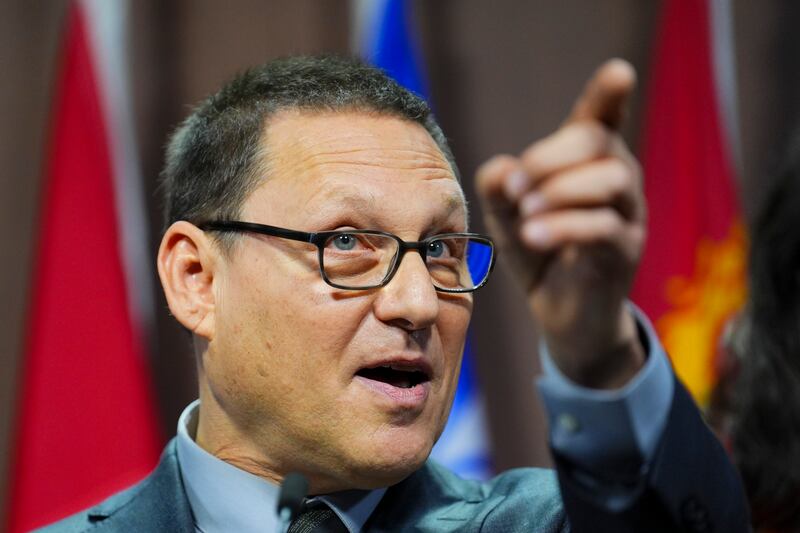
NDP Leader Avi Lewis, meanwhile, criticized the Carney government and called the announcement an “official surrender to the oil and gas lobby.”
“By gutting carbon pricing to the point of irrelevance, it has dismantled the last federal climate measure standing. We now have a federal government that no longer even pretends to rein in big corporate polluters,” Lewis said in a statement.
When asked about climate concerns, Carney insisted both the federal government and Alberta are committing to low emissions and net zero by 2050 through “a series of investments and commitments and market frameworks.”
“This is climate action. This is investment. This is moving forward,” he added.
Canada has committed to reducing greenhouse gas emissions by 40 to 45 per cent below 2005 levels by 2030, and a 45–50 per cent reduction by 2035. But in recent months, Carney and his cabinet ministers have dodged questions about those commitments.
On Thursday, when asked if the federal government still plans to meet those targets, Carney would not answer directly, but said an update is coming.
“We are putting in place a series of initiatives that will make material emission reductions. We’ll update our climate plans and our emission reduction targets in due course,” he said.
Conservatives push for new pipeline by end of year
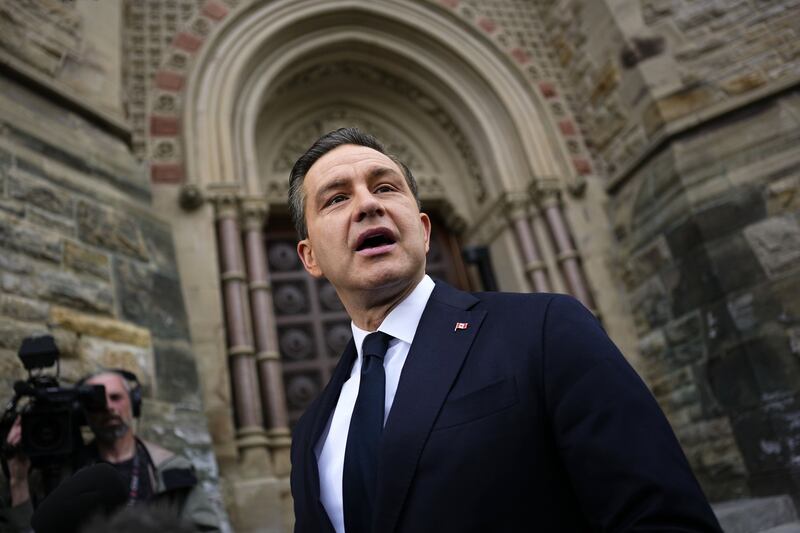
In response to Friday’s announcement, Conservative Leader Pierre Poilivere acknowledged Smith’s “hard work” but accused Carney of keeping “in place every anti-development law” from former prime minister Justin Trudeau.
Poilievre also outlined his party’s plan for a pipeline without an industrial carbon price, saying he would “approve Alberta’s submission within 100 days of receiving it” and start construction for a new pipeline to B.C.’s west coast “by the end of 2026.”
Eby: ‘Stop rewarding bad behaviour’
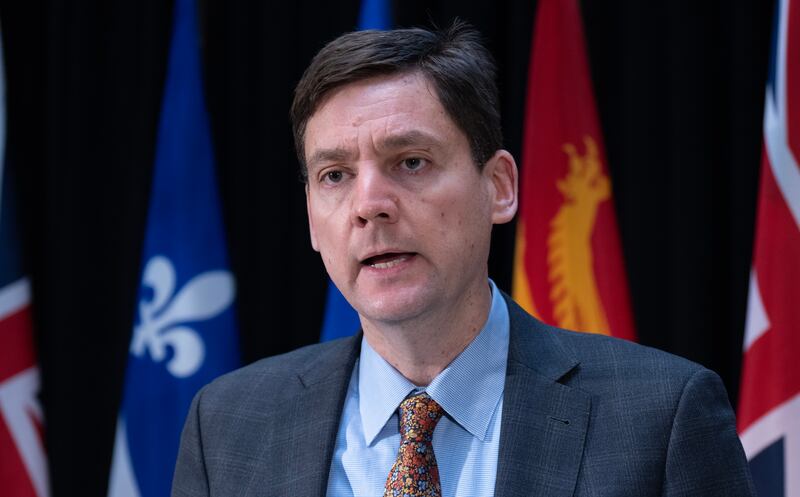
British Columbia’s Premier David Eby did not hold back on Friday from his ongoing criticism towards Alberta’s push for a new pipeline.
“As a country, it’s time to stop rewarding bad behaviour,” Eby said in a statement. “It cannot be the case that the projects that get prioritized in Canada are those where a premier threatens to leave the country.”
In his statement, Eby also highlighted 35 projects in B.C. that need co-ordination with, and support from, the federal government, saying these should take precedence over a pipeline that “has yet to identify a proponent or a route.”
Eby will be meeting with Carney next week in Vancouver, with the prime minister saying the two “will address a series of issues directly in the interests of British Columbia.”
The language in Friday’s deal has Canada and Alberta talking to B.C. “immediately in a trilateral discussion on the pipeline application,” during potential development and construction, and “to further the economic interests of British Columbia related to their own projects of interest that involve the province of Alberta, including interties.”
Friday’s deal also stipulates the federal government will fully respect Canada’s duty to “consult obligations with Indigenous Peoples,” both as it works to name the pipeline a project of national interest, and as it determines conditions for construction and development.
With files from CTV News’ Stephanie Ha, Spencer Van Dyk and Rob Buffam

