James Moore is a former federal cabinet minister under prime minister Stephen Harper, and is a contributing columnist for CTVNews.ca.
Forty years ago this week, Rick Hansen was halfway through his 26-month, 40,075-kilometer, 34-country Man In Motion world tour to advocate for global accessibility for people living with disabilities.
When the tour happened, I remember vividly cheering for Rick as a 10-year-old elementary school student as he came through my hometown and climbed Thermal Drive in Coquitlam. The Thermal Drive climb has become a legendary local story because Rick said the 1.6-km climb was the steepest and most difficult slope on the whole tour, second only to the Great Wall of China.
Twenty-five years later, on the exact anniversary of that day in 2012, I returned to Thermal Drive at Rick Hansen’s side as the local member of Parliament and minister of Canadian Heritage and I had the honour of introducing Rick to 1,600 school kids assembled on the hillside so they could hear his inspirational story.
Recounting to young impressionable minds the message of hope, inclusion and decency for those with disabilities to celebrate the 25th anniversary of his iconic tour is about is good as it gets.
These are the precious moments of being in public life that one never forgets.
About 10 years after that memorable anniversary day, I was with Rick Hansen again in my community. This time, it was different. This time, Rick’s wheelchair was alongside my son Spencer’s wheelchair as they opened Port Moody’s Mossom Creek fish hatchery that had just been modernized to be accessible for people with mobility challenges so they could move around the facility.
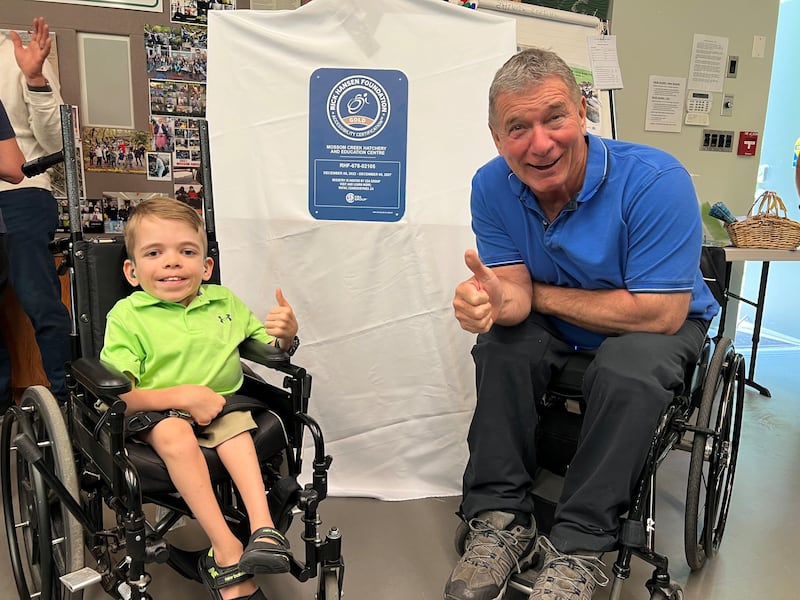
They unveiled a plaque recognizing the ‘gold status’ for accessibility because of the inclusion of automatic doors, wheelchair access to viewing ponds, audio equipment that transmits to hearing aids directly, gently inclining ramps and high visibility access points.
This is what progress looks like. This is how dignity is advanced. This is how inclusion in action presents itself.
I tell this personal story because societal ‘wins,’ when they happen, need to be noted and built upon. But also because it reminds me of how far things have come, yet how far things still need to go for us to truly be a society of true dignity for all those who live with accessibility challenges.
Rick Hansen is a treasure and has become a friend. But he, and Spencer, and the millions of their peers, need us all to wake up and join their fight with a genuine commitment to dignity and inclusion for all.
The scope of the challenge
If you have doubt about the scale of the challenge, here are some Statistics Canada numbers:
- About 8 million Canadians have a disability.
- 72% of the 8 million Canadians with a disability report encountering some form accessibility regularly in both indoor and outdoor public spaces.
- About 40% of seniors live with some form of disability. Pain, mobility, and flexibility-related is the most common. Hearing and sight deficits are common.
- People with disabilities earn significantly less. According to Statistics Canada, people with disabilities earn – on average – only 83% what persons without disabilities earn.
- One in four (24.4%) of youth with disabilities were not in education, employment or training, which is twice the share observed among without disabilities (12.3%).
- Not surprisingly, people with disabilities have a 50% more likelihood of living below the poverty line.
- According to a 2022 study, over one million Canadians with disabilities between the ages of 15 and 64 were not working but could work if they had the right supports.
Section 15 of the Canadian Charter of Rights and Freedoms guarantees equal protection and benefit of the law without discrimination and explicitly lists “mental or physical disability” as prohibited grounds for protection. But isn’t equality a hell of a thing to follow through on? It is always easier to say than do. But the pursuit matters.
So here is the uplifting news. I am convinced that there is goodwill and good intentions all around us. Governments, businesses, communities really do want to get this right.
Legislating a barrier-free future
Back in 2019, the Accessible Canada Act (ACA) passed the House of Commons unanimously, and it was a true cross-partisan moment of commitment to making things better. The ACA aims to identify, remove and prevent barriers to accessibility for people with disabilities across Canada, with the goal of achieving a “barrier-free Canada” by January 1, 2040. It is a good goal with a somewhat random timeline, and given how much work needs to be done, progress should accelerate.
The Act targets barriers to employment, physical spaces, program delivery, transportation, information technology application, services and more. And it applies to all federal public and private sector organizations under federal jurisdiction including federal departments and agencies, Crown corporations, federal regulated institutions, telecommunications and broadcasting firms and interprovincial transportation.
The scope is enormous and the ambition is genuine. And, the outcomes of the Act could be one of the most far-reaching of any piece of legislation adopted by Parliament in decades. With an aging population and accessibility issues growing in frequency, mark my words, this Act will be a centrepiece of Canada’s social policy for generations.
Not surprisingly, cynicism has crept into the conversation over the years since the Act was adopted into law. And that’s good. The optimism that welcomed the Accessible Canada Act has stirred critics that the approach has insufficient timelines, weak enforcement standards, weaker enforcement authority and insufficient funding.
Excellent, the debate will continue and continue. And the legislation will be amended and tweaked and future governments will make new commitments and shed failed ones, and there will be audits to learn what works and what doesn’t and around and around we go as we learn how to make things better for people with accessibility challenges.
This is imperfect and at times it may be exhausting and frustrating, but this is what governing with good intent looks like and how progress evolves. The fortunate thing is that the catalyst for improvement is not ever going away. The need for decency is inclusion for people with disabilities is growing, not receding. And, perhaps most importantly, the opportunity for Canada – economically and socially – to truly realize the full opportunity and capabilities and contributions of all Canadians of all abilities is massive.
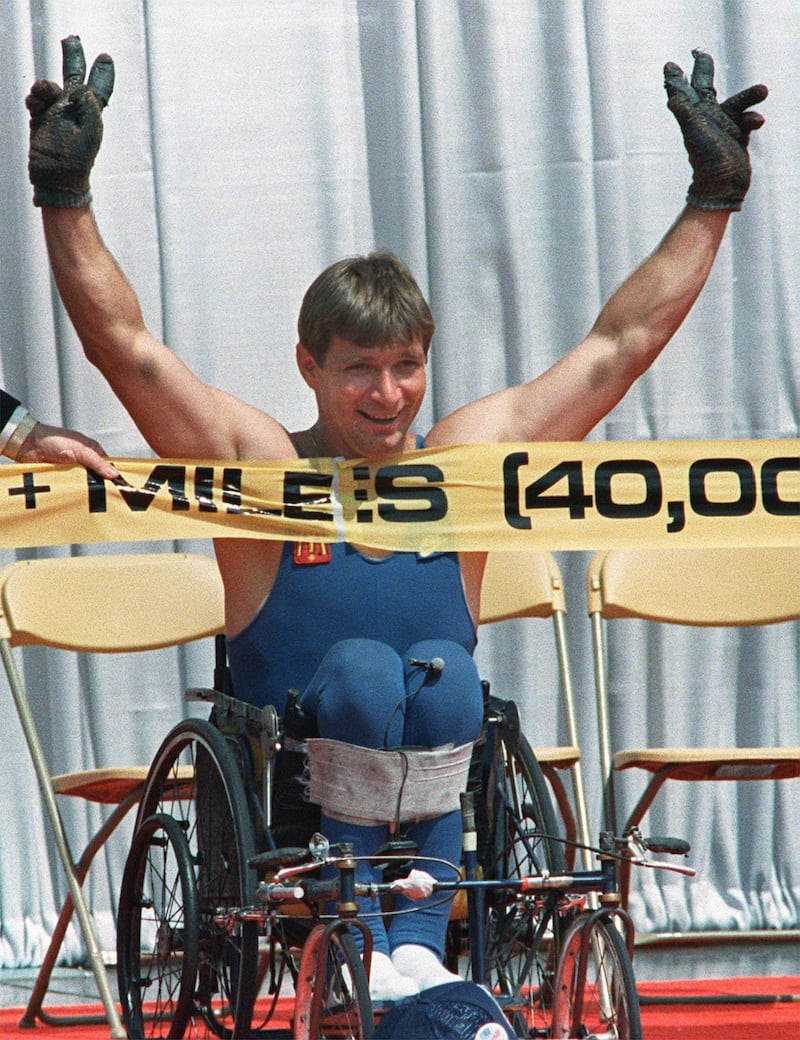
Canada has been blessed to have heroes and advocates with disabilities. The legacy of Terry Fox’s Marathon of Hope will inspire us forever. Rick Hansen continues his impassioned work for dignity and inclusion. In politics, Steven Fletcher – a quadriplegic since the age of 23 – became the first permanently disabled person to be elected to Parliament and named to cabinet in Canadian history under Prime Minister Harper and advocated tirelessly for accessibility. Carla Qualtrough – who introduced and championed the Accessible Canada Act as a cabinet minister – was born with a visual impairment and was a three-time Paralympic Games medallist and has always been a powerful voice for people with disabilities.
Last week, Minister Patty Hajdu reappointed another champion for accessibility – Stephanie Cadieux – as Canada’s Chief Accessibility Officer (CAO) to help drive progress on the Accessible Canada Act. Stephanie’s lived experiences as a member of the disability community (she has been using a wheelchair since she was 18) brings an understanding to the needs of Canadians and how they have evolved over years. As a former B.C. cabinet minister and MLA for 13 years, she also understands how to modernize this cornerstone legislation and its enforcement in the years ahead and her reappointment is a great sign for things to come.
Everyday battles for true inclusion
But we need more champions. We need more advocates. Because the battles to be fought are all around us. We need to make our all our school and community playgrounds inclusive for all our kids so that every child can play with all the other kids and not feel left out and heartbroken in their first social interactions with their peers. We can do this, but we fail to make the permanent commitment in regulations all the time.
We can make homes and workplaces adaptable for everyone – and if improvements are needed, let’s make them affordable, maybe funded, or at least tax deductible. Let’s find ways to make classrooms, public bathrooms, sports arenas, parks and public transportation inclusive of everyone as a default – not an aspiration. Let’s find a way to stop sports/entertainment ticketing of “accessible” seats to people without disabilities – many of whom are re-sellers who flip tickets meant for those who need them to people without disabilities, typically for a big profit. These are all things that we can figure out. These are all fights worth having. Progress demands it.
As I write this, I am thinking of my brave son and his journey through much of his life in a wheelchair. I think of the world his little 13-year-old body is entering into and the barriers and challenges that remain. It is a constant thought that I can’t escape. Life is unfair. Life is unfair for all of us in different ways. But when we know that there are ways to make things better for the people we love, we must join the fight for us all to live in the world we all so rightly deserve.

